Offline Emergency Assistant HandsOnAid: On-Device Small Model Field Test

HandsOnAid tested an offline emergency AI with a fine-tuned 4-bit Gemma 2B, scoring only 2.51/5 at best and revealing capability boundaries and data gaps.
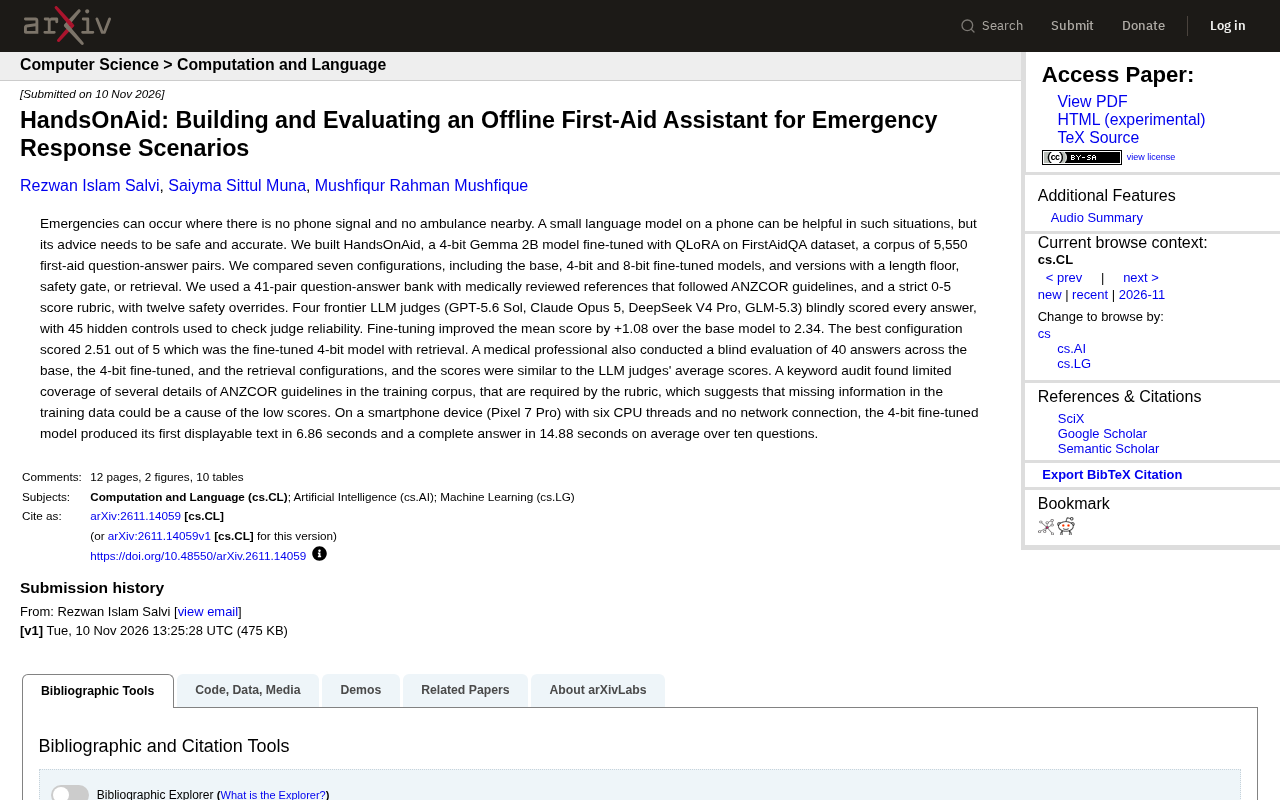
The HandsOnAid project used a 4-bit quantized Gemma 2B model with QLoRA, fine-tuned on 5,550 FirstAidQA emergency Q&A pairs, and evaluated response speed and answer quality on a real phone offline. It compared seven configurations and used four-model blind review, medical expert cross-validation, and 12 safety veto items. Fine-tuning improved average scores by +1.08, but the best configuration (4-bit fine-tuning plus retrieval) scored only 2.51/5. On a Pixel 7 Pro with pure CPU and offline operation, time to first token was 6.86 seconds and full-answer latency 14.88 seconds. A keyword audit found insufficient training-data coverage of ANZCOR guideline details, suggesting missing data may be the main cause of low scores.
In remote scenarios with no signal and no ambulance, can a phone and a small model take on the role of an emergency medical advisor? The HandsOnAid project offers a measurable answer. The research team used a 4-bit quantized Gemma 2B model, applied QLoRA fine-tuning on the FirstAidQA dataset, and tested response speed and answer quality on a real phone. The results are not perfect—the best configuration scored only 2.51/5—but they clearly reveal the current capability boundaries of "offline emergency AI" and the decisive impact of training data coverage on safety.
Solution Design: Small Model, Low Bit Depth, and Retrieval Augmentation
HandsOnAid's technical approach is pragmatic: choose a model like Gemma 2B that can run on a phone, use 4-bit quantization to compress memory usage, and then apply QLoRA for parameter-efficient fine-tuning on the 5,550 emergency Q&A pairs in FirstAidQA. The core goal of this combination is to provide usable inference capability on consumer-grade hardware under offline conditions.
The research team did not stop at a single model but compared seven configurations side by side: the base model, 4-bit and 8-bit fine-tuned versions, and variants with a length floor, safety gate, and retrieval augmentation. Among these, the "length floor" avoids overly short, information-poor answers; the "safety gate" attempts to block high-risk advice; and "retrieval" pulls relevant content from a knowledge base to assist generation. This multi-configuration comparison demonstrates the actual contribution of each component better than reporting only a single best result.
QLoRA (Quantized Low-Rank Adaptation) is a parameter-efficient fine-tuning technique that combines 4-bit quantization with LoRA: the base model's weights are frozen and stored at low bit depth, and training updates only small low-rank adapter matrices injected into each layer. This can reduce the memory required for fine-tuning by an order of magnitude, making it possible to fine-tune billion-parameter models on a single consumer-grade GPU or even some edge devices. QLoRA's key designs also include a paged optimizer and double quantization to further compress optimizer state and quantization constant overhead. In this project, QLoRA allowed the team to inject emergency-domain knowledge into Gemma 2B without full-parameter fine-tuning while maintaining the 4-bit inference format for deployment.
FirstAidQA is an instruction-tuning dataset for emergency Q&A, containing 5,550 Q&A pairs covering common emergency scenarios such as CPR, bleeding control, and burn treatment. It is typically built by extracting knowledge points from authoritative first-aid guidelines and textbooks and rewriting them into natural question-answer form, so the answer style tends to be standardized and step-based. The quality and breadth of the dataset directly determine which emergency details the model can learn, which is also important context for the later keyword audit finding of insufficient coverage: low scores may stem from the data rather than the model.
Evaluation Method: Four-Model Blind Review and Medical Expert Cross-Validation
The evaluation challenge in emergency care is that "safety" is hard to measure with automatic metrics. HandsOnAid's approach was to build a 41-pair Q&A bank, with reference answers medically reviewed and following ANZCOR guidelines, while using a strict 0-5 scoring standard and setting 12 safety veto items—any hit results in a deduction.
For scoring, four frontier models were introduced as blind judges: GPT-5.6 Sol, Claude Opus 5, DeepSeekAd V4 Pro, and GLM-5.3, each scoring every answer independently. To test judge reliability, 45 hidden control items were also embedded. More importantly, a medical professional conducted a blind review of 40 answers under the base model, the 4-bit fine-tuned version, and the retrieval configuration, and the results were close to the average scores of the four model judges. This cross-validation increases confidence in the scoring: on emergency Q&A, LLM judges' judgments are broadly aligned with human experts.
ANZCOR guidelines refer to the clinical first-aid and resuscitation guidelines published by the Australian and New Zealand Committee on Resuscitation, covering standardized procedural recommendations such as basic life support, CPR compression depth and rate, AED use, and management of choking and bleeding. They are an authoritative first-aid reference in Australia and New Zealand and are also widely used in first-aid training and assessment. This project uses ANZCOR guidelines as the basis for reference answers and scoring standards, meaning the model's answers need to align with these specific, verifiable procedural details; if details required by the scoring standard are missing from the training corpus, the model will struggle to earn points.
Safety veto is a hard rule in high-risk domain evaluation: when an answer contains advice that could directly cause harm (such as incorrect compression location, delayed emergency calls, or dangerous home treatment), the answer is judged unsafe or heavily penalized regardless of the quality of the rest. It compensates for the average-score system's insensitivity to "a few fatal errors," bringing evaluation closer to the reality of emergency care, where "one mistake can be fatal."
Interpreting Results: Fine-Tuning Works, but Absolute Performance Remains Low
The data yields conclusions at two levels. On the positive side, fine-tuning produced an average score improvement of +1.08, raising the base model's average score to 2.34. This shows that even with only 2B parameters and 4-bit quantization, domain fine-tuning can still significantly improve answer relevance and specificity.
But the absolute scores are not encouraging: the best configuration—4-bit fine-tuning plus retrieval—scored only 2.51/5. In other words, even with retrieval augmentation, the emergency advice the system provides remains in the range of "partially correct and requiring caution," still clearly far from reliable safety consultation.
The team further conducted a keyword audit and found that the problem may lie on the data side: the training corpus has limited coverage of details required by several scoring criteria in the ANZCOR guidelines. This points to an easily overlooked conclusion—low scores may not reflect insufficient model capability but rather the absence of such information in the training data. For high-risk domains like emergency care, data coverage auditing should be as important as model tuning.
On-Device Performance: Time to First Token and Full-Answer Latency
The other half of offline usability is speed. On a Pixel 7 Pro, using six CPU threads and fully offline, the 4-bit fine-tuned model's average performance on ten questions was: 6.86 seconds to the first displayable text and 14.88 seconds for a complete answer.
These numbers need to be understood in the context of emergency care. A wait of more than ten seconds is not short in an emergency, but considering the device is fully offline with no cloud compute support, this latency is already at the edge of "usable." A time to first token under 7 seconds means users can quickly see that the system has started responding, which has practical value for reducing anxiety. Of course, the power consumption and heat of pure CPU inference, as well as latency on longer and more complex questions, remain dimensions that need to be examined before actual deployment.
Time to first token (TTFT) refers to the time from when the user submits a question to when the model outputs the first displayable token, and is a core metric for perceived interactivity; full-answer latency reflects the total delay in generating all content and is directly related to output length and tokens generated per second. In on-device pure CPU inference, these two metrics are jointly constrained by model parameter count, quantization precision, thread count, and memory bandwidth. For emergency scenarios, TTFT determines whether users feel the system is "responding," while full latency determines how long it takes to read the complete steps; the two need to be evaluated separately.
Three Takeaways for Offline Emergency AI
First, small models plus domain fine-tuning are a viable path, but "viable" does not equal "trustworthy." The score of 2.51/5 reminds us that such systems are currently better suited as auxiliary references rather than replacements for professional judgment.
Second, the design of the evaluation system is as important as the model itself. Multi-model blind review, hidden control items, medical expert cross-validation, and safety veto items—this combination provides a reusable template for AI evaluation in high-risk domains.
Third, data coverage is the invisible ceiling on safety. The missing guideline details revealed by the keyword audit show that in domains with strict standards like emergency care, the completeness and accuracy of the training corpus should be treated as first-class citizens.
HandsOnAid's value is not in proving that offline emergency assistants are mature, but in using a reproducible method to quantify "how far off" they are. For subsequent researchers, this baseline is more useful than a polished promotional number.
One-line Summary
HandsOnAid tested an offline emergency AI with a fine-tuned 4-bit Gemma 2B, scoring only 2.51/5 at best and revealing capability boundaries and data gaps.
Paragraph Summary
The HandsOnAid project, under no network and no cloud support, used a 4-bit quantized Gemma 2B model with QLoRA, fine-tuned on 5,550 FirstAidQA emergency Q&A pairs, and evaluated response speed and answer quality on a real phone. The study compared seven configurations side by side and adopted an evaluation system with four-model blind review, medical expert cross-validation, and 12 safety veto items. Results show fine-tuning brought a +1.08 average score improvement, but the best configuration (4-bit fine-tuning plus retrieval) scored only 2.51/5, a low absolute level. On a Pixel 7 Pro with pure CPU and offline operation, time to first token was 6.86 seconds and full-answer latency was 14.88 seconds. A keyword audit further indicated insufficient coverage of ANZCOR guideline details in the training corpus, and missing data may be the main cause of low scores.
Related articles

ChatGPT Plus Subscription Pitfall Guide: Go/Plus/Pro Tier Comparison and Quick Activation
A complete ChatGPT Plus subscription guide based on a Bilibili tutorial: from registering an account, comparing Go/Plus/Pro tiers, to the practical steps for quickly completing your subscription.

GPT-6.2 Sol/Astra Released! A Step-by-Step ChatGPT Plus Subscription Guide and Tier Comparison
GPT-6.2 Sol/Astra is out—here's a ChatGPT Plus subscription guide: register an account, compare Go/Plus/Pro tiers, and subscribe in a minute.

Comparing Three Channels for Subscribing to GPT Plus in China: Is Website Top-Up the Easiest?
How to subscribe to GPT Plus in China? This article compares website top-up, credit card, and mobile top-up channels—process, cost, and risk—with steps and tips to help you choose wisely.