Offloop: A Shared Team Workspace for Humans and AI Agents

Offloop builds a shared workspace where humans and AI Agents collaborate as equal team members.
Offloop is a newly launched productivity tool that positions AI Agents as formal team members within collaborative workflows. It introduces two key mechanisms — Channels for persistent shared context and Flow for clear ownership at each work stage — to solve the pervasive problems of context loss and fragmented human-AI handoffs in multi-step complex work.
When AI Agents Join Team Collaboration
As AI Agent capabilities continue to grow, more and more work scenarios are incorporating AI into daily collaborative workflows. AI Agents refer to AI systems capable of autonomously perceiving environments, formulating plans, and executing actions. Unlike traditional large language model chatbots, Agents possess capabilities such as tool calling, multi-step reasoning, and autonomous decision-making. Since 2024, with the capability leaps of foundational models like OpenAI's GPT-4 and Anthropic's Claude, AI Agents have moved from concept to reality, spawning frameworks like AutoGPT, CrewAI, and LangGraph that make building multi-step automated workflows possible.
However, in reality, most people still use AI through isolated "one-question-one-answer" chat windows — every time a new conversation starts, the context resets to zero, with no way to continue previous planning and decisions. This touches on a fundamental technical and product design challenge: large language models have a "context window" limitation, meaning there's an upper bound on the number of tokens that can be processed in a single conversation. Even as context windows keep expanding (from 4K to 128K and beyond), cross-session memory loss remains a fundamental problem. Each time a new conversation is created, the model knows nothing about previous discussions, plans, decisions, or preferences. Most AI chat tools lack structured storage mechanisms for persistent project context.
Offloop, which recently launched on Product Hunt, attempts to solve this pain point by positioning itself as "a shared workspace where humans and AI Agents get work done together."
The product quickly gained 128 upvotes and 12 comments after launch, ranking #4 on that day's leaderboard, categorized under Productivity, Artificial Intelligence, and Tech.
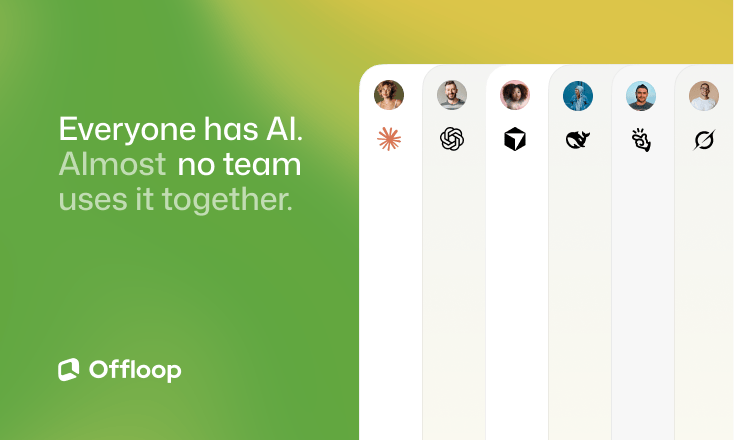
Core Philosophy: Keeping Work Flowing Through Human-AI Handoffs
Offloop's central proposition is: enabling team members and AI Agents to jointly plan, execute, and track complex multi-step work, rather than repeatedly restarting in disconnected AI chats.
To achieve this, Offloop has designed two key mechanisms:
Channels: Making Conversations and Decisions Fully Visible
Offloop introduces a concept similar to "Channels" found in team collaboration tools. The channel-based information organization model was first popularized by Slack in 2013, with the core idea of organizing information flows by topic, project, or team, enabling relevant participants to collaborate asynchronously in the same space. Discord, Microsoft Teams, and other products later adopted similar architectures. The channel mechanism solved the information fragmentation problem of the email era, but faces new challenges in the AI era: AI generates far more information than humans, and how to let AI outputs naturally settle into channels without causing information overload is a design problem requiring careful balance.
In Offloop, all conversations, discussions, and key decisions are preserved in channels and remain visible to the entire team. This means information produced by both human members and AI Agents is deposited in the same shared context, rather than scattered across individual private conversations.
This design directly addresses the biggest chronic issue in current AI usage — context loss. In traditional AI chat tools, valuable reasoning or planning often gets locked in someone's conversation history, invisible to other team members. Through its channel mechanism, Offloop attempts to make this implicit information explicit and shared.
Flow: Assigning Clear Owners for Each Stage
The second mechanism, Flow, is more ambitious. It assigns a clear owner to each stage of multi-step work and proactively pulls relevant people in at critical decision points.
The theoretical foundation behind this design is the Human-in-the-Loop (HITL) model — an important paradigm in AI system design that introduces human judgment at key nodes in automated processes, ensuring AI doesn't make high-risk decisions without oversight. This concept is already widely applied in autonomous driving (L2/L3 levels require human takeover readiness), content moderation (AI initial screening + human review), and other fields. In enterprise collaboration scenarios, HITL means AI can handle information gathering, preliminary analysis, and other repetitive work, but at nodes requiring creative judgment, ethical considerations, or cross-departmental coordination, control naturally returns to human decision-makers.
In other words, Flow doesn't just let AI execute tasks automatically — it builds a clear chain of responsibility and handoff between humans and machines. When work transitions from AI's automated execution to a decision point requiring human judgment, the system naturally introduces human involvement, ensuring work "keeps moving forward rather than starting over in a new AI chat."
What Problem Is Offloop Trying to Solve?
Current AI collaboration products on the market fall roughly into two categories: pure AI chat assistants that are powerful but lack team collaboration and process management; and traditional project management tools with clear processes but weak AI capabilities. Offloop's positioning falls precisely at the intersection — treating AI Agents as formal "team members" within collaborative workflows.
Based on the product description, Offloop aims to answer an increasingly urgent question: when AI Agents truly participate in multi-step real work, how should teams organize the division of labor, handoffs, and decision-making between humans and machines?
The keyword here is "handoff." In real work scenarios, a project often requires multiple handoffs — from research to proposals, from execution to review. Offloop's emphasis on seamless work transitions at these handoff points, rather than starting from scratch in isolated AI windows each time, genuinely captures a real pain point of AI deployment in team settings.
Opportunities and Challenges Coexist
As a newly launched product, Offloop currently offers more of a clear product vision and framework, with its actual effectiveness still awaiting market validation.
On the positive side, its definition of a "human-AI shared workspace" is quite clear, and the Channels and Flow mechanisms are logically complementary — the former solves information sharing, the latter solves process advancement. This approach of deeply embedding AI Agents into collaborative workflows represents an important evolutionary direction for AI productivity tools.
But the challenges are equally apparent. During 2024-2025, the AI productivity tool space has become intensely competitive. Slack launched Slack AI, offering channel summaries and intelligent search; Notion integrated Notion AI, supporting document generation and database queries; Linear introduced AI-assisted project management features. The greater threat comes from platform-level companies: Microsoft's Copilot is being comprehensively embedded into Office 365 and Teams, and Google's Gemini is deeply integrating with the Workspace ecosystem. In this competitive environment, Offloop needs to prove its irreplaceable differentiated value — which may stem from its "AI-native" product architecture, meaning it was designed from day one around human-AI collaboration rather than human-human collaboration.
Secondly, enabling AI Agents to truly serve as "stage owners" places high demands on the reliability and controllability of the underlying Agents — if AI makes errors at critical handoff points, the entire process could stall. Current challenges with AI Agents in complex tasks — hallucinations, tool calling failures, reasoning chain interruptions — haven't been fully resolved, meaning Offloop's Flow mechanism needs built-in fault tolerance and rollback capabilities. Additionally, while its launch momentum is solid, there's still a distance to achieving user scale.
Conclusion
Offloop represents a new paradigm attempt in AI collaboration tools: no longer treating AI as a passive Q&A tool, but rather as a collaborative partner on the team, planning, executing, and handing off work alongside human members. Its emphasis on context sharing and process ownership addresses the core challenge of deploying AI in team settings today.
For teams exploring how to truly integrate AI into daily workflows, Offloop offers a sample worth watching. Whether it can gain a firm foothold in the crowded productivity space remains to be tested by time and real users.
Related articles

Chain of Thought Isn't Just for AI: How Humans Can Use CoT to Improve Thinking Quality
Chain of Thought isn't just a prompt trick for large models. Starting from a Hacker News discussion, this article analyzes why CoT works for human thinking too, breaks down actionable ways to transfer it, and highlights the key differences between human CoT and machine CoT.
Cloudflare Teams Up with OpenAI: Closi…
Cloudflare Teams Up with OpenAI: Closing the Loop from Vulnerability Discovery to Defense with AI
Cloudflare uses OpenAI Daybreak to investigate security vulnerabilities and generate reviewable remediation plans, while developers use Codex to boost coding efficiency and quality.

Orca Multi-Agent Orchestration in Practice: A Guide to Parallel Collaboration with Claude and Codex
Orca is Stable AI's free open-source agent workbench supporting 34 agents like Claude Code and Codex in parallel. Learn its Git worktree isolation, multi-model orchestration, and mobile management.