Old Conclusions Meet New Models: Insights from LLM Replication Research

Rapid model iteration makes old LLM conclusions quietly expire; large-scale replication turns this into observable fact.
The article starts from a Hacker News discussion thread about replicating old LLM research conclusions at scale with new models, pointing out that monthly model iteration leaves many "LLMs will do X" claims neither falsified nor confirmed — they simply quietly expire. The real difficulty of replication lies not in running the scripts but in three issues: sensitivity of prompts and decoding parameters, benchmark contamination and silent model updates, and overly coarse statement granularity. It further proposes three impacts of large-scale replication: highlighting timeliness, changing citation practices, and offering a low-barrier research entry point, emphasizing the value of a public trackable results repository for paper credibility and engineering model selection.
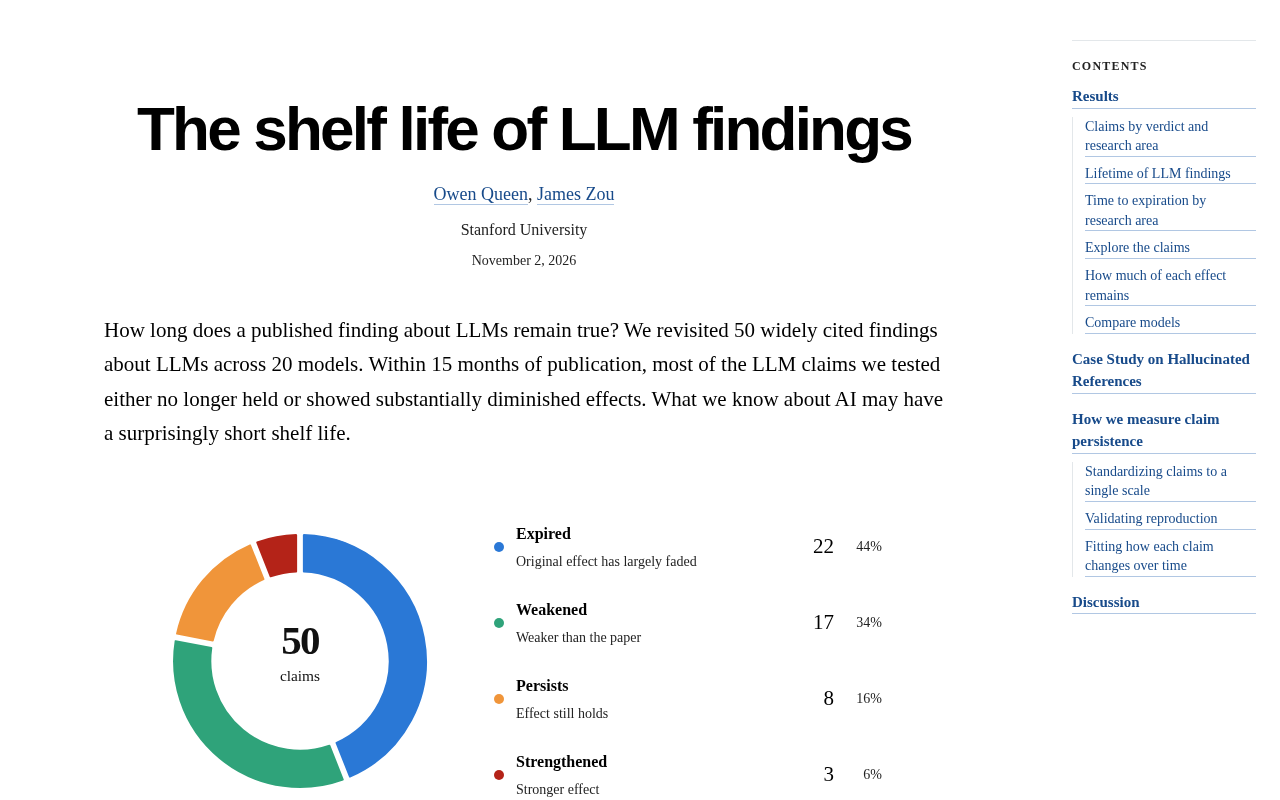
A discussion thread with a rather blunt title appeared on Hacker News: "Mass attempted replication of old findings of LLMs with new models" — using a new generation of models to replicate, at scale, old research conclusions about large language models. The post itself has only 5 points and 0 comments, so it carries limited information, but the question it points to is becoming increasingly sharp in today's AI research ecosystem: when model versions iterate on a monthly basis, do those "LLMs will do X"-style conclusions that were written into papers and repeatedly cited still hold up?
Why "replication" has become tricky in the LLM era
In traditional experimental science, replication is a basic action for testing the reliability of conclusions. But replication in LLM research faces a special difficulty: the object of study itself is drifting. With the same prompt and the same evaluation pipeline, switching to a new model version may already produce a noticeably different output distribution — the old paper's observation that "the model tends to take shortcuts on reasoning tasks" or "there is a systematic bias toward certain types of instructions" may not reproduce on the new model.
This creates an awkward situation: the conclusions of a large number of papers are in fact "a certain model at a certain point in time exhibited a certain behavior," yet they are often phrased as general claims about "LLMs." When the model generation changes, these claims are neither falsified nor confirmed — they simply quietly expire. The value of large-scale replication attempts lies in turning this "quiet expiration" into an observable, discussable fact.
Reproducibility in computational science usually refers to the ability of others to rerun an experiment based on the paper's description and obtain consistent results. In recent years, the machine learning field has further distinguished several levels: repeat means the same authors rerun with the same code, replicate means others test the conclusion with a new implementation on new data, and reproduce falls somewhere in between. The consistency requirements of the three loosen in turn.
For LLMs, the strictest problem is that the experimental object cannot be frozen: closed-source models cannot have their weights fixed, and open-source models can also produce numerical-level deviations due to inference frameworks, quantization precision, and hardware differences. The community therefore places more emphasis on reproducibility reporting standards, such as noting the model name and snapshot identifier, API access date, complete prompts, and decoding configuration in papers. The point of such standards is not to guarantee completely identical results, but to let later researchers judge whether a difference stems from the method or the environment.
The real difficulty of replication experiments is not getting the script to run
From an engineering perspective, replicating an LLM paper is far more troublesome than replicating a classic machine learning experiment.
Sensitivity of prompts and decoding parameters
Many conclusions depend on a specific prompt template, the number of few-shot examples, and the temperature setting. The original text may not fully record these details, and a replicator may get different results with a slight adjustment. As a result, "replication failure" itself becomes hard to attribute: is the conclusion invalid, or was the replication approach unlucky?
A prompt template is a fixed text skeleton organized around task instructions, usually containing role setting, task description, input placeholders, and output format requirements. Few-shot examples are several input-output demonstrations given in the prompt so that the model can imitate the format and style through in-context learning; the number, selection, and ordering of examples can significantly affect the output.
Temperature is a decoding parameter that controls sampling randomness: as the value approaches 0, the model tends to choose the highest-probability token and the output is more deterministic; as the value rises, the sampling distribution becomes flatter, diversity increases, but stability decreases. Related to it are top-p (nucleus sampling) and top-k, which together determine the truncation range of candidate tokens.
These parameters become an obstacle to replication because they are often not fully reported, and LLM outputs are highly sensitive to them — the same conclusion may hold at temperature=0 and disappear under default sampling. The standard practice in replication research is to publish the complete prompt text, example set, and all decoding parameters, and to perform parameter sweeps on key conclusions rather than single-point verification.
Benchmark contamination and version drift
The probability that a public benchmark appears in training data changes as models are updated, so scores on old benchmarks lose comparability. At the same time, API models undergo silent updates, and the same model name may correspond to different weights at different times. These two factors together mean that conclusions from cross-version comparisons require especially cautious interpretation.
Benchmark contamination refers to benchmark questions or answers entering a model's training corpus in some form, so that the model's performance on the benchmark cannot reflect its true generalization ability. As the scale of model training data expands and the scope of crawling widens, the time window from the release of a benchmark question to its being "memorized" becomes shorter and shorter. When replicating old papers, if the old and new models differ in their degree of contamination on the same benchmark, the score difference may come from memorization rather than capability improvement. A rigorous approach therefore distinguishes between "closed-book" and "open-book" settings, or uses benchmarks released later than the model's training cutoff (contamination-free benchmarks).
Version drift has two layers of meaning. One layer is the iteration of the model itself: under the same API name, the provider may replace the underlying weights, adjust the system prompt, or change safety policies without notice. The other layer is drift in the evaluation environment: library versions, default decoding parameters, and tokenizer details may all change. Together, these mean that "the same-named model" is not equal to "the same experimental conditions," and replication records must note access timestamps; otherwise cross-version comparisons lack comparability.
The granularity problem of how conclusions are stated
A coarse-grained assertion like "LLMs possess a certain capability" is often both right and wrong on a new model — it holds under a specific task format and fails when the question is phrased differently. Replication research therefore needs to break conclusions down and clarify the boundary conditions under which they hold, rather than simply checking a box or crossing it out.
Three impacts of large-scale replication on research practice
First, it brings "the timeliness of conclusions" to the fore. In paper writing, it may be necessary to more explicitly note the model version, access time, and evaluation configuration, anchoring conclusions to specific conditions rather than generalizing them into general laws about intelligent agents.
Second, it changes the way literature is cited. When the reproducibility of old conclusions is questionable, there is a risk in subsequent research directly citing their claims as premises; a safer approach is to re-verify the key baselines.
Third, it provides researchers with a low-cost entry point. Compared with proposing an entirely new method, systematic replication and boundary characterization also produce incremental knowledge, and their value to the community is often underestimated.
A signal worth paying attention to
This post is not very popular, but it reflects a consensus that is forming in the research community: knowledge accumulation in the LLM field cannot rely only on continuously stacking new conclusions; someone also needs to go back and check whether old conclusions still hold. If large-scale replication attempts can form a public, trackable repository of results, that has practical significance for both paper credibility and engineering model selection.
The information provided in the original post is limited to the title itself, lacking details on the specific experimental scope, the model generations involved, and the replication success rate. To evaluate the methodological rigor of this work, more complete materials are still needed. But the problem awareness itself is clear enough: in a field where models iterate rapidly, "it held then" and "it still holds now" are two different things, and the latter needs to be continuously tested.
Frequently asked questions
Does replication failure mean the original paper is wrong? Not necessarily. More commonly, the model behavior on which the conclusion depended has changed, or the replication configuration differs from the original. It is necessary to distinguish between "the conclusion is wrong" and "the conclusion no longer applies."
What can ordinary developers gain from replication research? Mainly a judgment about the stability of model behavior. Understanding which capabilities or biases are likely to drift with versions helps design more robust prompts and fallback strategies in engineering.
What indicators should this type of research focus on? Compared with a single success rate, the consistency of conclusions across different prompt variants and different model versions is more informative.
One-line Summary
Rapid model iteration causes old LLM conclusions to quietly expire, and large-scale replication turns this into an observable fact.
Paragraph Summary
The article starts from a Hacker News discussion thread about using new models to replicate old LLM research conclusions at scale, pointing out that model versions iterate monthly, causing many "LLMs will do X"-style claims to be neither falsified nor confirmed after a generation change — they simply quietly expire. The real difficulty of replication is not getting the script to run, but three points: sensitivity of prompts and decoding parameters, benchmark contamination and silent model updates, and overly coarse granularity in how conclusions are stated. The article further proposes three impacts of large-scale replication: highlighting the timeliness of conclusions, changing the way literature is cited, and providing a low-barrier entry point for research, while emphasizing the value of a public, trackable repository of results for paper credibility and engineering model selection.
Related articles

Non-Coding Dad Builds 3D Earth Toy with Claude Code, Unexpectedly Goes Viral in Classrooms
A non-coding father used Claude Code to build My Earth Toy, a 3D interactive Earth with 830+ landmarks, 470+ animals, and 180+ vehicles—now used in classrooms worldwide. Discover how AI coding lowers the barrier to creation.

Meta, Google, and TikTok Sue California Attorney General: The Battle Over Youth Social Media Law
Meta, Google, and TikTok jointly sue the California Attorney General to block a state law restricting social media use by minors under 16. This article analyzes the lawsuit's background, the law's core provisions, and its potential impact on tech industry regulation.

T-Mobile Parent Company CEO on Musk's Telecom Ambitions: Welcome, But You'll Need $200 Billion
Deutsche Telekom CEO Tim Höettges responds to Musk's SpaceX Starlink Mobile plan, saying "welcome to the party" but questioning feasibility—estimating at least $200 billion needed to become a major U.S. carrier.