Ollama Adds Three New Models with /v1/systemone API Support

Ollama adds Nimble, Tev1 4b, and Tev1 0.8b models, all accessible via the /v1/systemone endpoint.
Ollama has announced three new locally runnable models: the lightweight Nimble, the mid-sized Tev1 4b (~4B parameters), and the compact Tev1 0.8b (~800M parameters). All three are served through the `/v1/systemone` endpoint, letting developers switch between them without modifying existing workflows. The Tev1 series covers use cases ranging from well-equipped local workstations to resource-constrained laptops and edge devices. The update's core value lies in giving developers more free, private, locally-run model options with a unified API to reduce switching costs. Full details on training data, benchmarks, and licensing have yet to be disclosed.
Three New Models Now Available on Ollama
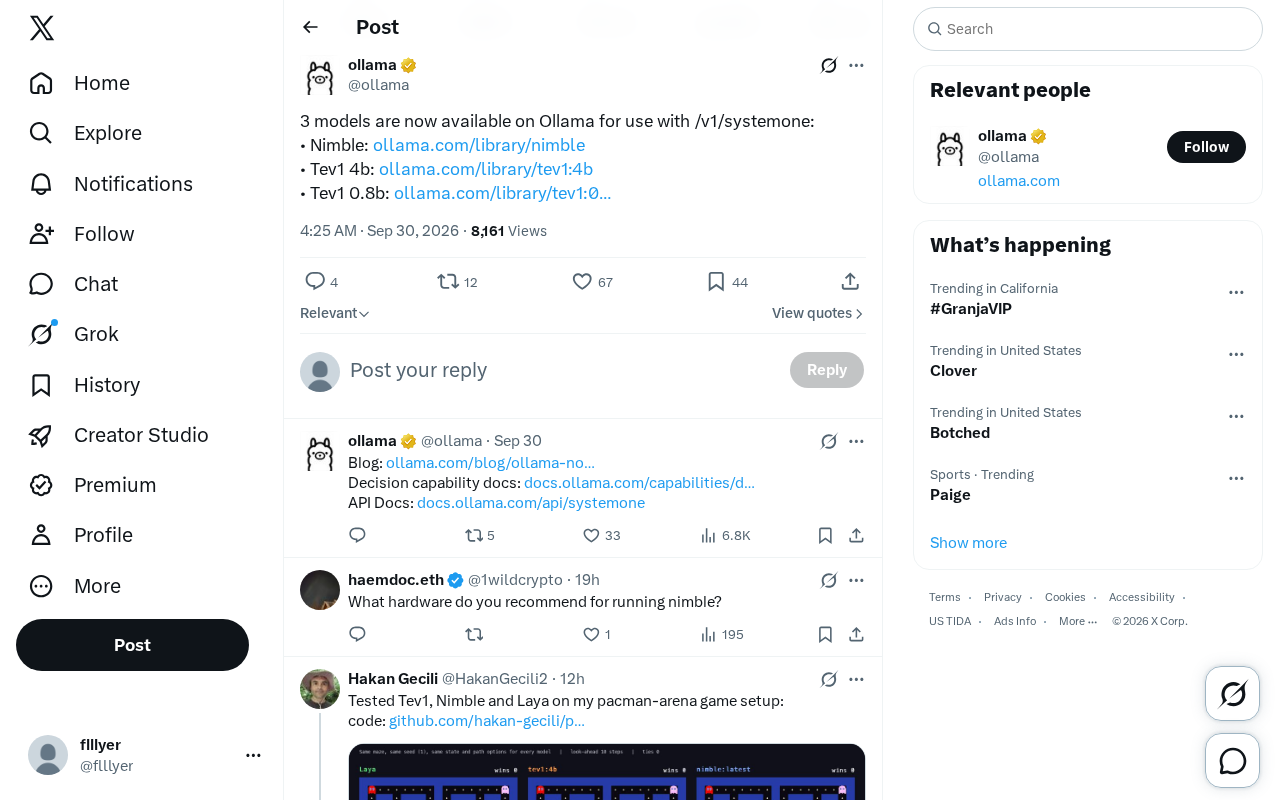
Ollama, the popular local large language model runner, has announced that three new models are now available on the platform, accessible via the /v1/systemone endpoint. This update gives developers more options for deploying and testing models of different scales locally.
According to the official announcement, the three newly added models are:
- Nimble: A lightweight, fast-response-focused model
- Tev1 4b: A mid-sized model with approximately 4 billion parameters
- Tev1 0.8b: A compact model with approximately 800 million parameters
The naming makes it clear that the Tev1 series offers two variants at different parameter scales, allowing developers to make trade-offs based on their hardware capabilities and performance requirements.
How the Three Models Differ
Nimble: Built for Agile Response
As the name suggests, Nimble is designed with low latency and fast inference in mind. This type of model is typically well-suited for scenarios where response speed matters more than deep reasoning — such as interactive conversations, real-time assistance, and similar use cases.
In the LLM space, "lightweight and fast" is typically achieved through a few technical approaches: reducing total parameter count, applying quantization (compressing model weights from float16 down to int8 or even int4), or pruning the inference path. Nimble's exact parameter count hasn't been disclosed, but based on its positioning, the priority appears to be Time to First Token rather than reasoning depth on complex tasks. In practice, models like this are often used as a "front-end routing layer" — responding to users quickly while optionally handing off more complex requests to a larger model — striking a dynamic balance between user experience and compute consumption.
Tev1 4b and Tev1 0.8b: Covering Different Compute Tiers
The two Tev1 variants form a clear gradient:
- Tev1 4b (~4 billion parameters) strikes a balance between capability and resource usage, making it suitable for local environments with a decent GPU or a relatively powerful CPU.
- Tev1 0.8b (~800 million parameters) is smaller with a lower memory footprint, ideal for resource-constrained devices such as laptops or even edge hardware.
This tiered design is a common pattern in the open-source model ecosystem — offering the same model family at different parameter scales to serve a range of needs, from personal experimentation to lightweight production use.
What the /v1/systemone Endpoint Means
All three models are served through the /v1/systemone endpoint. An API-based interface means developers can access different models using a consistent method, reducing the cost of switching between them. For existing Ollama users, this kind of update allows you to try new models directly within your current workflow without significant code changes.
Ollama's core value proposition has always been "run large models locally with ease," and continuously expanding its model library is key to staying competitive. Every new batch of models gives local inference users more options to compare and combine.
Ollama's API design is highly compatible with OpenAI's /v1/chat/completions specification — a mainstream strategy among local LLM toolchains. This compatibility means developers can use the same client code (such as LangChain, LlamaIndex, or custom scripts) to swap underlying models at any time without modifying business logic. As a dedicated endpoint, /v1/systemone may include specific optimizations for system-level call scenarios, though the official documentation has not yet detailed how it differs behaviorally from the standard chat endpoint. Developers integrating these models are advised to consult Ollama's official API docs to confirm that request formats and parameter fields are fully compatible with their existing workflows.
Practical Value for Developers
For developers and enthusiasts focused on local deployment, this update offers several tangible benefits:
- More options: From Nimble to the Tev1 series, the new additions cover a range of speed and scale preferences.
- Easy to try: Pull and run locally via Ollama — no dependency on cloud APIs required.
- Cost control: Running locally avoids per-call billing, making it ideal for iterative experimentation and privacy-sensitive use cases.
It's worth noting that the official announcement is fairly brief. Details such as training data, benchmark performance, and licensing terms have not been disclosed in the original content. Users interested in adopting these models are encouraged to visit Ollama's official model pages for complete specifications and documentation before evaluating fit for their use case.
Summary
Ollama's three newly added models — Nimble, Tev1 4b, and Tev1 0.8b — further expand the local LLM landscape and are all accessible through the unified /v1/systemone endpoint. While public details remain limited for now, updates like this reflect the vitality of the local AI tooling ecosystem. Developers eager to try them out can head to the Ollama platform to find detailed information on each model.
Related articles

Chain of Thought Isn't Just for AI: How Humans Can Use CoT to Improve Thinking Quality
Chain of Thought isn't just a prompt trick for large models. Starting from a Hacker News discussion, this article analyzes why CoT works for human thinking too, breaks down actionable ways to transfer it, and highlights the key differences between human CoT and machine CoT.
Cloudflare Teams Up with OpenAI: Closi…
Cloudflare Teams Up with OpenAI: Closing the Loop from Vulnerability Discovery to Defense with AI
Cloudflare uses OpenAI Daybreak to investigate security vulnerabilities and generate reviewable remediation plans, while developers use Codex to boost coding efficiency and quality.

Orca Multi-Agent Orchestration in Practice: A Guide to Parallel Collaboration with Claude and Codex
Orca is Stable AI's free open-source agent workbench supporting 34 agents like Claude Code and Codex in parallel. Learn its Git worktree isolation, multi-model orchestration, and mobile management.