Ollama v0.34.4-rc1 Released: XGrammar 0.2.7 Upgrade Improves Structured Output

Ollama v0.34.4-rc1 upgrades XGrammar to 0.2.7, fixing typed dict and short array structured output bugs.
Ollama has released v0.34.4-rc1, with the core change being an upgrade of the XGrammar library in its mlxrunner backend to version 0.2.7. XGrammar uses constrained decoding to ensure LLM outputs conform to predefined schemas. This update fixes two specific issues: schema handling errors for typed dictionary values and reliability defects in short array generation scenarios. Structured output is essential for deploying LLMs in production systems, directly impacting AI agents, data extraction pipelines, and function-calling workflows. This is a release candidate suitable for developer testing; production environments should await the official stable release.
Ollama Releases v0.34.4-rc1 Preview
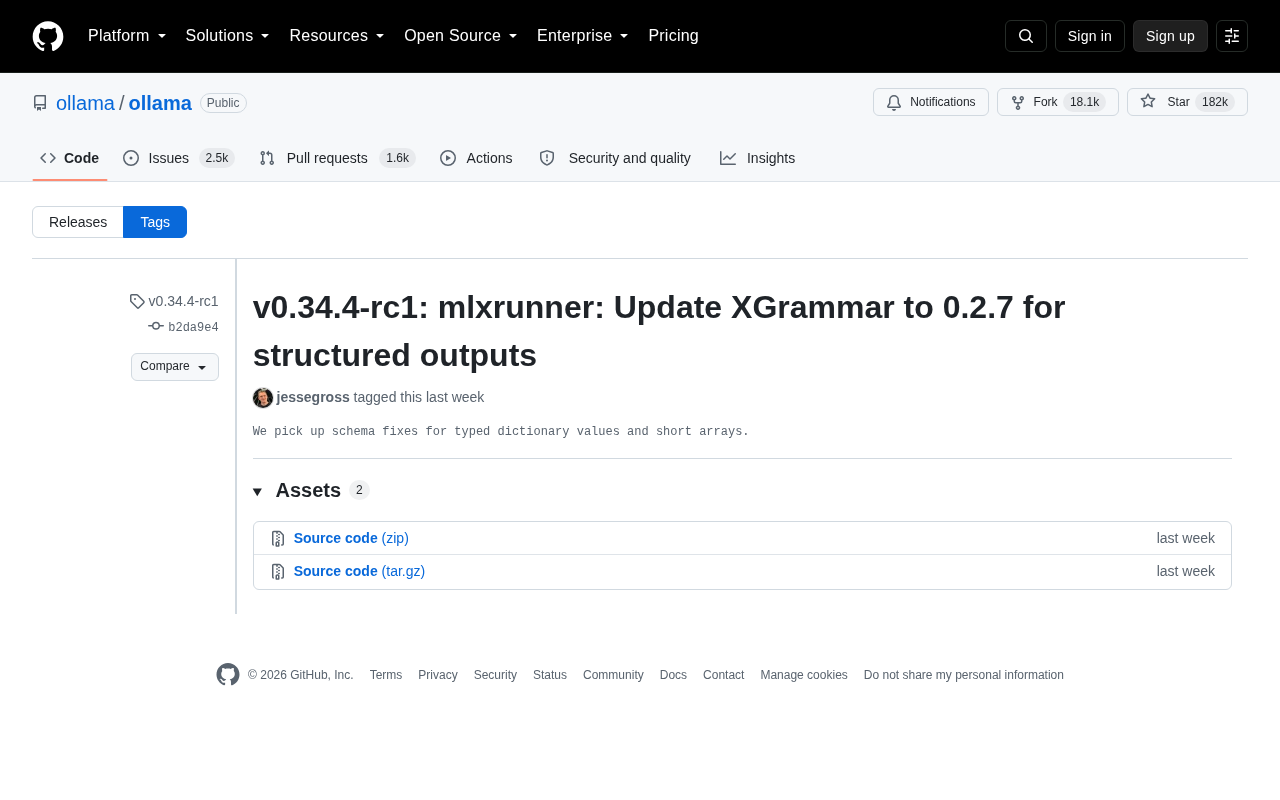
Ollama has released v0.34.4-rc1, a release candidate focused on structured output improvements. The core change in this version is upgrading the XGrammar library in mlxrunner to version 0.2.7, bringing several fixes for structured output scenarios.
As one of the most popular local LLM runtime frameworks, Ollama has accumulated over 180,000 stars on GitHub with more than 18,000 forks, making it a key tool for locally deploying and running open-source large language models. This release candidate, tagged by developer jessegross, continues Ollama's ongoing effort to polish inference reliability.
What the XGrammar Upgrade Brings
XGrammar is a library focused on efficient and flexible structured generation, widely used to constrain LLM output formats and ensure models produce content conforming to predefined schemas (such as JSON Schema). In local inference scenarios, structured output capability directly determines whether a model can reliably generate data that downstream programs can parse.
According to the official release notes, upgrading to XGrammar 0.2.7 delivers two main categories of schema-related fixes:
Typed Dictionary Value Handling
The new version fixes issues with handling typed dictionary values. In practice, developers frequently need to constrain model outputs to dictionary structures with specific value types — for example, requiring a field to be a mapping from strings to integers. Previous versions could behave unexpectedly when processing these type-constrained dictionaries, and this update addresses those issues.
Improved Short Array Support
The second fix targets short array scenarios. The schema parsing and execution logic has been optimized for generating fixed-length or short-length array structures. This means that when an application requires the model to output short arrays — such as coordinate pairs or small lists of tags — the results will be more reliable.
XGrammar works by compiling format specifications like JSON Schema into finite state machines (FSMs) or context-free grammars (CFGs), then masking the candidate vocabulary at each token generation step to allow only tokens that conform to the current grammar state. This approach is known as "constrained decoding." Compared to post-hoc validation, it fundamentally eliminates the possibility of malformed output rather than relying on retry mechanisms. XGrammar's advantage over earlier similar libraries (such as Outlines and lm-format-enforcer) lies in its faster compilation of complex schemas and lower runtime inference overhead, enabling minimal performance impact in local inference scenarios. mlxrunner is Ollama's backend runtime for Apple Silicon (M-series) devices, so this upgrade means Mac users will directly benefit when using structured output.
Why Structured Output Matters
Structured output is a critical component for integrating LLMs into real production systems. When developers build AI agents, data extraction pipelines, or function-calling workflows, they rely heavily on models producing strictly formatted, parseable results. Any flaw in schema handling can cause downstream parsing failures or unexpected errors.
By continuously tracking updates to low-level constrained generation libraries like XGrammar, Ollama can quickly bring upstream community fixes into local runtime environments, giving users a more stable structured generation experience without needing to dig into underlying details. This kind of continuous iteration on the fundamentals is precisely what keeps open-source tools competitive.
What a Release Candidate Means
It's worth noting that v0.34.4-rc1 is a release candidate rather than a stable production release. These versions are typically used for broader testing before an official release, gathering community feedback and verifying that fixes are effective. Developers who want to try the structured output improvements early can test this release candidate; production environments that prioritize stability should wait for the subsequent official release.
While this update is modest in scope, it's a reliability improvement worth noting for developers who rely on Ollama for structured data generation. As local LLM use cases continue to expand, this kind of foundational polish will keep improving the overall user experience.
In the software release lifecycle, a Release Candidate (RC) comes after beta testing and before the general availability (GA) release. The naming convention (rc1, rc2, etc.) indicates which round of candidacy it represents — if a blocking issue is found during rc1, the team fixes it and ships rc2, continuing until no critical issues remain before promoting to a stable release. For active open-source projects like Ollama, RC versions are typically listed separately as "Pre-release" on the GitHub Releases page and are not automatically pushed to users via the standard ollama pull command — they require manually specifying the version number to install. This mechanism protects most everyday users from potential regressions while giving community contributors and early adopters a channel to participate in validation.
Related articles

Chain of Thought Isn't Just for AI: How Humans Can Use CoT to Improve Thinking Quality
Chain of Thought isn't just a prompt trick for large models. Starting from a Hacker News discussion, this article analyzes why CoT works for human thinking too, breaks down actionable ways to transfer it, and highlights the key differences between human CoT and machine CoT.
Cloudflare Teams Up with OpenAI: Closi…
Cloudflare Teams Up with OpenAI: Closing the Loop from Vulnerability Discovery to Defense with AI
Cloudflare uses OpenAI Daybreak to investigate security vulnerabilities and generate reviewable remediation plans, while developers use Codex to boost coding efficiency and quality.

Orca Multi-Agent Orchestration in Practice: A Guide to Parallel Collaboration with Claude and Codex
Orca is Stable AI's free open-source agent workbench supporting 34 agents like Claude Code and Codex in parallel. Learn its Git worktree isolation, multi-model orchestration, and mobile management.