Ollama v0.34.4 Released: Faster Structured Outputs and Stronger Apple Silicon Optimization

Ollama v0.34.4 improves structured output speed, fixes stability bugs, and enhances Apple Silicon support.
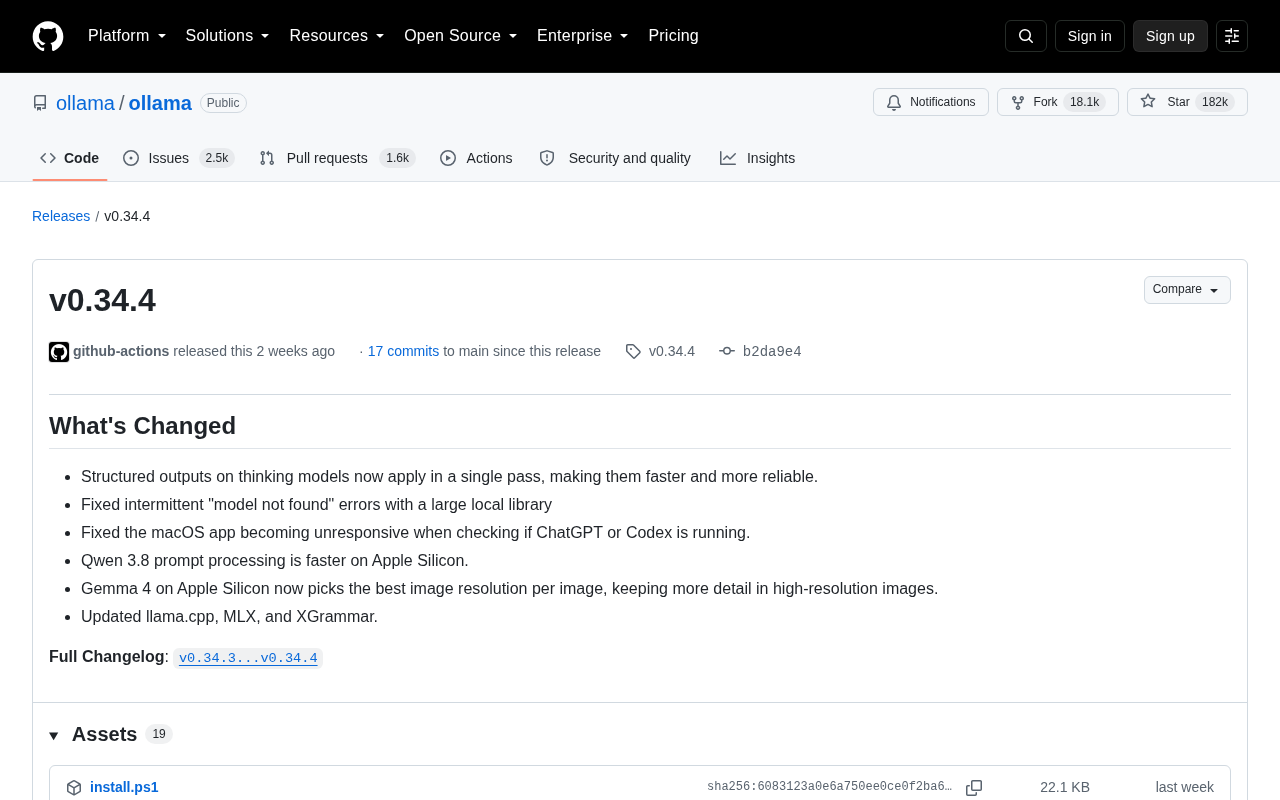
Ollama v0.34.4 is a refinement-focused minor release. The headline improvement is switching structured output generation for thinking models from multiple passes to a single pass, making JSON and other formatted outputs faster and more reliable for agent workflows and function calling. Stability fixes address intermittent "model not found" errors with large local model libraries and macOS app freezes caused by ChatGPT/Codex process detection. Apple Silicon users also benefit: Qwen 3.8 gets faster prompt processing, and Gemma 4 now auto-selects the optimal image resolution for better detail. Core dependencies — llama.cpp, MLX, and XGrammar — have all been updated to keep pace with upstream community progress.
Ollama, one of the most popular tools for running large language models locally, continues its rapid release cadence. The latest v0.34.4 is a minor version update, but it delivers several practical improvements in inference performance, stability, and Apple Silicon compatibility. For developers and enthusiasts who rely on locally deployed LLMs, these optimizations have a direct impact on day-to-day experience.
Structured Output: Performance and Reliability Improvements
The most notable change in this update is the optimization of structured outputs for thinking models. Previously, generating structured outputs on reasoning models could require multiple passes, which hurt both speed and consistency.
v0.34.4 switches this process to a single pass, making structured outputs both faster and more reliable. For use cases where models need to return data in a fixed format — such as JSON for function calling, tool invocation, or data extraction — this improvement significantly reduces latency and improves output stability, cutting down on format parsing failures.
As more applications use local models as components in agent workflows, the quality of structured outputs directly determines the viability of downstream processes. These kinds of low-level optimizations may not be flashy, but they're critical for reliable production deployments.
Structured Outputs refer to forcing a language model to generate responses in a predefined format (most commonly a JSON Schema) rather than free-form text. This is typically achieved in one of two ways: dynamically filtering out invalid tokens during inference using grammar constraints, ensuring each generation step conforms to the target format; or guiding the model via prompt engineering and then parsing and validating the result. Thinking Models output an internal reasoning process before producing a final answer (usually wrapped in <think> tags). This "thinking" content doesn't need to conform to a structured format — only the final answer does. The previous multi-pass approach required handling the thinking and answer content in separate stages, introducing extra coordination overhead. The single-pass approach unifies both within the same inference loop, reducing intermediate state transitions and thus lowering latency while avoiding boundary errors that can arise when splicing formatted outputs.
Key Stability Fixes
This release also addresses two issues that affected the user experience:
- Intermittent "model not found" errors with large local model libraries: Users who store a large number of models locally occasionally encountered errors where a model couldn't be found. This has been fixed in the current version — a particularly important fix for power users managing many models.
- macOS app becoming unresponsive: The macOS client could freeze when detecting whether ChatGPT or Codex was running. This compatibility conflict has been resolved, improving desktop stability.
Both fixes address real pain points in everyday use, demonstrating that the Ollama team is actively polishing product stability alongside feature development.
Apple Silicon-Specific Optimizations
Apple Silicon (M-series chip) users represent a significant portion of Ollama's user base. This update brings two targeted improvements for that platform:
Faster Prompt Processing for Qwen Models
On Apple Silicon, prompt processing speed for Qwen 3.8 has been improved. Prompt processing is the phase where the model parses input before generating a response. Speeding up this stage means users get their first token faster, resulting in a smoother overall experience.
Better Image Handling for Gemma Multimodal
Gemma 4 on Apple Silicon now automatically selects the optimal resolution for each image, preserving more detail when processing high-resolution images. For multimodal tasks involving visual understanding, this translates to more accurate image recognition and better output quality.
These optimizations reflect Ollama's continued investment in the Apple ecosystem, making Macs with M-series chips an increasingly competitive platform for running local LLMs.
Core Dependency Updates
Beyond the above improvements, v0.34.4 also updates several key underlying dependencies, including llama.cpp, MLX, and XGrammar.
- llama.cpp is Ollama's core inference engine; updates to it typically bring performance improvements and support for new model architectures.
- MLX is Apple's machine learning framework, directly complementing the Apple Silicon optimizations mentioned above.
- XGrammar is closely related to structured outputs and grammar-constrained generation; its update reinforces the technical direction of the structured output improvements in this release.
Keeping these dependencies up to date ensures Ollama continues to benefit from the latest advances in the upstream open-source community.
llama.cpp is an open-source project initiated by Georgi Gerganov that implements efficient LLM inference in pure C/C++, enabling quantized models to run on CPU without a GPU. It supports the GGUF model format and has become a de facto standard in the local inference ecosystem — Ollama uses it as its core inference backend. MLX is Apple's machine learning framework designed specifically for Apple Silicon, taking full advantage of the M-series chips' Unified Memory architecture, which allows CPU and GPU to share tensor data with zero-copy overhead. This yields significant memory efficiency advantages in edge inference scenarios. XGrammar is a library focused on grammar-constrained generation. It compiles structured specifications like JSON Schema into efficient token masks, dynamically blocking invalid candidate tokens at each decoding step. This ensures output format compliance without sacrificing inference speed, making it a key low-level component for implementing structured outputs.
Summary
Overall, Ollama v0.34.4 is a release centered on refinement: no groundbreaking new features, but solid improvements across three dimensions — structured outputs, stability, and Apple Silicon performance. For users building applications on top of reasoning models, or running local LLMs on a Mac, upgrading to this version will deliver a noticeably faster and more stable experience. Users in these categories are encouraged to check the official release page and update at their earliest convenience.
Related articles

Amphibious Transforming Drone: Beyond 100x Power Savings, What Are the Real Needs?
Is the amphibious transforming drone just a gimmick? Starting from the 100x power difference of the M4 Morphobot, explore real application scenarios and thesis topic ideas, analyzing boundary conditions where pure drones and pure ground robots both fail.

Warhound Raises $200 Million: Genetically Engineered "War Dogs" Paired with Anduril Gear
Warhound raises $200M, backed by Ben Lamm and Palmer Luckey, to genetically engineer dogs for military and law enforcement use and equip them with Anduril gear. This article analyzes its technology direction, funding logic, and ethical controversy.

Claude API Comes to Google Cloud: IAM Integration and SDK Access Guide
Anthropic hosts the full Claude API on Google Cloud with IAM-controlled permissions and unified billing. This guide covers the Vertex AI and Anthropic-hosted entry points, IAM role configuration, and SDK access.