Ollama v0.35.0-rc0 Released: Introduces System One Scoring API

Ollama v0.35.0-rc0 ships a new System One Scoring API aimed at RAG and Agent use cases.
Ollama has released v0.35.0-rc0, a release candidate preview whose headline change is a new System One Scoring API (PR #18606). This addition provides built-in support for ranking and quality-evaluating model outputs in RAG and Agent workflows, reducing the need for developers to build custom evaluation logic. Features are essentially frozen at the RC stage; official API details remain sparse and will be confirmed in the stable release. Production users should wait, while developers can test in isolated environments.
Ollama Releases v0.35.0-rc0 Preview
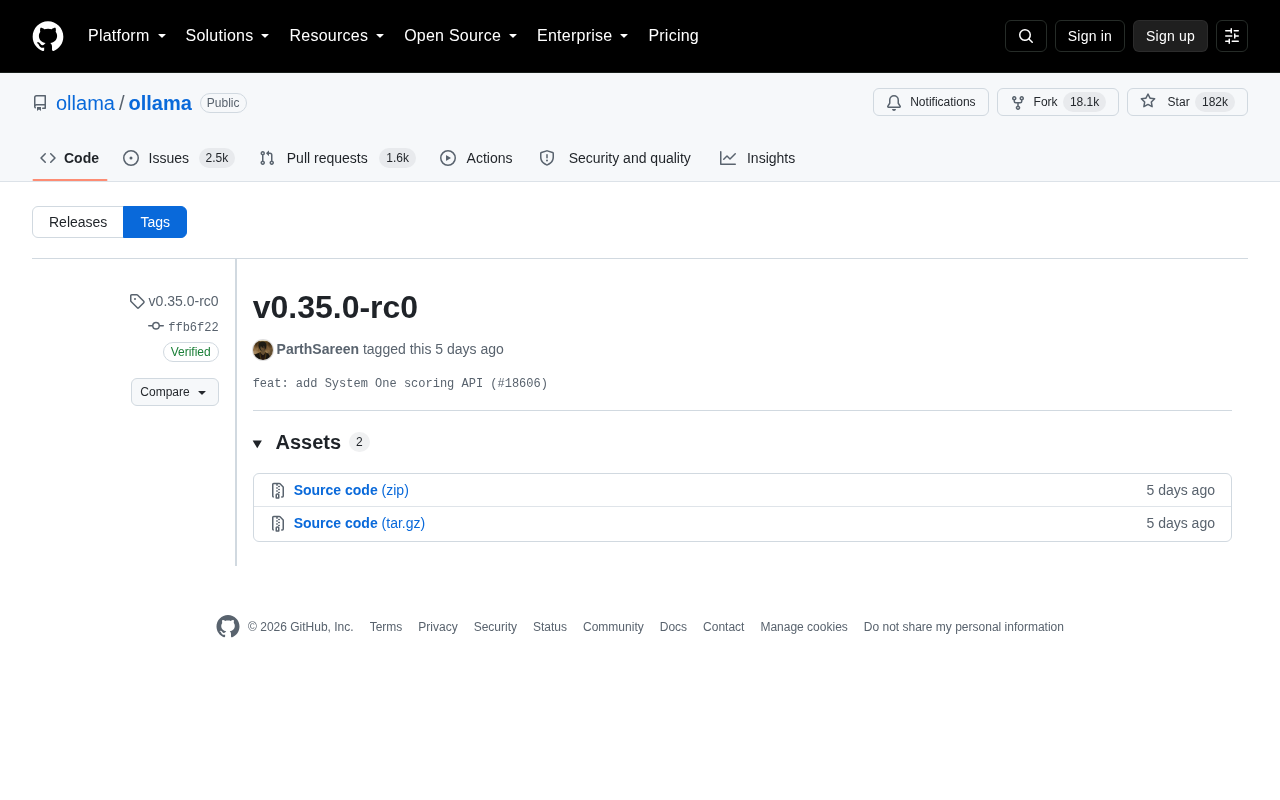
Ollama, the local LLM runtime framework, has pushed out v0.35.0-rc0 (a release candidate preview). As one of the most popular open-source projects on GitHub — with over 180,000 stars and 18,000 forks — every Ollama update is closely watched by the local LLM community.
This RC0 release was tagged by maintainer ParthSareen, with commit ffb6f22 carrying a verified GitHub signature (GPG key ID: B5690EEEBB952194), confirming the authenticity of the release artifacts.
Core Change: System One Scoring API
Based on the publicly available release information, the most notable change in this version is the addition of a System One Scoring API (feat: add System One scoring API, PR #18606).
Scoring APIs are typically used to evaluate the quality of model outputs, assess confidence levels, or rank and filter candidate responses. For applications built around RAG (Retrieval-Augmented Generation), Agent workflows, or any scenario where multiple candidate answers need to be compared and selected, a built-in scoring interface can significantly reduce the overhead of implementing custom evaluation logic.
That said, the official release notes are currently quite sparse. Details about the System One API — including how to call it, input parameter formats, supported scoring dimensions, and underlying implementation — will need to be confirmed once the full release documentation or source code is available.
What Does an RC Release Mean?
RC (Release Candidate) is the final testing phase before an official stable release. Features are essentially frozen at this stage, and the primary goal is to gather community feedback and surface potential bugs. Production users are advised to hold off on upgrading until the stable release lands. Developers who want to get an early look at the new API, however, can try it out in a test environment and report any issues via GitHub.
RAG (Retrieval-Augmented Generation) is one of the most widely adopted architectural patterns for LLM applications: before generating a response, the system retrieves relevant document chunks from an external knowledge base and injects them into the context, allowing the model to reference up-to-date or proprietary information. In this pipeline, a scoring API plays a critical role — it can rank multiple retrieved document candidates or multiple generated answer candidates by relevance or quality, helping the system surface the best result and effectively reducing hallucinations. Similarly, in Agent workflows, scoring mechanisms are commonly used to assess the reliability of tool call results or intermediate outputs in multi-step reasoning, informing decisions about whether to retry or switch strategies.
Why Ollama Deserves Continued Attention
Ollama dramatically lowers the barrier to running large models locally — a single command is all it takes to spin up mainstream open-source models like Llama, Mistral, or Qwen, with no complex environment setup required. Its advantages are especially pronounced in privacy-sensitive, offline, and cost-constrained scenarios, and it has become the underlying runtime for many desktop AI tools.
As more applications build their ecosystems around Ollama, capability expansions like the scoring API reflect a clear evolution: from "just running models" toward "providing a complete inference toolchain." The more official capabilities developers can reuse, the less custom plumbing they need to build themselves.
Ollama's core architecture uses llama.cpp as its inference backend, supports quantized models in GGUF format, and can run large models on consumer-grade GPUs or even CPU-only setups. It exposes an OpenAI-compatible HTTP API, allowing tools and SDKs already built for OpenAI to switch to local inference with near-zero migration cost. Models are managed similarly to Docker images, using commands like ollama pull and ollama run, which greatly reduces the cognitive overhead of local deployment. This is why projects like Open WebUI, Continue, and Dify have all adopted Ollama as their preferred local inference runtime.
Upgrade Recommendations
- Production users: Stay on the current stable release and wait for v0.35.0 to officially land.
- Developers / early adopters: Feel free to install rc0 in an isolated environment and focus on validating whether the System One Scoring API meets your needs.
- Stay informed: Consider watching the repository on GitHub, or wait for the official changelog to get the full feature list.
Since this is an RC preview with limited public information, this article is based solely on what's visible on the official release page. Once the stable version is out, the complete capabilities and usage details of the new API will become much clearer.
Related articles

Chain of Thought Isn't Just for AI: How Humans Can Use CoT to Improve Thinking Quality
Chain of Thought isn't just a prompt trick for large models. Starting from a Hacker News discussion, this article analyzes why CoT works for human thinking too, breaks down actionable ways to transfer it, and highlights the key differences between human CoT and machine CoT.
Cloudflare Teams Up with OpenAI: Closi…
Cloudflare Teams Up with OpenAI: Closing the Loop from Vulnerability Discovery to Defense with AI
Cloudflare uses OpenAI Daybreak to investigate security vulnerabilities and generate reviewable remediation plans, while developers use Codex to boost coding efficiency and quality.

Orca Multi-Agent Orchestration in Practice: A Guide to Parallel Collaboration with Claude and Codex
Orca is Stable AI's free open-source agent workbench supporting 34 agents like Claude Code and Codex in parallel. Learn its Git worktree isolation, multi-model orchestration, and mobile management.