Ollama v0.40.1 Released: Cloud API Proxy and Multiple Windows Fixes

Ollama v0.40.1 pre-release focuses on Windows fixes, cloud API proxy, and simplified CLI onboarding.
Ollama v0.40.1 is a maintenance pre-release building on v0.40.0 with targeted improvements. Key changes include a new server-side proxy for cloud usage and balance APIs to support hybrid cloud scenarios and future monetization features; a fix for the 2GiB read boundary overflow when loading large models on Windows; a workaround for symlink permission issues in manifest handling on Windows; and removal of the account step from the CLI onboarding flow. The release also cleans up an MLX metal residency patch now merged upstream and fixes several broken documentation links. Three new contributors made their first commits, reflecting the project's active community.
Release Overview
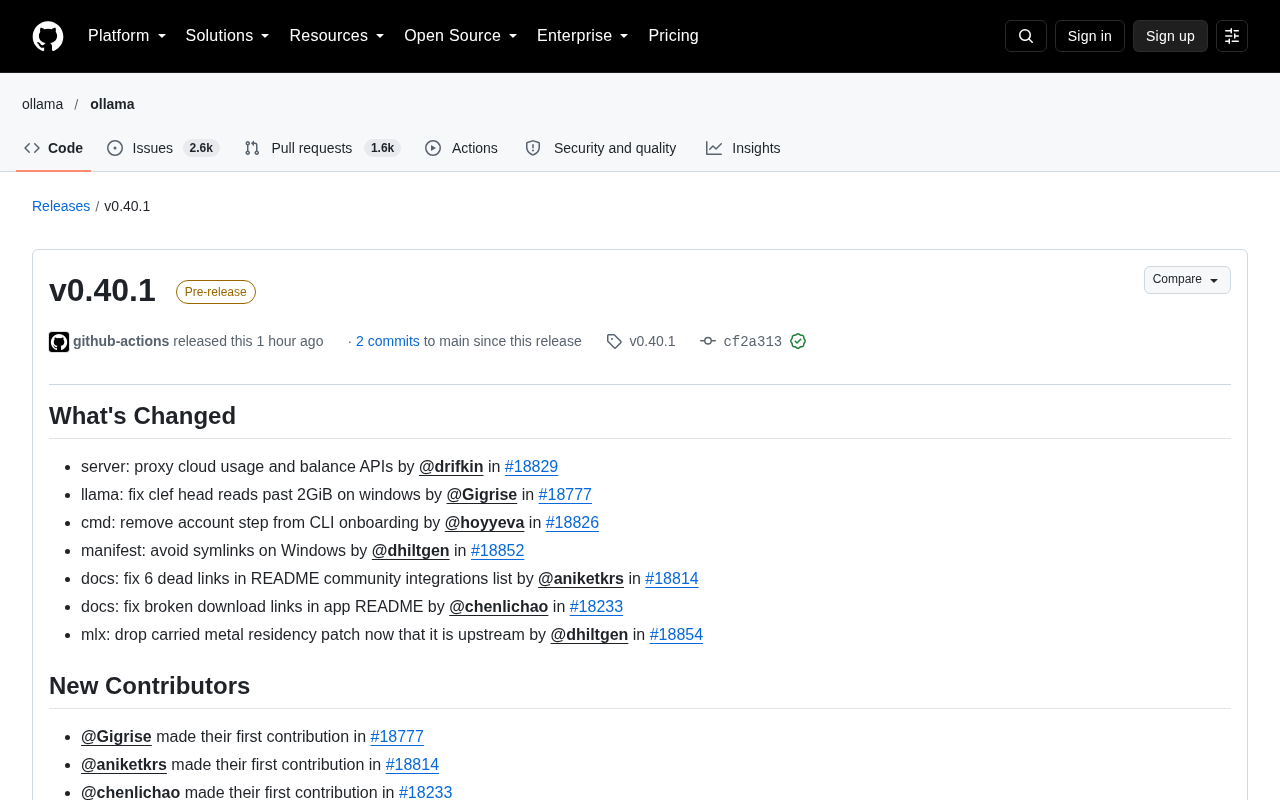
Ollama recently released v0.40.1 as a pre-release version, automatically built by GitHub Actions on October 7th. As a maintenance update following closely after v0.40.0, this release introduces no major new features. Instead, it focuses on strengthening cloud capabilities, improving platform compatibility, and performing documentation upkeep — a typical stability-oriented iteration.
For developers and enthusiasts relying on Ollama to run large language models locally, these minor version updates are easy to overlook, yet they are precisely what keeps the day-to-day experience running smoothly.
Core Changes Explained
Cloud Usage and Balance API Proxy
The most directionally significant change in this update is server: proxy cloud usage and balance APIs (#18829), submitted by contributor drifkin. This change enables the Ollama server to proxy cloud-side usage and balance query endpoints.
From a technical standpoint, this reflects Ollama's ongoing efforts to deepen its integration with cloud services. As the boundary between local inference and cloud capabilities continues to blur, having the server act as a middleware proxy for cloud APIs creates a unified management entry point — and lays the groundwork for future commercial features like billing and quota management.
"Proxying cloud APIs" means the local Ollama server acts as an intermediary, forwarding client requests for cloud usage and balance endpoints to the remote service, then returning the response to the caller. With this pattern, developers no longer need to hardcode cloud service addresses or credentials in client code — they simply interact with the local Ollama service. This architecture is especially valuable for private deployments or hybrid cloud scenarios, allowing teams to seamlessly switch between local and cloud inference under the same API interface without modifying upstream application logic. The ability to query balance and usage data also provides the foundational data support needed for future enterprise-grade features like usage caps and cost allocation.
Two Critical Windows Platform Fixes
This release is particularly welcome for Windows users, containing two targeted fixes:
- Large model read boundary fix (#18777): Submitted by new contributor Gigrise, this resolves an issue where llama exceeded the 2GiB boundary when reading the clef head on Windows. Bugs involving large file memory access typically only surface when loading larger models — fixing this significantly improves large model loading stability on Windows.
- Avoiding symlinks (#18852): Submitted by dhiltgen, this change makes manifest handling on Windows bypass symlinks. Because Windows has different permission requirements for symbolic links compared to Unix-like systems, avoiding symlinks reduces deployment failures caused by permission-related issues.
2GiB (approximately 2,147,483,648 bytes) is the maximum value representable by a 32-bit signed integer. In file I/O or memory-mapped scenarios, if code uses a signed 32-bit integer to describe offsets or sizes, files exceeding this threshold will cause integer overflow, leading to incorrect read position calculations or even program crashes. Today's mainstream large language model weight files routinely reach several to tens of gigabytes — these boundary issues typically go unnoticed during small model testing but surface consistently when loading production-scale larger models. Windows handles symbolic links fundamentally differently from Linux/macOS: creating symlinks on Windows usually requires administrator privileges or enabling "Developer Mode," making it easy for standard users in typical installation environments to encounter permission failures during manifest operations. Bypassing symlinks eliminates this platform-specific permission barrier.
Simplified CLI Onboarding Flow
Contributor hoyyeva removed the account step from the CLI initial onboarding process (#18826). This adjustment lowers the barrier for new users getting started with Ollama — no longer requiring account creation or login at the command-line stage — making the out-of-the-box local experience feel more streamlined.
Documentation and Dependency Maintenance
Beyond functional changes, this release also includes several documentation and underlying maintenance updates:
- Fixed 6 broken links in the README community integrations list (#18814, contributor aniketkrs)
- Fixed a broken download link in the app README (#18233, contributor chenlichao)
- Removed the metal residency patch from MLX that has been merged upstream (#18854, contributor dhiltgen), reducing the project's self-maintained patch burden
The MLX patch cleanup is worth noting — it means the related optimization has been officially accepted by the upstream project, and Ollama no longer needs to maintain that code independently. This is a positive example of open-source collaboration working as intended.
MLX is Apple's open-source machine learning framework designed specifically for Apple Silicon (M-series chips), leveraging the Unified Memory architecture for zero-copy data sharing between CPU and GPU. The metal residency patch involves optimization of GPU memory residency management through Metal (Apple's GPU compute API), reducing memory swap overhead during model inference and improving inference throughput on Mac devices. Previously, Ollama needed to maintain this patch separately in its own codebase to deliver the optimization to users before it was merged upstream. Now that the patch has been officially accepted by MLX upstream, Ollama can obtain this capability directly through dependency upgrades — no longer bearing the additional patch maintenance cost, and reducing the risk of merge conflicts in future versions.
What This Means for Users
Although v0.40.1 is a pre-release, it sends a few signals worth paying attention to. Windows, as a platform with a large user base, continues to receive targeted fixes — indicating that the team is consistently investing in cross-platform consistency. The introduction of cloud API proxying suggests that Ollama, building upon its "local-first" positioning, is constructing more robust cloud collaboration capabilities.
This release also welcomed the first contributions from three new contributors (Gigrise, aniketkrs, chenlichao), reflecting the continued vitality of this open-source project's community. For general users, upgrading production environments after the stable official release is recommended. However, users eager to try the latest improvements — or those experiencing Windows large model loading issues — can prioritize testing this pre-release version.
Related articles

Random Pruning of the DPO Computation Graph: 1.4x Training Speedup and Lower Peak Memory
DPO training too slow and memory-hungry? This paper proposes a random pruning framework for the DPO computation graph, sampling independently across position, sequence, and branch dimensions; branch pruning achieves a 1.426x step-time speedup and cuts training time by about 30%, with in-depth attribution of memory and time gains.

Why Does JEPA Underperform MLM in Longitudinal EHR Representation Learning?
New study compares JEPA and MLM for longitudinal EHR representation learning on MIMIC-IV: three JEPA variants train stably without collapse but underperform MLM; target size, not heterogeneity, drives prediction error.

Transfer Learning + Visible Light Communication: A New Approach to Energy-Efficient Indoor Positioning
A study proposes a transfer learning-based visible light communication indoor positioning method, achieving 47% accuracy improvement on the BOSCH factory dataset, 67.5% model efficiency under high noise, and introducing the ME composite metric for energy-efficient positioning in energy-constrained industrial IoT scenarios.