Omni: An AI Engineering Platform That Deploys AI Agents from Local to Cloud with One Click
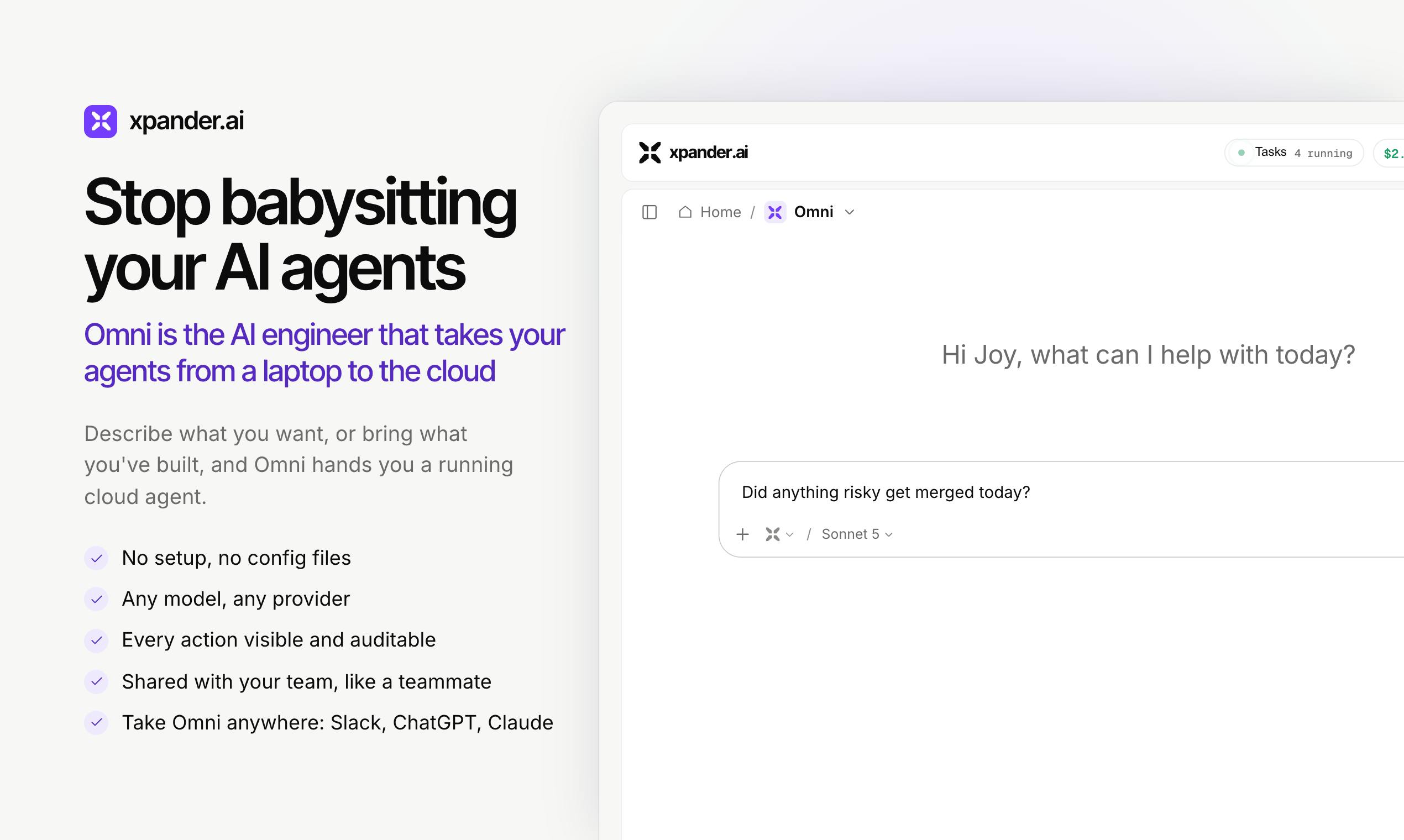
Omni deploys local AI agents to the cloud with automated testing, scheduling, and continuous optimization.
Omni by xpander topped Product Hunt by addressing a key pain point: AI agents stuck on local machines. Positioning itself as an "AI engineer," Omni lets users describe or import workflows, auto-wires tools with mock data testing, and delivers cloud-based agents that are schedulable, long-running, and team-shareable. It also offers continuous operations including automatic prompt optimization, model comparison, and failure debugging — bridging the notorious demo-to-production gap in AI agent development.
From "Babysitting" AI Agents to "Hosting" AI Agents
On Product Hunt's daily leaderboard, a product called Omni surged to the top with 188 votes (categorized under Slack, Artificial Intelligence & Virtual Assistants). Built by the xpander team, its tagline is provocatively straightforward — "Stop babysitting your AI agents."
This phrase precisely hits a pain point of today's AI workflows: many people's most powerful AI workflows still "live" inside Claude on their local machines, and tasks stop running the moment they close their laptops. Claude here refers to the large language model developed by Anthropic, with users typically initiating conversations and task orchestration through clients like Claude Desktop. The limitation of "running locally" is essentially a process lifecycle problem: when users close the application or shut their laptops, the operating system suspends or terminates the related processes, interrupting the AI workflow. This mirrors the classic distinction in traditional software engineering between "foreground scripts" and "background services (daemons)" — the former depends on user sessions, while the latter runs independently of user state. In enterprise scenarios, no critical business process should depend on the online status of a single personal device, which is the fundamental reason why moving to the cloud is an inevitable trend.
These workflows serve only you — they can't be scheduled, can't run for extended periods, and can't be shared with a team. Omni aims to solve this exact "last mile" problem — moving AI agents from your laptop to the cloud.
Omni's Core Features: Deploy AI Agents to the Cloud in Three Steps
According to official descriptions, Omni positions itself as an "AI engineer", not just another general-purpose chat assistant. Its core workflow can be summarized in three steps:
1. Describe or Import Your Requirements
You can either "describe what you want" in natural language or "bring what you've already built." This bidirectional compatibility means that whether you're a new user starting from scratch or a veteran who's already accumulated a set of Claude workflows locally, you can seamlessly onboard.
2. Automatic Wiring and Testing
Omni automatically "wires the tools and skills" and tests them on mock data. Mock data refers to test datasets that simulate the structure and format of real business data but don't contain actual sensitive information. In AI agent scenarios, mock testing carries special significance: since large language model outputs are non-deterministic (the same input may produce different outputs), unit tests alone can't cover all edge cases. Mock testing allows developers to verify whether the agent's tool chain is correct, whether API integrations work smoothly, and whether error handling is adequate — all without consuming real resources or affecting production data. This step represents a key value proposition of the product — it automates the integration and debugging work that previously required manual effort, lowering the barrier from prototype to production.
3. Deliver a Running Cloud-Based Agent
Ultimately, what Omni delivers is an agent truly running in the cloud: it can be scheduled, long-running, and shareable with your team. This means your AI workflows no longer depend on any single device — they become team-level infrastructure.
Continuous Operations: Keeping AI Agents "Healthy"
Another differentiating highlight of Omni is that it goes beyond "deployment" to handle continuous operations. According to official descriptions, it proactively performs the following:
-
Improving system prompts: Continuously optimizing agent behavior. System prompts are a special instruction layer in the large language model architecture, injected before user messages to define the model's role, behavioral boundaries, output format, and business rules. Unlike user prompts, system prompts are typically invisible to end users yet play a decisive role in model performance. In production-grade AI applications, writing system prompts is known as "Prompt Engineering" and has evolved into an independent technical discipline. Omni's claim to automatically optimize system prompts is essentially performing "meta-prompt engineering" — using AI to optimize AI's instructions. This approach is known academically as Automatic Prompt Optimization (APO), with research from institutions like Google DeepMind and Microsoft, but balancing optimization effectiveness with behavioral predictability in industrial deployment remains an open challenge.
-
Comparing different models: Helping users find the optimal balance between cost and performance. This corresponds to the increasingly important Model Routing strategy in current AI applications. Different large language models vary significantly in capability, latency, and pricing: taking mid-2025 market rates as an example, GPT-4o offers strong reasoning but at higher cost, Claude 3.5 Haiku is fast and inexpensive, while open-source models like the Llama series can be privately deployed to reduce long-term costs. In agent scenarios, not every step requires the most powerful model — simple information extraction might work fine with a lightweight model, while complex reasoning decisions need a flagship model. Automatically selecting the most cost-effective model at different task nodes, known as "Model Cascading" or "Hybrid Inference," has become an important optimization direction in AI engineering.
-
Debugging and fixing failed runs: Automatically diagnosing and correcting when a task fails.
This "self-maintenance" capability directly aligns with its "AI engineer" positioning. Traditionally, after deploying an LLM application to production, monitoring, tuning, and failure recovery all demand significant engineering team effort. Omni attempts to delegate this work to AI as well — which is the literal meaning of "Stop babysitting."
Why Cloud-Based AI Agents Deserve Attention
From an industry trend perspective, the AI field's center of gravity is shifting from "chatting" to "executing," from single-turn Q&A to sustainably running AI Agents. The technical foundation for this shift is the widespread adoption of "Tool Use / Function Calling" capabilities in large language models since 2023. Traditional chatbots could only generate text, whereas AI Agents with tool-calling capabilities can execute code, query databases, call APIs, manipulate file systems, and even control browsers. Mainstream models including OpenAI's GPT-4, Anthropic's Claude 3.5, and Google's Gemini all support this capability. Building on this, open-source frameworks like LangChain, CrewAI, and AutoGen have further lowered the barrier to multi-agent orchestration.
Yet the vast majority of agent projects hit the same bottleneck: demos are impressive, but productionization is painful. The "Demo to Production" gap exists primarily because demo environments tolerate high error rates, use simple data, and have short call chains, whereas production environments must handle concurrency, access control, error recovery, cost management, log auditing, and a host of other engineering concerns.
Omni's product design directly targets this gap. It packages the agent lifecycle — build, test, deploy, monitor, optimize — into a relatively complete pipeline. For individual developers, it lowers the cost of turning local scripts into persistent services; for teams, it provides a vehicle for sharing and collaboration.
It's worth noting that Omni is categorized under Slack, suggesting it may deeply integrate with team collaboration tools, allowing agent outputs to flow directly into daily workflows rather than remaining siloed in an isolated console.
A Measured Perspective: What Omni Still Needs to Prove
As a newly launched product on Product Hunt, Omni currently represents more of a vision and feature claims — actual performance remains to be validated over time. Several questions worth watching:
- Reliability of automatic wiring: Real business scenarios are far more complex than mock data, and the success rate of automatic integration remains unknown;
- Boundaries of "auto-improving prompts and auto-fixing": AI fixing AI can itself introduce unpredictable behavior, and ensuring controllability and auditability is crucial;
- Cost and lock-in risk: Long-running cloud-based agents mean ongoing compute costs, and platform lock-in is also a legitimate concern.
Nonetheless, the core proposition Omni raises is both valid and important: When AI evolves from a tool into an "employee," we need more than just stronger models — we need a complete engineering framework to keep it working reliably. Whether it can truly deliver on its promise to "stop babysitting" is well worth continued observation.
Related articles

Kira Community: How an AI Creation Tool Is Transforming Into a Creator Community
Kira Community pivots from an AI image/video generation tool to a creator community, using hashtags to organize content and help creators build portfolios and find peers.
DeepSeek V4 Pro Real-World Test: 7 Projects Reveal Its True Coding Ability and Value
Real-world test of DeepSeek V4 Pro across 7 projects covering frontend, backend, 3D games, and long tasks. Frontend lags behind Claude, but at 1/180th the cost.
Google Search Launches Five AI Learning Features: A Complete Guide to Test Prep Assistants and Smart Learning Platforms
Google Search launches five AI learning features covering standardized test prep, structured knowledge review, and interactive practice — transforming search into a smart learning platform.