OmniAct: A Single Policy Mastering One Million Embodiments via Kinematic Conditioning
OmniAct conditions on kinematic graphs and uses a single flow-matching policy to generate embodiment-specific manipulation behavior for a million robot morphologies.
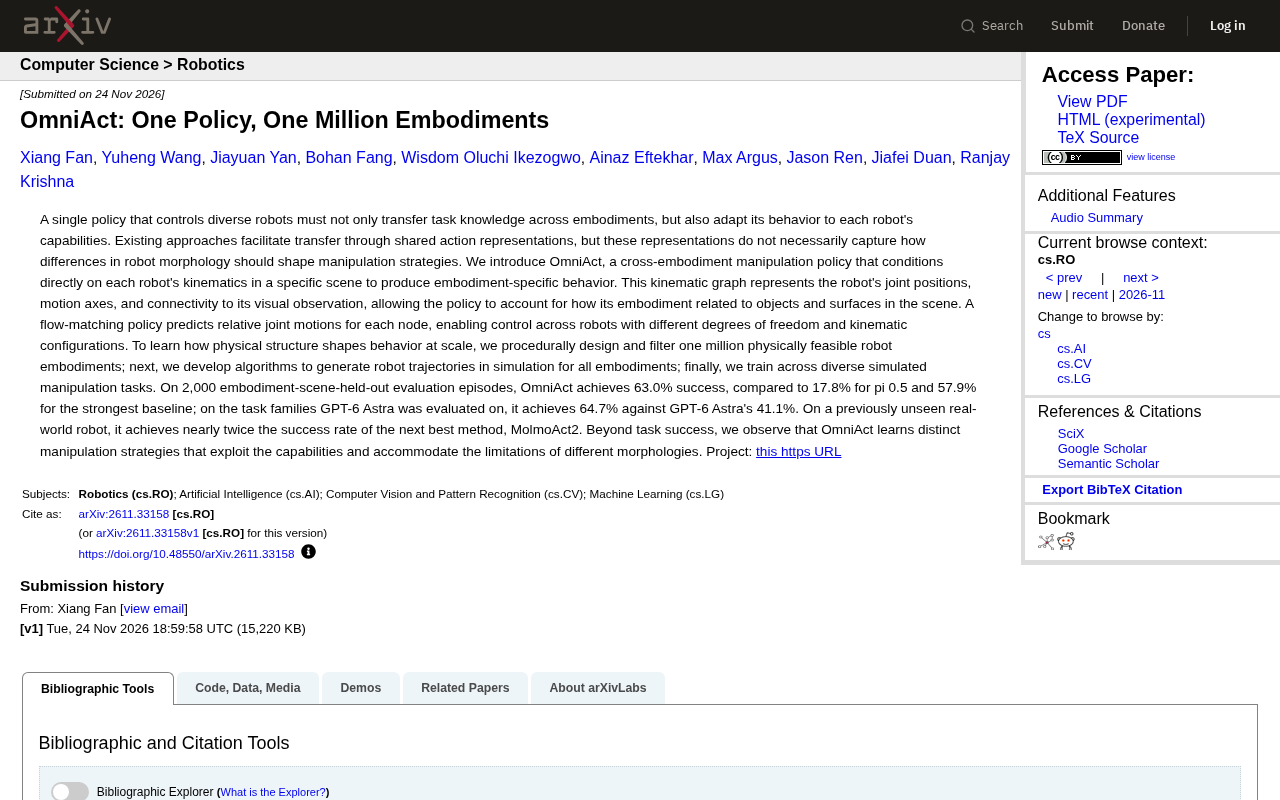
OmniAct proposes a new path for cross-embodiment robotic manipulation: instead of relying on shared action representations, it constructs robot kinematics as a graph structure used directly as policy input. Each joint is a node, connections are edges, and the graph is aligned with visual observations so the policy can reason about the spatial relationship between body and scene. A flow matching policy then predicts relative joint motion per node, naturally adapting to different degrees of freedom and configurations. On the training side, one million physically feasible morphologies are procedurally generated and filtered, with trajectories automatically generated in simulation. It achieves 63.0% success on 2,000 held-out morphology-scenario episodes, far exceeding the strongest baseline of 57.9% and pi 0.5's 17.8%; on an unseen real robot its success rate is nearly twice that of the next-best method MolmoAct2, and it exhibits differentiated strategies that exploit morphological capabilities and avoid limitations.
Cross-embodiment robotic manipulation has long been a core challenge for generalist robot policies: a single policy must transfer task knowledge across different robot bodies while also adapting its behavior to each body's capabilities. Existing methods mostly rely on shared action representations to enable transfer, but such representations may not capture how differences in robot morphology should shape manipulation policies. OmniAct proposes a different path—directly conditioning the policy on robot kinematics, letting the same policy generate embodiment-specific behavior for each morphology.
From Shared Action Spaces to Kinematic Conditioning
The traditional approach to cross-embodiment transfer is to find a universal action abstraction that lets different robots "speak the same language." The problem is that action representations flatten morphological differences—yet it is precisely these differences that determine what a robot can and cannot do in a given scenario. The same grasp action means completely different joint coordination for a multi-fingered dexterous hand versus a two-finger gripper.
OmniAct's approach is to construct each robot's kinematic information in the current scene as a kinematic graph, where nodes correspond to joint positions and motion axes, and edges represent the connectivity between joints. This graph is aligned with visual observations, so the policy can reason about "what is the relationship between my body and the objects and surfaces in the scene," rather than blindly transferring within an abstract action space.
Kinematic graph is the core representation of OmniAct, and understanding it helps grasp the essential difference from shared action representations. A kinematic graph is a graph-structured description of the robot's body structure: each node corresponds to a joint and carries information such as the joint type (revolute or prismatic), position, and motion axis direction; each edge represents the physical connection (link) between two joints. Unlike a vector that merely encodes joint angles, a kinematic graph preserves topological and geometric relationships, so it can distinguish structural differences such as a "six-DOF robotic arm" versus a "seven-DOF robotic arm with a dexterous hand." Node features in the graph are typically also aligned with visual features of the current scene, enabling the policy to reason about the spatial relationship between the body and objects, rather than transferring within an abstract action space.
Flow Matching Policy and Degree-of-Freedom-Agnostic Control
On top of the kinematic graph, OmniAct employs a flow matching policy to predict relative joint motion for each node. The advantage of relative motion prediction is that it naturally adapts to different degrees of freedom and kinematic configurations—however many joints the robot has and however they are connected, the graph structure reflects it, and the policy does not need to design separate output layers for each morphology.
The fundamental difference from shared action representations is that actions are no longer abstract quantities detached from the body, but relative quantities attached to a specific kinematic structure. What the policy learns is "how this joint should move under this structure," not "what action this task usually corresponds to."
Flow matching is a class of generative modeling methods that has attracted attention in robot policy learning in recent years. The basic idea is to learn a continuous-time vector field that transports a simple prior distribution (such as Gaussian noise) along a probability path to the target action distribution; training optimizes by regressing the conditional vector field (i.e., the "flow" pointing from noise to the real action), and sampling generates actions by numerically integrating an ordinary differential equation. Compared with diffusion policies, flow matching can typically generate high-quality actions with fewer sampling steps and lower inference latency; compared with deterministic regression policies, it can express multimodal action distributions. OmniAct uses flow matching to predict relative joint motion on kinematic graph nodes, aligning the generation process with the graph structure.
Procedural Generation of One Million Embodiments and Large-Scale Training
For the policy to truly learn how physical structure shapes behavior, the morphological diversity of the training data must reach scale. The research team procedurally designed and filtered one million physically feasible robot morphologies, then developed an algorithm to generate trajectories for all morphologies in simulation, ultimately completing training on a diverse set of simulated manipulation tasks.
The key to this data pipeline is not the quantity itself, but that the filtering step ensures the physical feasibility of morphologies, preventing the policy from learning incorrect priors from unrealizable configurations. The combination of one million morphologies and diverse tasks forms the foundation of OmniAct's generalization capability.
Procedural embodiment generation refers to constructing robot body structures in bulk using algorithms rather than manual design. A typical approach is to sample link lengths, joint types, and connection topologies, then apply physical feasibility constraints (such as joint limits, self-collision checks, and workspace reachability) for filtering, eliminating configurations that cannot run stably in simulation. The value of this is covering a morphology space that is difficult to exhaustively enumerate by manual design, while ensuring every sample is physically realizable. Combined with an automated trajectory generation pipeline, manipulation data can be synthesized for each morphology in simulation, thereby converting "morphological diversity" into a trainable data scale. This idea is in line with domain randomization, but the object of randomization extends from visual and physical parameters to the robot body structure itself.
Evaluation Results: Dual Advantages Across Morphologies and Tasks
In 2,000 held-out morphology-scenario evaluation episodes, OmniAct achieves a 63.0% success rate, compared with 17.8% for pi 0.5 and 57.9% for the strongest baseline. On the task families evaluated by GPT-6 Astra, OmniAct reaches 64.7%, versus 41.1% for GPT-6 Astra. On a previously unseen real-world robot, its success rate is nearly twice that of the next-best method, MolmoAct2.
The significance of these numbers is that they cover three dimensions simultaneously: held-out morphologies, held-out scenarios, and transfer from simulation to real bodies. The performance on real robots is particularly noteworthy, showing that kinematic conditioning brings not only in-simulation generalization but also the ability to transfer to bodies outside the training distribution.
Held-out evaluation is a key setting for measuring generalization: the morphologies and scenarios used in evaluation never appear during training, so the success rate reflects the policy's ability to adapt to new bodies and new environments rather than its fit to the training distribution. The "morphology-scenario held-out episodes" in the article simultaneously change the robot structure and the task scenario, making it harder than holding out only scenarios or only morphologies. When comparing with baselines, note that generalist policies such as pi 0.5 rely on shared action representations and degrade noticeably when encountering bodies with large differences in degrees of freedom or topology; kinematic conditioning methods take the body structure directly as input, so performance degrades more gently on new morphologies. The real-robot experiments further test the ability to transfer from simulation to reality.
Differentiated Manipulation Strategies Shaped by Morphological Differences
Beyond task success rates, the research team observed that OmniAct learns differentiated manipulation strategies that exploit the capabilities of different morphologies and avoid their limitations. This reveals more about the nature of the method than the numbers themselves: the policy does not force the same set of actions onto all robots, but generates embodiment-specific behavior based on kinematic structure.
From a broader perspective, OmniAct suggests a design principle for generalist robot policies—rather than seeking a universal abstraction in action space, make the body structure itself an input to the policy. When morphology becomes a condition rather than an obstacle, the goal of a single policy covering massive numbers of bodies has a feasible foundation.
Project homepage: https://omniact.github.io/
Related articles

The Gemini 4 Trio and 3.8 Flash: A Full Comparison of Positioning, Pricing, and Benchmarks
A comparison of Gemini 4 Neon, Carbon, Argon, and Gemini 3.8 Flash: positioning, context, API pricing, Artificial Analysis and Arena benchmark scores, and available entry points.

AI Coding Model Leaderboard: Opus 5.5 Crowned, Gemini Neon Stages a Comeback
Tech blogger Matthew Berman releases an AI coding model tier list: Claude Opus 5.5 holds S-tier, Gemini Neon surprises with A-tier, OpenAI Astra lands B-tier. How do open-source models like DeepSeek fare? We break down the scoring logic and practical takeaways.

New Jersey Joe Sandwich: Meat and Coleslaw on Triple-Decker Rye
New Jersey Sloppy Joe isn't a ground beef burger—it's triple-decker rye bread with meat, Swiss cheese, and coleslaw, plus Russian dressing. Learn the authentic Essex County method and family recipe.