OmniCam: Blender-Style 3D Camera Control in ComfyUI
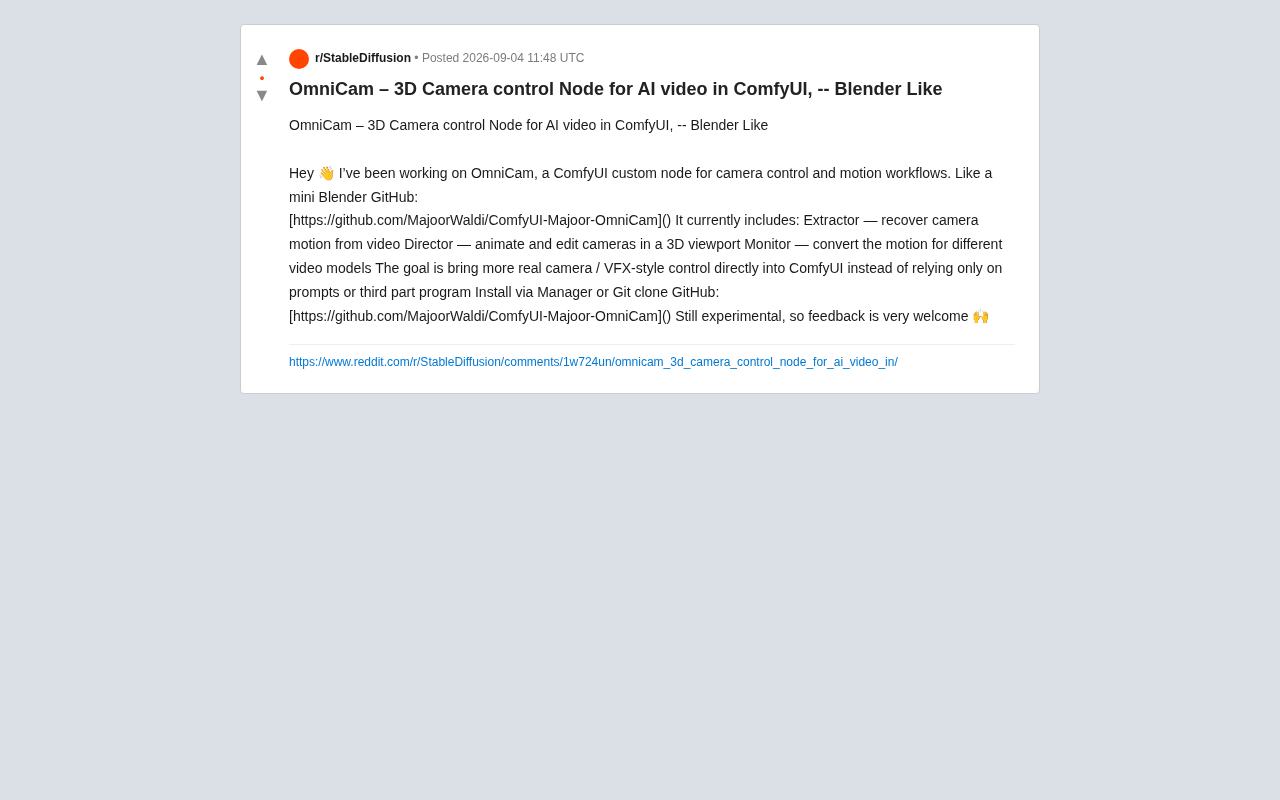
OmniCam brings professional 3D camera motion control to AI video generation in ComfyUI.
OmniCam is an open-source ComfyUI custom node that brings Blender-style 3D camera control to AI video generation. It features three core modules: Extractor for recovering camera trajectories from existing videos, Director for visually editing camera motion in a 3D viewport, and Monitor for converting motion data into formats compatible with various AI video models. The tool represents a shift from prompt-driven to parameterized visual control in AI filmmaking.
When AI Video Meets Professional Camera Control
In the world of AI video generation, creators have long faced a thorny problem: how do you precisely control camera movement in your shots? The traditional approach relies almost entirely on text prompts—vague descriptions like "slow push in" or "orbit shot" to guide the model, with unpredictable results. Now, a ComfyUI custom node called OmniCam is bringing professional filmmaking camera control concepts into the AI video workflow.
According to developer MajoorWaldi's introduction on Reddit, OmniCam is positioned as a "mini Blender"-style tool, aiming to embed real camera motion and VFX-level control directly into ComfyUI, so creators no longer need to bounce back and forth between prompts and third-party software.
A brief note on ComfyUI for context: ComfyUI is an open-source, node-based workflow interface for image and video generation. Users connect nodes with different functions to build complex AI generation pipelines. Unlike traditional WebUIs such as Automatic1111, ComfyUI's core strength lies in its modular architecture—every processing step is represented as a visual node, giving users precise control over everything from noise sampling to VAE decoding. This architecture is naturally suited for plugin extensions, giving rise to a massive custom node ecosystem, and OmniCam is one of the latest professional-grade additions to it.
Breaking Down OmniCam's Three Core Modules
OmniCam consists of three functional modules that form a complete camera motion pipeline—from "extraction" to "editing" to "conversion."
Extractor: Recovering Camera Motion Trajectories from Video
The Extractor module is responsible for recovering camera motion trajectories from existing videos. Creators can take a piece of live-action footage or reference video and reverse-engineer the camera movement data from it. This capability is immensely valuable in practice—you can directly "borrow" the camera work from a film and apply it to your own AI-generated footage, without having to manually design camera paths from scratch.
From a technical standpoint, recovering camera motion from video relies on SfM (Structure from Motion) or Visual Odometry techniques from the computer vision field. The core principle involves detecting and matching feature points across consecutive frames, then using epipolar geometry constraints to estimate the camera's pose changes in 3D space. In recent years, deep learning-based methods—such as DROID-SLAM and DUSt3R—have dramatically improved the robustness and accuracy of motion estimation, making it possible to extract professional-grade camera motion data even from ordinary handheld footage. OmniCam's Extractor module packages these technologies into a ComfyUI node, significantly lowering the barrier to entry.
Director: A Camera Direction Tool in 3D Viewport
The Director module is the most "Blender-like" part of the entire tool. It allows users to animate and edit the camera directly within a 3D viewport. This visual approach is highly consistent with the workflow logic of traditional filmmaking software: you can see the camera's position, orientation, and motion path in 3D space and make intuitive adjustments. Compared to blindly entering prompts, this WYSIWYG control method is far more aligned with professional creators' habits.
In traditional filmmaking, camera motion design is an extremely precise craft. Directors and cinematographers must consider focal length, motion speed curves, keyframe interpolation methods, and many other parameters. The Director module brings this professional mindset into AI video creation, meaning creators can set keyframes and adjust Bézier curves to precisely control camera acceleration, deceleration, and motion trajectories—just as they would in Blender or Maya—rather than relying on the model's uncertain interpretation of natural language.
Monitor: Adapting to Different AI Video Models
The Monitor module addresses the compatibility problem—it's responsible for converting camera motion data into formats recognizable by different video models. With numerous AI video generation models available today, each accepts camera control signals differently. Monitor allows the same motion design to be flexibly exported to multiple models, eliminating redundant work.
The necessity of this module stems from the significant fragmentation in camera control interfaces across current AI video models. For example, models like Wan2.1 support camera extrinsic matrix injection (in 4×4 transformation matrix form) via CameraCtrl conditioning, while some models accept optical flow maps or depth map sequences through ControlNet to implicitly convey motion information. Others use specialized formats like Plücker coordinates (a mathematical representation that uses six-dimensional vectors to describe ray directions in 3D space). Monitor acts as a unified translation layer, so creators only need to design camera motion once and can then adapt it to multiple generation backends—especially practical given the rapid pace of model iteration today.
Why OmniCam Deserves Your Attention
The significance of OmniCam lies not in any single feature, but in the important trend it represents for AI video creation: the shift from prompt-driven to parameterized, visual control.
Early AI video generation was almost entirely a "black box" affair—creators entered text, the model produced output, and the process in between was uncontrollable and unreproducible. As the technology matures, professional creators increasingly need fine-grained control. Camera motion, as one of the core elements of cinematic language, directly determines the professionalism of the final product. A simple example: for the same scene, using a slow dolly in versus a zoom in conveys entirely different emotions—the former changes the spatial relationship between the viewer and the subject, while the latter compresses the perspective between foreground and background. These subtle differences in cinematic language are nearly impossible to express precisely through text prompts, but parameterized control makes it possible.
By connecting the Extractor, Director, and Monitor stages, OmniCam effectively builds a camera workflow within the ComfyUI open-source ecosystem that approaches traditional DCC (Digital Content Creation) software. DCC tools include Blender, Maya, Houdini, and other traditional 3D production applications that handle core tasks like modeling, animation, and rendering in the film industry. A clear convergence trend is emerging in the industry: on one hand, DCC software is integrating AI capabilities (such as Blender's AI denoiser and procedural generation plugins); on the other, AI generation tools are adopting the professional control paradigms of DCC software. OmniCam sits right at the intersection of this convergence. This approach of "bringing VFX tools into the AI pipeline" is becoming a key pathway for improving the practicality of AI video—the goal being to make AI generation capabilities a standardized, callable module within traditional production pipelines, rather than a standalone black box.
Installation and Current Status
For users who want to try it out, OmniCam's deployment barrier is fairly low. The developer provides two installation methods:
- Search and install directly through ComfyUI's Manager (ComfyUI Manager is a community-maintained plugin management tool, similar to VS Code's extension marketplace, allowing users to install and update custom nodes with one click)
- Manually clone from the GitHub repository using Git clone
The open-source project is available at github.com/MajoorWaldi/ComfyUI-Majoor-OmniCam.
It's worth noting that the developer has explicitly stated the project is "still experimental" and is actively soliciting community feedback. This means the current version may have stability issues or incomplete features. However, precisely because of its open-source and early-stage nature, community users have the opportunity to participate in the tool's iterative development. For users with some ComfyUI experience, the cost of trying it out is low; for beginners, it's recommended to familiarize yourself with ComfyUI's basic node workflow before diving in.
Conclusion
OmniCam may not yet be a mature commercial-grade solution, but it clearly points toward the future direction of AI video creation: more professional, more controllable, and closer to film industry workflows. As more tools like this emerge within open-source ecosystems like ComfyUI, the boundaries between AI video and traditional filmmaking are being gradually dissolved. For creators following the cutting edge of AI video, tools like OmniCam that bring professional camera control into AI workflows are well worth keeping an eye on.
Related articles
OpenAI Declares the AGI Era Has Arrived: Conceptual Controversies and Technical Realities
OpenAI launches GPT-6 Astra claiming the AGI era has arrived, sparking controversy. Deep analysis of AGI definition ambiguity, technical progress realities, industry standards battle, and practical impacts on users and developers.
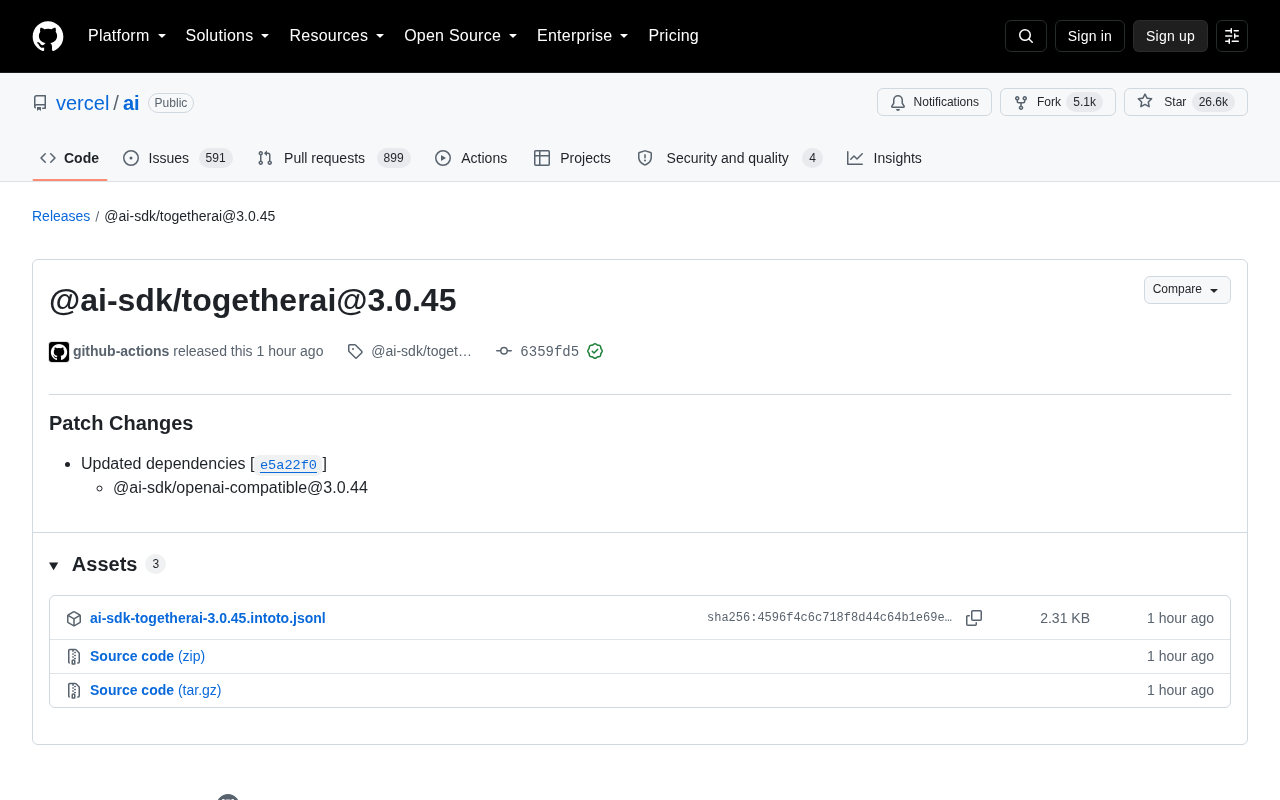
Vercel AI SDK TogetherAI Adapter 3.0.45 Update Analysis
Analysis of @ai-sdk/togetherai 3.0.45 patch update covering dependency sync, OpenAI compatibility layer architecture, and semantic versioning strategy in Vercel AI SDK.
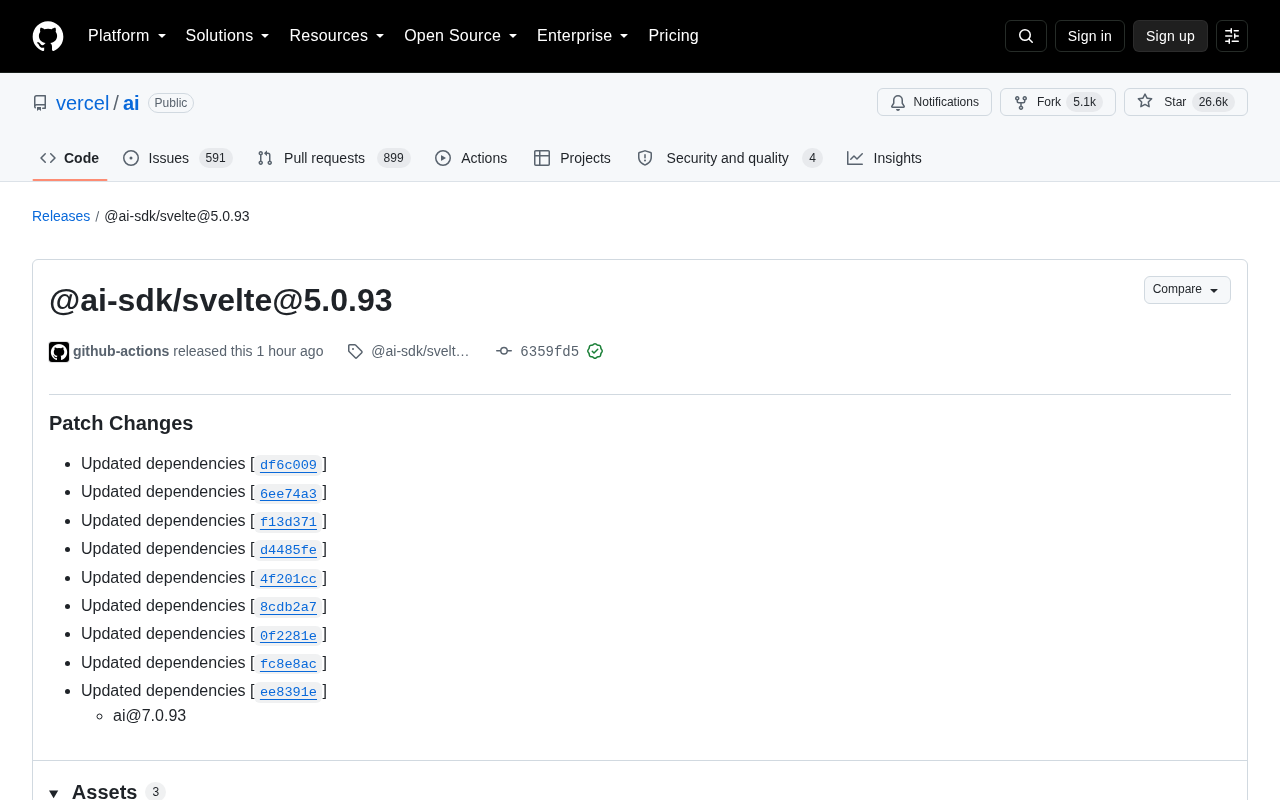
Deep Dive into Vercel AI SDK Svelte 5.0.93 Release Update
In-depth analysis of Vercel AI SDK Svelte 5.0.93 patch update, covering multi-framework adaptation, dependency sync, and automated release pipelines for Svelte AI app development.