Omnigraph: An Open-Source Graph Database Built for AI Agents

Omnigraph is an open-source object-storage-native graph database that governs agents' shared knowledge with Git-style branching and merging.
Omnigraph is an open-source graph database designed for AI agents, running on users' own S3-compatible object storage without a hosted memory API. It introduces a Git-like branching, review, and merge workflow to prevent misinformation from contaminating shared context, combines graph structure with a typed ontology, and unifies semantic, keyword, and hybrid search with graph traversal in a single query. It received 122 votes and ranked third on Product Hunt.
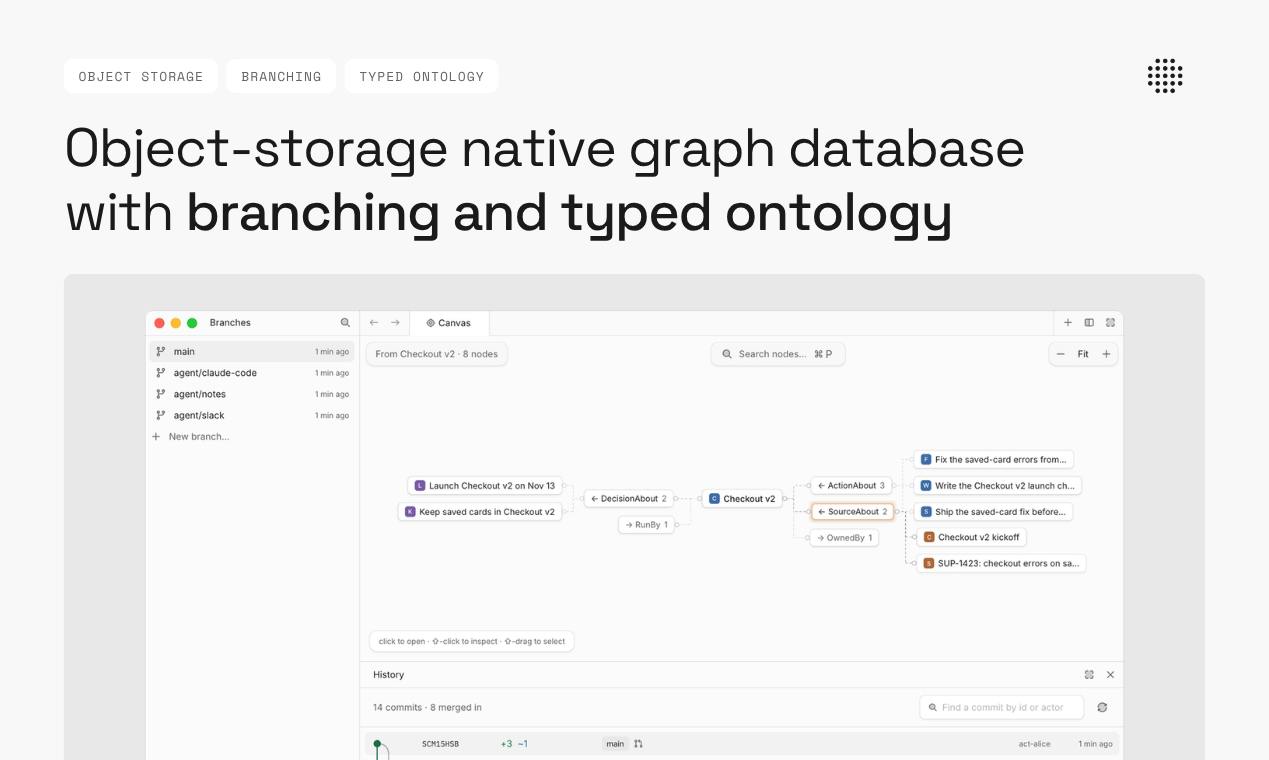
Collaboration among AI agents is shifting from simple message passing toward the construction of shared knowledge bases, but safely managing this shared knowledge and preventing misinformation from contaminating the global context has always been a challenge. Omnigraph gained rapid attention after launching on Product Hunt. It is an open-source, object-storage-native graph database designed specifically for AI agents, and its core highlight is the introduction of Git-like branching, review, and merge mechanisms, so that every write an agent makes to shared knowledge can be validated before it takes effect.
Why do agents need a graph database?
Traditional vector databases excel at semantic retrieval but struggle to express complex relationships between entities; relational databases have rigid structures and are unsuitable for dynamically evolving knowledge graphs. Graph databases are naturally suited to storing entities and their associations, and Omnigraph goes further by combining graph structure with a typed ontology, providing agents with a structured shared memory. Every piece of data an agent writes must conform to predefined ontology constraints, which reduces the generation of dirty data at the source.
Typed Ontology is a core concept in knowledge engineering, referring to a formal specification system that defines entity types, attributes, and their interrelationships within a domain. In an ontology, each entity (such as "person," "company," or "order") is assigned an explicit type, attributes have value-range constraints, and relationships have direction and cardinality restrictions (for example, an "employment" relationship connects a person and a company, and a person can be employed by multiple companies). Unlike free-form property graphs, a typed ontology requires all written data to conform to a predefined schema, which is similar to a relational database schema but more flexible, capable of expressing inheritance, polymorphism, and complex associations. For multi-agent systems, the ontology serves as a shared vocabulary, ensuring that different agents understand the same concept consistently, thereby reducing semantic ambiguity and dirty data. Omnigraph's combination of graph structure and typed ontology is equivalent to adding a "syntax check" to agents' shared memory, validating structural legality at write time rather than cleaning up afterward.
Branching, review, and merging: making knowledge collaboration as controllable as code
Omnigraph's most appealing design is bringing the Git workflow to graph data. Any modification an agent makes to the graph first creates a branch, experiments or reasoning happen on the branch, and once confirmed correct, a merge request is initiated. Other agents or humans can review the changes, and only after approval do they enter the main graph. This means agents can boldly explore and trial-and-error without worrying about damaging the shared context. For scenarios requiring multiple agents to collaboratively complete complex tasks, this mechanism provides the necessary safety boundary.
The Git workflow is centered on distributed version control: each modification is made on an independent branch, changes are recorded as commit snapshots, and then merged into the mainline via a merge request after code review. This mechanism can be transferred to graph data because changes to a graph database are essentially additions, deletions, and modifications of nodes and edges, which can be tracked and reviewed like file diffs. After Omnigraph introduces this model, each write by an agent is equivalent to a "commit," branches isolate experimental reasoning from the stable state of the main graph, and pre-merge review acts as a quality gate. This design draws on the idea of "optimistic concurrency control": agents can explore in parallel without blocking each other, and conflicts are explicitly resolved at merge time. Compared with database transactions, the branch model is better suited to long-running reasoning tasks, because transactions typically require holding locks for short periods, whereas branches allow asynchronous review and collaboration.
Object-storage native and unified query
Omnigraph runs directly on users' own S3-compatible object storage and does not require a hosted memory API or proprietary storage service. This lowers the barrier to data deployment and aligns with open-source tools' commitment to data sovereignty. In terms of query capabilities, it integrates semantic search, keyword search, and hybrid search with graph traversal into a single query, so agents can simultaneously obtain embedding-based similarity matching and relationship-based path queries without stitching together results across multiple systems.
Hybrid Search refers to a retrieval method that combines semantic vector similarity with exact keyword matching, typically merging and ranking the two result sets using algorithms such as Reciprocal Rank Fusion. Semantic search excels at capturing content with similar intent but different wording, while keyword search ensures that exact matches for proper nouns, codes, and the like are not lost. In graph database scenarios, hybrid search also needs to work in concert with graph traversal: first locate entry nodes via vectors or keywords, then expand along relationship edges, thereby leveraging both content similarity and structural association. Omnigraph integrates these three types of operations into a single query, avoiding the overhead of agents stitching results back and forth across multiple systems and reducing reasoning errors caused by cross-system data inconsistency.
Open-source ecosystem and early feedback
Omnigraph received more than 120 votes on Product Hunt, ranking third for the day, with comment discussions focusing on the actual overhead of the branch model and the flexibility of ontology design. As an open-source project, it allows developers to deploy and extend it themselves, making it suitable for teams that are sensitive about data privacy or require deep customization. However, although the typed ontology improves data quality, it also requires teams to invest effort in designing a reasonable ontology structure early on, which may pose a certain burden during the rapid prototyping stage.
Overall, Omnigraph addresses the gap in knowledge governance within multi-agent collaboration, offering a noteworthy solution through its branch-and-merge workflow and object-storage-native architecture. For AI teams building shared memory systems, it provides a new self-hostable and auditable option.
One-line Summary
Omnigraph is an open-source object-storage-native graph database that governs agents' shared knowledge with Git-style branching and merging.
Paragraph Summary
Omnigraph is an open-source graph database designed specifically for AI agents, running on users' own S3-compatible object storage without requiring a hosted memory API. To address the challenge of misinformation contaminating the global context in multi-agent shared knowledge bases, it introduces a Git-like branching, review, and merge workflow: each agent write first creates a branch, and after experimental confirmation a merge request is initiated, entering the main graph only after review approval, thereby providing a safety boundary. Technically, it combines graph structure with a typed ontology to constrain dirty data at the source, and integrates semantic search, keyword search, and hybrid search with graph traversal into a single query. Launched on Product Hunt, it received 122 votes and ranked third; early feedback focused on branch overhead and ontology design flexibility, making it suitable for AI teams that need self-hostable, auditable shared memory.
Related articles

Daybreak Red Deployment Guide: A Reference Architecture for Supervised Security Investigation
A breakdown of the Daybreak Red reference architecture: security control design, deployment configuration process, and runtime monitoring for supervised security investigation.

Gemini 4 Neon Tops the Models Engineering Index
Gemini 4 Neon tops the Models Engineering Index, sparking Hacker News debate over ranking credibility and evaluation methods. Here's what it means for developers.

Apple's Self-Developed AI Agent: An Agent That Can Operate Your Mac Is Coming
Apple is reportedly developing an AI agent that can operate a Mac, targeting Meta Muse, Claude, OpenAI Dots, and others. This article analyzes Apple's system-level advantages, the competitive landscape, and likely rollout paths in the agent race.