OmniRoute Breakdown: How a 57K-Star AI Unified Gateway Manages Multi-Provider Routing
How OmniRoute's 57K-star AI gateway unifies multi-provider routing with smart fault isolation and auto scoring.
OmniRoute is an open-source local AI gateway with 57K GitHub stars that lets developers manage multiple AI providers through a single OpenAI-compatible endpoint. Its standout features include three-layer fault isolation (provider, connection, and model level), a 15-factor automatic routing scorer optimized for different modes like coding and low-latency, and 12 combinable context compression engines. Best suited for developers juggling multiple AI coding tools or small teams needing centralized routing and failover management.
One Entry Point to Manage All AI Providers
If you use multiple AI coding tools simultaneously, the most annoying part often isn't writing code itself. Once one account gets rate-limited, you have to reconfigure addresses, API keys, and model names across multiple setups. This fragmented maintenance cost grows linearly with the number of providers you connect. OmniRoute is a local AI gateway designed precisely for developers facing this problem.
Its core idea is simple: connect multiple AI providers and accounts to a single OpenAI-compatible endpoint, let the system automatically select healthy routes, and retry other candidates on failure. What you get isn't a new model, but a routing layer for centrally managing model entry points. Claude Code, Codex, Cursor, and any other client that supports custom OpenAI-compatible endpoints can all point to this unified entry.
The "OpenAI-compatible" aspect is an important technical prerequisite. OpenAI's Chat Completions API has become the de facto standard interface format in the AI industry — virtually all major LLM providers, including Anthropic, Google, Mistral, DeepSeek, and others, offer API endpoints compatible with the OpenAI format, either natively or through protocol translation middleware. Clients only need to implement one request format (with parameters like model, messages, temperature, etc.) to connect to models from different vendors. OmniRoute leverages this ecosystem trend: it exposes a standard endpoint locally, so downstream clients don't need to care which provider the request actually gets routed to. This design pattern is called an API Gateway in microservices architecture, and its application in the AI domain is becoming increasingly common.
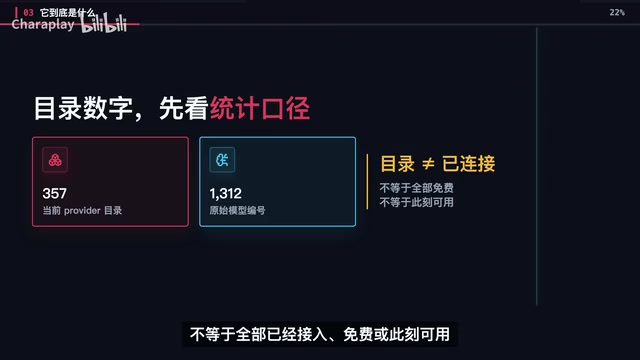
The default address is the /v1 endpoint on local port 20128. As of August 28, 2026, the GitHub snapshot shows the project has approximately 57,000 Stars, with about 350 Provider entries listed in the directory and over 1,300 raw model IDs in the model registry. It's important to note that these are directory counts — they don't mean all entries are fully integrated, free, or currently available.
Why Simple Address Forwarding Can't Handle Multi-Provider Management
The pain points of traditional approaches go beyond tedious configuration. Each AI provider has its own quotas, rate-limiting windows, error formats, and model naming conventions. When one account returns a 429, it might just mean that particular key needs temporary cooldown; when a model returns a 404, it might just mean that model isn't authorized for that account.
Here it's important to understand the special significance of HTTP 429 status codes in AI API scenarios. HTTP 429 Too Many Requests is the standard status code servers use to tell clients their request rate is too high, usually accompanied by a Retry-After header indicating the cooldown period. In AI API scenarios, 429 errors can occur at multiple levels: account-level (the entire API Key's RPM/TPM quota is exhausted), model-level (a specific model's global concurrency limit is reached), or organization-level (the entire organization's usage cap is hit). Different levels of 429 imply completely different failure scopes — and this is exactly what simple forwarding tools cannot distinguish.
The critical issue is: if you treat every error as a complete provider failure, you'll take down links that are still perfectly usable, wasting a large amount of available resources through false positives.
So a truly useful AI gateway can't just do address forwarding. It must determine which candidates are currently available, which are healthier, which have more remaining quota, which are better suited for coding tasks, and at what level a failure actually occurred. This is the core value that distinguishes OmniRoute from simple proxy tools.
Three-Layer Fault Isolation Mechanism
When handling failures, OmniRoute doesn't simply blacklist an entire provider. Instead, it breaks faults down into three layers, confining the impact to the smallest possible scope:
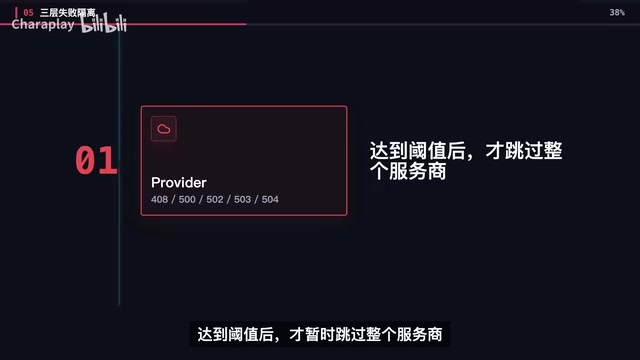
- Provider Circuit Breaking: When upstream returns errors like 408, 500, 502, 503, or 504, the system accumulates failure counts and only temporarily skips the entire provider after reaching a threshold.
- Per-Connection Cooldown: If a 429 is determined to be account-level rate limiting, only that specific key is cooled down — other connections continue working normally.
- Per-Model Locking (disabled by default, configurable): When a 429, 404, or widespread error is clearly model-level, only the specific combination of that provider, connection, and model gets locked.
This layered design draws from the classic Circuit Breaker Pattern in microservices architecture. This pattern was first systematically described by Michael Nygard in his book Release It! and later widely popularized by Netflix's Hystrix library. A circuit breaker has three states: closed (requests pass through normally), open (requests are directly rejected to protect upstream), and half-open (a small number of requests are tentatively allowed through to detect recovery). OmniRoute's innovation is that instead of maintaining a single circuit breaker at the provider level, it maintains independent state machines at three granularities — provider, connection (key), and model — preventing failures at one level from cascading upward and causing false kills.
The logic behind this fault isolation design is clear: one model being down doesn't mean the account is down; one account being rate-limited doesn't mean the entire provider is down. The system only tries other candidates when the error is a switchable target-level failure. Of course, the prerequisite is that healthy targets still exist in the candidate pool — when all upstreams are unavailable, the gateway can't conjure answers out of thin air.
Automatic Routing Mode: OmniRoute's Most Core Capability
OmniRoute's most noteworthy capability is its automatic routing mode. You don't need to manually configure a fixed route first — coding requests directly use "auto coding mode," and the gateway dynamically builds a virtual candidate pool from currently available connections, then scores and ranks the candidates.
According to the source code and routing documentation, the scoring system includes 15 factors. Core factors include health status, quota, cost, latency, task fitness, and stability, while also covering dimensions like context and image availability. Two of these factors have a default weight of 0.
This multi-factor scoring approach falls under the category of Weighted Multi-Attribute Decision Making. Traditional load balancing strategies — such as Round Robin, Least Connections, and Weighted Random — typically focus on a single dimension. In AI API scenarios, however, selecting the optimal upstream requires simultaneously considering multiple competing objectives: there's a trade-off between low latency and high quality, and another between low cost and large context windows. By adjusting the weight coefficients of different factors for different modes, the system can achieve fundamentally different optimization directions within the same scoring framework — similar to multi-objective ranking in recommendation systems, where the core challenge is whether the weight calibration truly reflects users' actual preferences.
Different modes have different optimization directions:
- Normal Auto Mode: Favors balance
- Coding Mode: Prioritizes coding task fitness
- Fast Mode: Favors low latency
- Budget Mode: Favors low cost
It's important to emphasize that these are optimization directions, not absolute guarantees. You can also manually create custom fallback chains (Combos), sorted by priority, round-robin, current usage, or cost. But for most people, using auto mode is sufficient — the client simply declares the task type, and the gateway decides which route to take based on current state.
A Concrete Usage Scenario
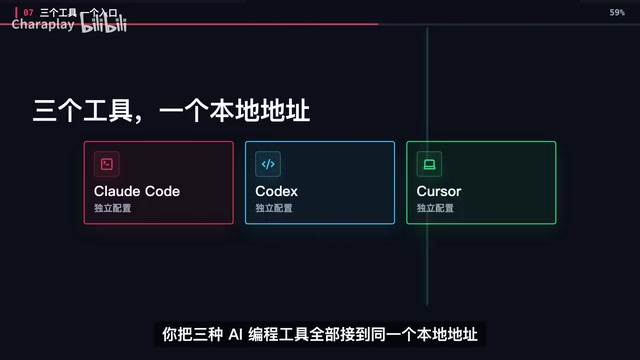
Imagine you connect three AI coding tools to the same local address, with all coding requests using auto coding mode. The first request goes through Candidate A. When that account enters quota cooldown, the next request automatically skips it and selects the healthy Candidate B.
The three tools no longer need to maintain their own provider lists individually. You only need to update connections, quotas, and routing rules in OmniRoute — client configurations stay untouched. This is where it truly saves maintenance cost: completely decoupling client entry points from upstream selection.
Context Compression and Deployment Considerations
The project also offers context compression, with 12 combinable engines listed in the official documentation. The default stacking mode first processes command, test, and build outputs, then handles repetitive natural language — primarily suited for duplicate logs, excessively long tool returns, and recurring context.
Context compression is an active area in current AI engineering, with several main technical approaches: rule-based deduplication and trimming (removing duplicate lines, truncating overly long outputs), summary-model-based semantic compression (using a small model to extract key points first), and token-level attention sparsification. OmniRoute's 12 combinable engines lean more toward engineered rule-based compression — first identifying content types (command output, test logs, natural language), then applying different compression strategies to different types. The advantage of this approach is strong determinism and no additional inference latency, but it has limited capability for handling semantic-level redundancy. The inference cost of large language models is approximately linearly related to the number of input tokens, and in coding scenarios — where compilation error logs and test outputs can easily run to thousands of lines — the cost savings from compression can be very significant.
The official savings range cited is 15% to 95%, but this only applies to redundant or particularly long content. Repetitive logs might see large savings, while ordinary short text might see almost none, and aggressive compression requires first evaluating answer quality. This percentage comes solely from official documentation and has not been independently verified.
The "local-first" claim is also easy to misunderstand. In local mode, the control plane, routing decisions, and database all run on your machine, but requests still go to whichever upstream is ultimately selected. It's not an offline model, and it doesn't turn cloud models into local inference. For remote deployment, you need to proactively configure authentication, TLS, access control, and storage encryption.
The source code uses AES-256-GCM for credential encryption. This is an Authenticated Encryption with Associated Data (AEAD) algorithm that simultaneously provides data confidentiality and integrity protection. GCM mode generates authentication tags based on Galois field multiplication, capable of detecting whether ciphertext has been tampered with. Compared to traditional block cipher modes like CBC, it offers higher security and is better suited for parallel computation. However, if no storage encryption key is configured, the system falls back to plaintext storage — meaning all API Keys will be stored in plaintext in the local SQLite database. For single-user scenarios on a local machine, this risk is relatively manageable; but if deployed on shared servers or in container environments, unencrypted credential storage poses a serious security concern. This is a security boundary that deserves special attention.

OmniRoute's Real-World Boundaries and Target Audience
Before deciding whether to adopt it, a few real-world boundaries are worth remembering:
- The project updates frequently — directory contents and compatibility change with versions, and numbers should be verified against the repository at the time of release.
- 300+ directory entries don't equal stable free access points — quotas, regions, login methods, and model statuses all change.
- It's feature-rich, but deployment complexity is also non-trivial. If you only use one stable API and never switch models, you probably don't need an entire gateway.
Overall, OmniRoute is best suited for two types of users: individual developers who use multiple AI coding tools simultaneously and don't want to repeatedly maintain addresses and keys; and small teams with multiple providers and accounts who need centralized management of routing, quotas, and failover.
The project is under the MIT license, allowing free use and modification, but the software is provided as-is with no availability guarantees. If what you need is an observable, self-hostable model routing layer, OmniRoute is worth studying in depth. If you expect permanently free access or 90% token savings every time, you'll need to temper your expectations. The recommended approach is to first connect one of your own providers, run an auto coding scenario, observe the routing logs, and then decide whether to dive deeper.
Related articles
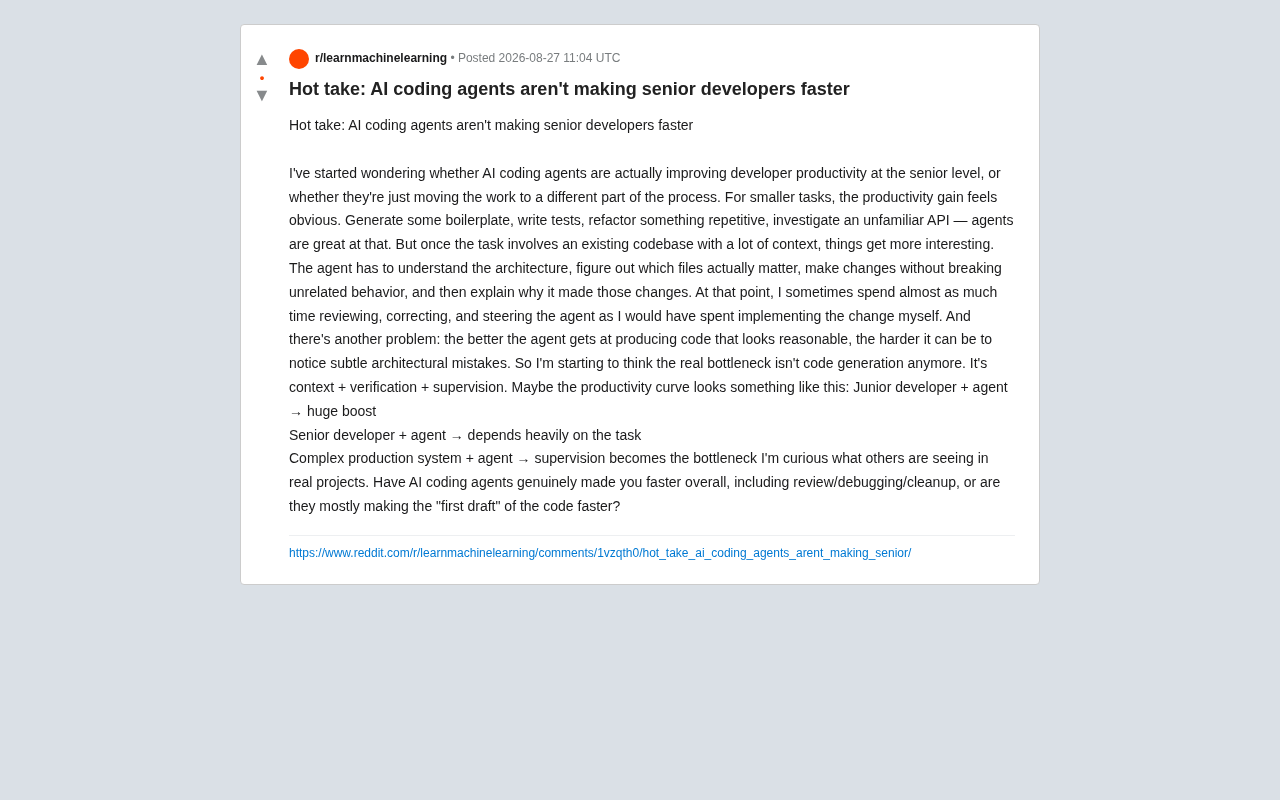
Do AI Coding Assistants Actually Boost Productivity for Senior Developers? The Truth About Bottleneck Migration
Do AI coding assistants truly boost senior developer productivity? This article reveals how productivity bottlenecks migrate from code writing to verification and supervision.

Heteropessimism: Why Modern Dating Feels Increasingly Hopeless
Heteropessimism is becoming a cultural phenomenon: women use self-deprecating humor about relationships with men, reflecting political regression, economic inequality, and emotional struggles.

Organizing Machine Learning Notes with Claude Code: Self-Study Practices and Methodology for CS189
A self-learner uses Claude Code to restructure UC Berkeley CS189 machine learning notes by topic, using a dual-document approach to map knowledge connections and fill conceptual gaps.