OmniVibe: Deep Dive into the AI Agent Creator Economy Marketplace
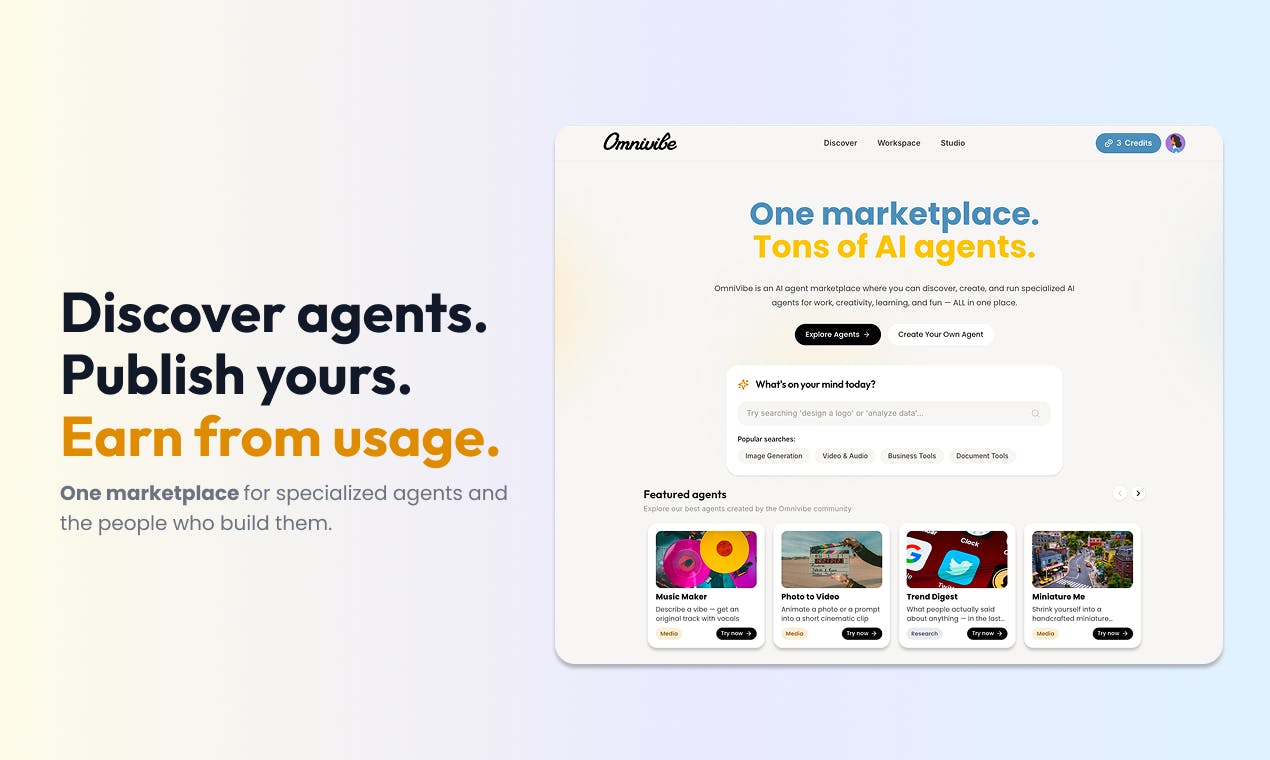
OmniVibe: A marketplace enabling AI agent creators to monetize through pay-per-use revenue sharing
OmniVibe is a two-sided marketplace platform that connects AI agent creators with users. It allows developers to publish agents and earn revenue through qualified usage, while users can invoke multiple agents simultaneously in a Slack-like interface. The platform addresses key pain points in the agent ecosystem.
When AI Agents Need a "Home"
As large language models continue to evolve, AI agents built around specific tasks are becoming the new favorite of the developer community.
The Relationship Between Large Language Models and AI Agents: Large Language Models (LLMs) are natural language processing systems based on deep learning that understand and generate human language after training on massive text datasets. AI agents, on the other hand, are autonomous execution systems built on top of LLMs—they don't just converse, they can call tools, execute tasks, and make decisions. If LLMs are the "brain," then agents are complete entities with "hands and feet." A typical agent contains three core components: a perception module (receiving inputs), a reasoning module (making decisions based on LLMs), and an action module (calling APIs, operating tools). From ChatGPT's Plugins to AutoGPT, agents are moving from concept to practical use, becoming the mainstream form of AI application deployment.
However, there's an awkward reality: these agents often remain scattered across developers' local environments, GitHub repositories, or obscure SKILL.md files, making them both difficult to discover and unable to generate actual returns for creators.
OmniVibe, recently launched on Product Hunt, attempts to solve this pain point. The product positions itself as a "marketplace for agent creators & users." After launch, it received 99 upvotes and 9 comments, ranking 8th on the daily leaderboard, covering three categories: Productivity, Social Media, and Artificial Intelligence.
OmniVibe's Two-Sided Market Model: Connecting Creators and Users
OmniVibe's core logic is building a typical two-sided marketplace that simultaneously serves both producers and consumers of AI agents.
Understanding Two-Sided Markets: A two-sided market is a platform business model that serves two interdependent user groups and creates value through network effects. Classic examples include Taobao (connecting buyers and sellers), Uber (connecting riders and drivers), and the App Store (connecting developers and users). The core challenge for such platforms is the "chicken-and-egg" cold start problem—without supply-side participants, you can't attract demand-side users, and vice versa. Successful two-sided markets typically break this deadlock through subsidies, exclusive content, or pioneer user strategies, and achieve growth flywheels through cross-network effects (the more users on one side, the greater the value for the other side). In the AI field, this model is being applied to scenarios like model marketplaces, dataset trading, and agent distribution.
For Creators: Monetizing AI Agents
For creators, OmniVibe's greatest value proposition is helping agents "break out of local environments." The official product description states it provides a home for your agents "beyond local runtimes, GitHub repos, or SKILL.md files." Creators can import and publish their existing agents, then earn revenue through "qualified usage."
This design directly addresses a core contradiction in the current agent ecosystem—many quality agents lack monetization channels. Developers invest effort building practical tools, yet can only share them open-source. OmniVibe attempts to establish a sustainable incentive mechanism for these creators using a "pay-per-use" revenue-sharing model, which is the foundation of its self-proclaimed identity as "home for the agent creator economy."
Applying Creator Economy: The creator economy refers to an economic model where content creators directly provide value to audiences through digital platforms and earn revenue. This concept emerged from the success of platforms like YouTube, Patreon, and Substack, with its core being "disintermediation"—creators no longer rely on traditional publishers or agencies, but instead directly reach users and monetize through platform tools. Successful creator platforms typically have three elements: low-barrier creation tools, efficient distribution mechanisms, and transparent revenue systems. Applying this model to the AI field means agent developers can, like content creators, build personal brands and income streams through continuous production of quality "works" (agents), rather than relying solely on corporate employment or project outsourcing.
For Users: Invoking AI Agents Like Sending Messages
On the user side, OmniVibe's interaction design is quite clever. Users can either actively browse various agents in the marketplace or directly tell the platform their needs in natural language, with OmniVibe automatically matching the "right agents."
More noteworthy is its collaboration model—OmniVibe supports users working with multiple agents simultaneously, with the official comparison being "like messaging colleagues on Slack." This means users are no longer conversing with a single AI, but orchestrating like a team, letting multiple specialized agents each handle their roles and process tasks in parallel.
Agent Orchestration Technology: Agent orchestration refers to the technical paradigm of coordinating multiple AI agents to work together to complete complex tasks. Unlike single agents, orchestration systems need to solve problems like task decomposition, role assignment, state synchronization, and result aggregation. Common orchestration patterns include: sequential execution (Pipeline), parallel processing (Parallel), hierarchical collaboration (Hierarchical), and dynamic routing (Dynamic Routing). At the implementation level, mainstream frameworks like LangGraph, AutoGen, and CrewAI provide different abstraction levels—from low-level message passing to high-level team simulation. The advantage of this architecture lies in specialized division of labor: one agent handles data analysis, another handles copywriting, a third handles quality review, similar to human team collaboration, which can significantly improve the completion quality of complex tasks.
This "multi-agent collaboration" paradigm precisely aligns with the current trend in the AI field of evolving from monolithic models to agent orchestration.
The New Battleground of AI Agent Creator Economy
From an industry perspective, OmniVibe's emergence is no coincidence. Over the past two years, the concept of an AI App Store has been repeatedly mentioned, from OpenAI's GPT Store to various plugin markets—giants are all attempting to build entry points for agent distribution.
The GPT Store Dilemma: OpenAI's GPT Store, launched in November 2023, was seen as a pioneer in agent distribution, allowing users to create and share customized GPT applications. However, its business model has been questioned: creators lack clear revenue-sharing mechanisms, with the platform mainly relying on ChatGPT Plus subscription fees rather than in-app purchases or usage-based revenue sharing. This results in quality creators lacking motivation for sustained investment, with many GPTs becoming "one-off works." Additionally, the GPT Store's closed ecosystem (supporting only OpenAI models) limits its scalability. In contrast, the traditional App Store uses 70/30 revenue sharing, supports in-app purchases and subscriptions, forming a healthy developer ecosystem. For AI application markets to succeed, they must address the fundamental issue of creator incentives.
But these platforms mostly depend on single model ecosystems, and creator revenue models remain unclear.
OmniVibe's differentiation lies in two points: first, emphasizing cross-source agent aggregation—no matter where your agent comes from, you can import and publish it; second, treating creator monetization as a core proposition rather than an add-on feature. It attempts to replicate the successful path of content platforms' "creator economy"—just as YouTube is to video creators and the App Store is to developers, OmniVibe wants to become the distribution and settlement infrastructure for the agent era.
Challenges and Observations for OmniVibe
As an early-stage product, OmniVibe still faces many practical challenges.
First is the quality and trust issue. How "qualified usage" is defined and tracked directly relates to the fairness of creator revenue and determines whether the platform can eliminate gray practices like usage manipulation. Second is agent reliability—multiple agents working together means more complex error propagation chains, making stable user experience critical.
Additionally, two-sided markets commonly face "cold start" challenges—without enough quality agents, you can't attract users; without user-generated usage, creators lack motivation to join. Whether OmniVibe can break this cycle through early incentives will determine how far it can go.
Conclusion
OmniVibe represents an attempt to transform AI agents from "tools" into "assets." It keenly captures the dual pain points of agent creators lacking monetization outlets and users lacking unified invocation entry points, offering its answer through a Slack-like multi-agent collaboration interface.
In today's world where AI application formats remain undefined, whoever can first establish a thriving agent creator ecosystem may become the distribution hub of the next era. Whether OmniVibe can deliver on its vision as "home for the agent creator economy" deserves continued attention.
Related articles
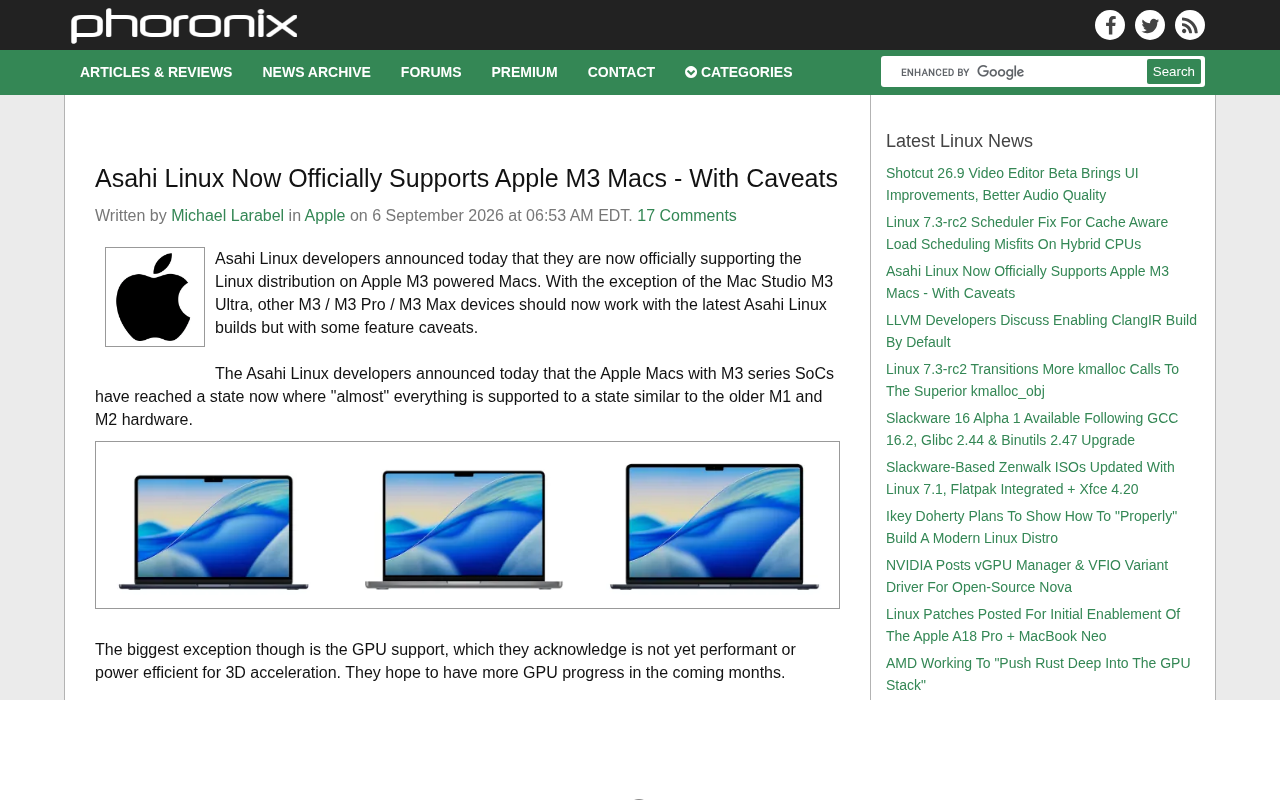
Asahi Linux Officially Supports M3 Chip Macs: Current Status and Limitations Explained
Asahi Linux officially expands support to Apple M3 chip Macs. This article explains M3 adaptation technical challenges, current GPU acceleration and peripheral support limitations, and the future of running Linux on Apple Silicon.
Berlin Under Ransomware Attack: Why Government Agencies Have Become Prime Targets
Berlin faces a severe ransomware attack targeting municipal systems. This analysis explores why government agencies are high-value targets, decodes double extortion tactics, and examines cybersecurity defense strategies in urban digital transformation.
AI Penetration Testing Learning Roadmap: Four Stages from Beginner to Advanced
A systematic breakdown of the four-stage AI penetration testing roadmap covering AI-assisted vulnerability discovery, automated asset collection, enterprise security integration, and intelligent Agent development.