One Developer, 49 Automated Tasks: Solo Skills Open-Sources 26 AI Agent Skills

A solo developer turned 49 repetitive tasks into AI agent skills — and open-sourced 26 of them.
A Korean indie developer abstracted every repetitive task from running a one-person operation into AI automation skills, building up 49 in total and open-sourcing 26 on GitHub as "Solo Skills." Compatible with agents like Claude Code and Codex, 8 of the skills include executable scripts that go beyond prompt templates. The project's deepest value isn't the feature list — it's the writing methodology: each skill file is an incident postmortem that encodes hard-won lessons (like dry-running before sending messages, or refusing to fabricate when source material is missing) as hard constraints, preventing AI from confidently doing the wrong thing.
One Person's "Company," Powered by 26 AI Skills
A Korean indie developer took every repetitive chore from his daily operations, turned each one into an AI automation skill, and eventually built up a collection of 49. He then open-sourced 26 of them on GitHub under the name Solo Skills (referred to as "SoloSpills" in the original video). The project is built specifically for solo operators — independent developers with no team who wear every hat and handle everything themselves.
The author runs a startup community for Korean artists, now in its sixth cohort. Product demo videos, e-books, blog posts, meeting notes, client message replies — he handles all of it alone. Whenever he found himself doing the same task for the third time and feeling the grind, he'd write it up as an automation skill. Over time, 49 manual chores became reusable workflows.
26 Ready-to-Use Skills, 8 with Full Scripts Included
The 26 skills in the public repository share one key trait: compatibility with mainstream agentic AI tools. AI agents like Claude Code (mistakenly called "Cloud Code" in the video) and Codex — systems that can "read a skill spec" — can call these skill definitions directly with minimal adaptation.
What makes it even more practical: 8 of the skills don't just provide a description — they include executable scripts. Two concrete examples:
- Automatic model switching: When the primary model hits its usage limit, the script automatically switches to a fallback model, keeping the workflow uninterrupted.
- Demo video generation without screen recording: Product demo videos can be generated automatically without ever recording your screen.
Skills that come with scripts are more than prompt templates — they're automation components you can actually run. At the time the video was captured, the project had earned approximately 355 stars on GitHub.

Agentic AI refers to AI systems that can read structured task definitions, autonomously plan steps, and call tools to execute them — as opposed to conversational AI that simply answers one-off questions. Claude Code is Anthropic's developer-facing agent product that can read project files, run code, and call APIs from a terminal environment. Codex is OpenAI's early code generation model, whose successor versions also support "skill definition files" as inputs to drive automated tasks. The defining trait of these agents is this: as long as you clearly specify what a task should do, what it shouldn't do, and how to verify results, the agent can execute it repeatedly and reliably — no manual prompting required each time. Solo Skills leverages exactly this property, packaging the author's operational knowledge into skill files that agents can call directly.
The Real Value Isn't the Features — It's the "Incident Postmortem" Writing Style
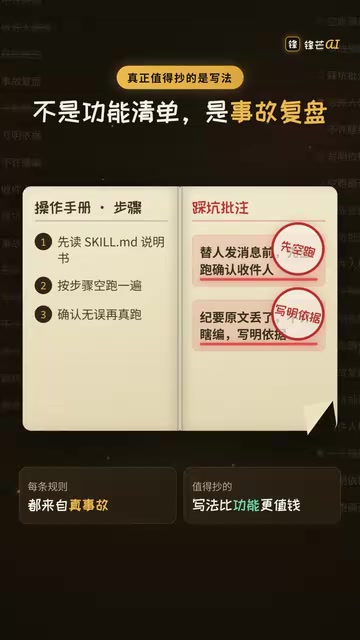
If you treat Solo Skills as just a feature list, you're missing the most valuable part. The video author's take is blunt: this isn't a feature list — it's an incident postmortem.
Each skill file is fundamentally an operations manual, packed with lessons the author learned the hard way and the constraints he derived from them. This approach encodes "mistakes made in real operations" as rules, so AI agents don't repeat them. A few examples illustrate this clearly:
- Before sending a message on someone's behalf, always do a dry run first — confirm the recipient is correct before actually sending — to prevent the irreversible mistake of messaging the wrong person.
- When writing meeting notes, if the original transcript is missing, do not make things up — every conclusion must cite its source — to prevent AI hallucinations from contaminating official records.
These constraints reflect a core philosophy: when you let AI do your work, the biggest risk isn't that it can't do the job — it's that it will confidently do it wrong. Writing human-earned lessons into skill definitions is like equipping the agent with brakes and guardrails.
AI Hallucination refers to the tendency of large language models to generate plausible-sounding but factually incorrect content with high confidence, even when no real basis exists. In high-accuracy scenarios like meeting notes and client communications, hallucinations are especially damaging — the AI might fabricate a source for a conclusion, or "fill in" missing details when source material is incomplete, corrupting the official record. Constraints like "do not fabricate when the original is missing" in Solo Skills are essentially hallucination suppression at the skill level: by explicitly requiring the model to stop and flag uncertainty when information is insufficient — rather than confidently filling the gap — the skill forces the model to expose what it doesn't know. This is a mainstream defensive strategy for deploying LLMs in serious production workflows.
Don't Expect Plug-and-Play — The Real Value Is the Methodology
The video author offers a practical warning: don't expect these skills to work out of the box. Many of them are tightly coupled to the author's specific accounts, servers, and service environments. Trying to run them directly will likely stall at the configuration stage.
So the real thing worth borrowing from Solo Skills isn't the 26 specific skills themselves — it's the methodology behind them:
Take any task you've repeated three or more times, and write it up as a skill document — complete with the lessons you learned the hard way.
For indie developers, solo founders, or small teams, the transferable value of this approach far exceeds any of the code. You don't need to copy his meeting notes script, but you can use the same logic to turn your own recurring operational tasks into reusable, AI-executable skill documents.
What This Means for Indie Developers
The capability ceiling of an AI agent depends heavily on how well-written the "manual" you give it is. Solo Skills demonstrates that instead of chasing a universal prompt, you're better off writing each task like an incident postmortem — explicitly defining edge cases, failure examples, and verification steps. This approach to accumulating "human-AI collaboration playbooks" may ultimately determine the reliability of your automation more than the number of skills you have.
Interested readers can find the repository by searching Solo Skills-related keywords on GitHub.
Related articles
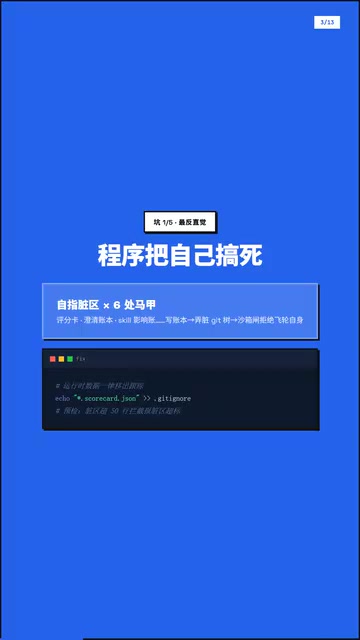
Letting AI Build AI Tools: A 7-Day, 31-Commit Bootstrapping Post-Mortem
An engineer ran a fully autonomous AI-builds-AI pipeline for 7 days, 31 commits, with a 1-in-6 success rate. This post-mortem covers 5 failure types, 11 structural rules, and how every mistake became a permanent immunity gate.
Building an AI-Powered E-Commerce Business from Scratch: A Real-World Account of Multi-Agent Architecture for Print-on-Demand
A blogger builds a print-on-demand e-commerce company from scratch using AI agents — documenting specialized Agent profiles, GPT-5.6 vs Claude Fable multi-model orchestration, and reusable skill accumulation.

AI Agent Earns $10K in One Week: 3 Key Upgrades Explained
A blogger shares how he earned $10K in a week with an AI Agent — not by adding more skills, but through verification, approval gates, and subagents to raise trust and enable true automation.