One Developer Built a 24/7 Full-AI Pixel News Network PNN with Claude Opus 5.5

One dev turned an AI TV station joke into a real 24/7 pixel news network using Claude Code and Opus 5.5 in about a week.
An indie developer took the offhand idea of a fully AI-operated, never-offline TV channel and built it into PNN (Pixel News Network) using Claude Code and Opus 5.5 — a pixel-art livestream pulling from 70 news sources, with AI characters who have memory and relationships, music acts with synced lip animation, a 15,000-fact sourced database with hallucination guards, tiered model scheduling for cost control, and 2,500 automated checks protecting the live broadcast. The whole thing runs on a home Mac Studio and serves as a compelling stress test of what single-person AI-assisted development can actually achieve.
It Started with a Ridiculous Late-Night Idea
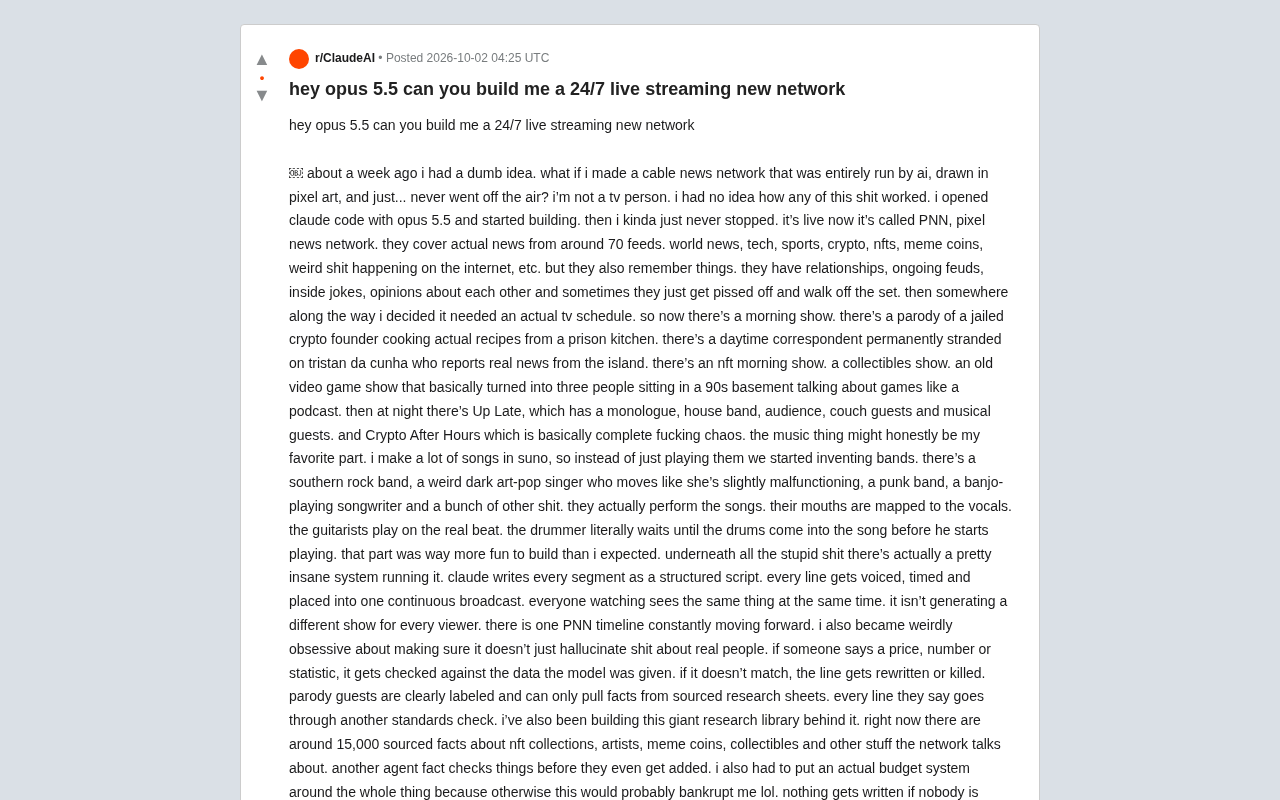
An indie developer shared a surprising project on Reddit: using Claude Code paired with Opus 5.5, he built a fully AI-operated, entirely pixel-art-rendered, never-offline cable news network from scratch — called PNN (Pixel News Network).
In his own words, it started as "a stupid idea" — make a TV channel that's completely run by AI and never goes dark. He openly admits he has zero background in television, had no idea how any of it worked, opened Claude Code, and "just never stopped." PNN is now live and can be watched in real time at www.pnn.watch.
What makes this project worth paying attention to isn't just the concept — it's what it demonstrates about how far a single person can take a "side project" idea using the latest generation of AI coding assistants.
What Kind of TV Station Is PNN, Exactly?
Content-wise, PNN draws from around 70 sources and covers real news: world events, tech, sports, crypto, NFTs, meme coins, and all manner of internet weirdness.
What's genuinely interesting is the cast of AI characters. These aren't one-off news-reading bots — they have memory. Characters have relationships, long-running feuds, inside jokes, opinions about each other, and will occasionally lose their temper and storm off the set mid-broadcast.
As the project evolved, the developer also built out a full programming schedule:
- Morning Show: A standard morning news program
- Prison Kitchen: A character parodying a jailed crypto founder who cooks real recipes from "prison kitchen"
- Island Reporter: A daytime correspondent permanently stranded on Tristan da Cunha, reporting real news from the island
- NFT Morning Show & Collectibles Program
- Retro Gaming Show: Eventually evolved into three people sitting in a '90s basement talking about games like a podcast
- Up Late: A late-night show with an opening monologue, house band, live studio audience, couch interviews, and musical guests
- Crypto After Hours: Described by the developer as "complete chaos"
Making the AI Band Actually "Play" Music
The developer says the music segments are probably his favorite part. He uses Suno regularly for his own music, so he invented a whole roster of bands: a Southern rock group, a dark art-pop singer who moves like she's slightly glitching, a punk band, a banjo-playing singer-songwriter, and more.
The technical details here are particularly impressive. These characters actually perform songs — lips sync to vocals, guitarists strum in time with the actual beat, and drummers wait until the drums kick in before they start playing. This fine-grained timeline mapping is what elevates "AI-generated content" into something resembling a believable performance, and the developer admits it ended up being more satisfying than he expected.
Suno is an AI music generation tool where users input text descriptions (style, mood, lyrics, etc.) to generate complete songs with vocals. In PNN's architecture, Suno handles the actual audio production, while the pixel-art characters' animations — lip sync, instrument playing motions aligned to the beat — require a separate timeline-mapping system that binds audio events (vocal entry, drum hits) to visual frames with precision. This "audio-driven animation" approach is well-established in games and VTubing (e.g., Live2D), but applying it to a fully AI-generated pixel-art livestream still required significant custom engineering work.
The Surprisingly Serious Engineering Underneath
Beneath all the absurdist content is a remarkably rigorous technical foundation.
Single-timeline broadcasting. Claude writes each segment as a structured script, with every line of dialogue voiced, timed, and inserted into a continuous broadcast stream. Every viewer sees the same frame at the same moment — the system doesn't generate a custom feed for each viewer but maintains one continuously advancing PNN timeline. This is fundamentally different from typical "personalized" generative content.
Hallucination prevention. The developer is almost obsessive about not letting the model fabricate information about real people. Any time a line of dialogue includes a price, number, or statistic, it gets cross-checked against the source data the model received. Discrepancies trigger a rewrite or deletion. Parody guests are explicitly labeled, can only cite sourced research material, and every line gets run through an additional "standards check."
A massive fact library. He built a research database that now holds approximately 15,000 sourced facts covering NFT projects, artists, meme coins, collectibles, and other internet culture topics. A separate agent verifies facts before they're added to the database.
"Hallucination" is one of the core failure modes of large language models — the model generates content that sounds plausible but is factually wrong, with high apparent confidence. This is especially dangerous in number, name, and citation-heavy contexts. PNN's anti-hallucination design follows a classic RAG + validation approach: verified facts are stored in a structured database (the knowledge base in Retrieval-Augmented Generation), the model must retrieve from it during generation, and outputs are automatically compared against source data afterward — with mismatches triggering rewrites or deletions. The pre-ingestion verification agent adds a second layer of filtering at the data source itself.
Cost Control and Model Routing
To avoid going broke, the developer built a budget mechanism into the system: nothing gets generated when nobody is watching. Model usage is also tiered — Haiku handles most routine dialogue, while Sonnet takes on heavier show production and fact-checking tasks.
More surprisingly, this entire "fake TV station" runs on a Mac Studio sitting in his home. To avoid taking down the livestream again, he built approximately 2,500 automated checks that run before any change is pushed — because he once brought the entire broadcast network down and decided he never wanted to go through that again.
Anthropic's Claude model family offers multiple capability and cost tiers: Haiku is the lightweight version — fast, cheap, suited for high-frequency repetitive tasks; Sonnet sits in the middle, handling content generation and verification that requires some reasoning depth; Opus is the flagship, most capable but most expensive. Routing different tasks to different models is a standard "tiered model scheduling" strategy in production AI systems — use expensive models for a small number of critical decisions, cheap models for high-volume routine output, and balance quality against cost. "Stop generating when no one is watching" is a demand-based on-demand compute approach that avoids burning API quota for zero-audience scenarios.
What It's Actually Like to Build with Opus 5.5
The developer says the wildest part of the whole project was the experience of building it with Opus 5.5. He describes it as feeling "less like using an AI and more like having a brilliant engineer sitting next to you who never gets tired."
Most of his instructions were casual and conversational — things like "make her jump weird, uncanny, stiff, slightly mechanical" or "that guitar looks like a banjo, fix it." The model would build it, run it, show him a video or sketch, and he'd respond with what wasn't working.
What surprised him more was that the model would push back — if an idea was dumb, it would explain why. It also tested changes on a "time-shifted copy" of PNN before touching the live broadcast, catching a large number of bugs on its own before anything went to air. This "pushback and self-validation" collaboration style arguably says more about the value of next-generation coding assistants than any individual feature.
Claude Code is Anthropic's AI coding assistant, running in agent mode. It can read and write files, execute commands, run tests, and autonomously plan and course-correct across multi-step tasks directly in a terminal environment — not just output code snippets in a chat window. This is fundamentally different from earlier "autocomplete-style" coding assistants (like early GitHub Copilot), which passively respond to cursor context. Claude Code is closer to an engineering collaborator that accepts high-level goals, breaks them into subtasks, and executes continuously. The PNN workflow of "test changes on a time-shifted copy, catch bugs, then push to live" is a textbook example of Claude Code's agent mode — the model doesn't just write code, it runs it and verifies it too.
How Far Can One Person Go?
PNN matters as a boundary-case example: a person with no television background, who self-admittedly knew nothing going in, used Claude Code and Opus 5.5 to turn a "joke idea" into a complete system — with a program schedule, fact-checking, cost controls, automated testing, and uninterrupted 24/7 broadcast capability — in roughly a week.
The developer plans to keep it running for at least a year to see what it becomes, and welcomes questions from anyone curious about how it works. The project itself is a fascinating stress test of just how high the ceiling on AI-assisted solo development really is.
Related articles

Carbon-X: A 14.8B Open-Source Model That Handles DNA and Text Simultaneously
Carbon-X is a 14.8B open-source multimodal model on Hugging Face where DNA and text share a token stream. 6-mer tokenization, 302B token mid-training, deployable on a single 80GB GPU, 66.7% average on five DNA benchmarks, Apache 2.0 license.

6-DOF Robotic Arm Jitter Challenge: Robstride Actuators and MIT Mode Tuning in Practice
A freelance filmmaker builds a 6-DOF motion-control camera arm using Robstride actuators and STM32 MIT mode, but encounters J2/J3 coupled jitter. This article outlines the background, tech stack, and possible debugging directions, including control parameters, gravity compensation, mechanical resonance, and real-time performance.

Liquid AI LFM2.5-24B Tested on Mac mini M6: 70 TPS and 128K Context
Bilibili creator tests Liquid AI LFM2.5-24B on Mac mini M6: 70 tokens/sec with 4-bit quantization, 128K context running OpenClaw, and Apple Shortcuts optimization. Compares with smaller models on speed vs. intelligence trade-offs.