One Gaming PC Handles Three Local AI Scenarios: Coding Assistant, Knowledge Base, and Batch Processing Tested

Deploying Strata locally on a single gaming PC to run three key scenarios: coding assistant, private knowledge base, and batch processing.
The article describes how a Bilibili creator locally deployed the Strata model on a gaming PC to run three high-frequency scenarios: via an OpenAI API-compatible local endpoint, VS Code with the Continue extension only needs its address changed to get an offline-capable coding assistant; importing company documents into a local knowledge base leverages a 260K-token context to answer questions from entire manuals; and overnight batch processing of hundreds of files is free from call limits and rate limiting. The author compares data paths and cost structures between cloud and local, noting local deployment is a one-time investment that turns pure profit from year two with stable speed, at the cost of Strata running strictly as a single instance—not suited for multi-user sharing, but sufficient for one person.
Cloud AI is convenient to use, but once your data leaves your hands, you no longer control it. Bilibili creator "Strata Local Deployment Review 4" used a single gaming PC to run three high-frequency scenarios: an offline-capable coding assistant, a private knowledge base on a company intranet, and overnight batch document processing. This setup doesn't rely on any online service—the only trade-off is concurrency: Strata runs strictly as a single instance, which is more than enough for one person.
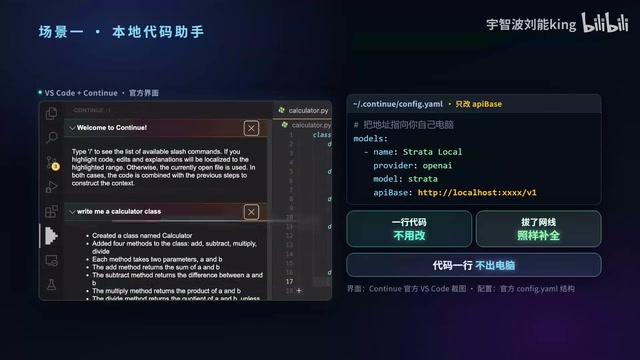
Scenario 1: A Coding Assistant That Works Even Offline
The most practical use case is the local coding assistant. Strata ships with a local endpoint that's compatible with the OpenAI API format. You keep using VS Code with the Continue extension, just change the endpoint address to your machine's local address—not a single line of code needs to change, and your coding assistant goes from cloud-based to locally deployed. It still works offline, and your code never leaves your computer.
The creator specifically highlighted an advantage that cloud solutions can't match: the model runs on your own machine, so the environment is exactly the same as yours. When you ask it "will this code run?", its judgment is based on the real local environment—no more awkward "well, it works on my machine" moments. For engineers who frequently develop in isolated networks or intranet environments, this feature is worth more than model parameters.
OpenAI API format has become the de facto standard for the LLM toolchain: as long as the server exposes endpoints like /v1/chat/completions and accepts the same request body structure, any client compatible with that format can connect directly. This means that when you switch models or change deployment locations, plugins, SDKs, and scripts usually don't need code changes—you just swap the base_url and model name. Continue is a VS Code coding assistant extension that follows this protocol, sending requests for completions, chat, code explanation, and more to the configured endpoint. Strata replicates this interface locally, effectively disguising itself as an "OpenAI service" so it can seamlessly plug into the existing ecosystem—this is an important prerequisite for low-cost local deployment.
Scenario 2: Turning Company Documents into a Q&A Knowledge Base
The second scenario is a private knowledge base. Companies have product manuals, technical documentation, and internal policies—looking up a single clause used to take forever. Import all these documents into a local knowledge base tool, connect the backend to Strata, and it becomes an internal knowledge base where "ask one question and get the answer." Just upload documents, build the index, and you're ready to go.
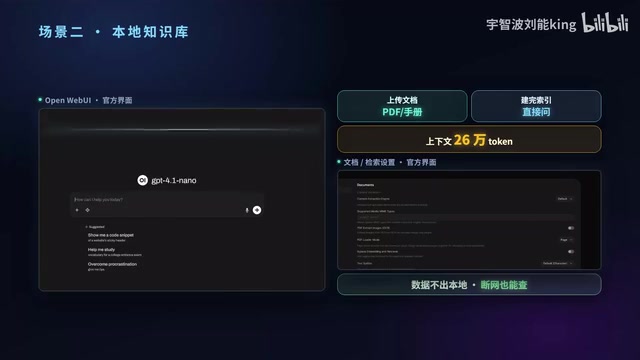
A 260K-token context window is the key enabler—an entire technical manual can be read in one pass, and then customer questions can be answered based on the manual's content. Data stays local, works offline, and is ideal for teams with strict restrictions on information flow.
Knowledge base Q&A typically follows the retrieval-augmented generation (RAG) approach: first split documents into chunks, convert them into vectors using an embedding model, store them in a vector database, and build an index; when a question comes in, retrieve the most relevant chunks, then pass them along with the question to the LLM to compose an answer. There are two easily confused concepts of "context" here—the retrieval stage determines which materials get fed to the model, while the model's context window (like the 260K tokens mentioned here) determines how much material can fit in a single pass. The larger the window, the less you need to split things up and the more you can feed in entire documents, reducing retrieval misses—but it also drives up VRAM usage and inference time. Keeping all data local is precisely the core selling point of combining RAG with private deployment.
Scenario 3: Sleep Through It, Wake Up to 100 Processed Files
Batch tasks are the most underrated value of local deployment. Drop 100 files in before bed, have them translated, summarized, and key information extracted, then just check the results the next morning. No call limits, no insufficient balance, no "too many requests, please try again later."
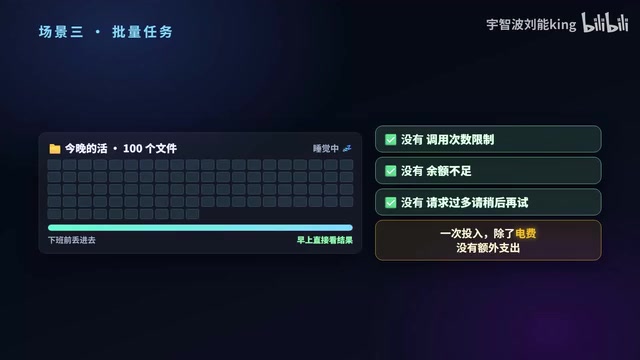
The creator singled out this type of need because it hits a pain point of cloud APIs: batch tasks in the cloud are often constrained by quotas and rate limits, whereas with local deployment, after the initial investment, there are no additional costs beyond electricity. From year two onward, it's pure profit—that's his cost assessment.
Privacy-Sensitive Tasks: From "User" to "Owner"
One more scenario deserves separate mention: contract review, financial report inspection, and internal meeting minutes processing. You wouldn't dare send this content directly to ChatGPT, but in a local environment you can process it with peace of mind—shut down and it's wiped clean. The creator put it bluntly—with cloud AI you're a user, with local AI you're the owner.
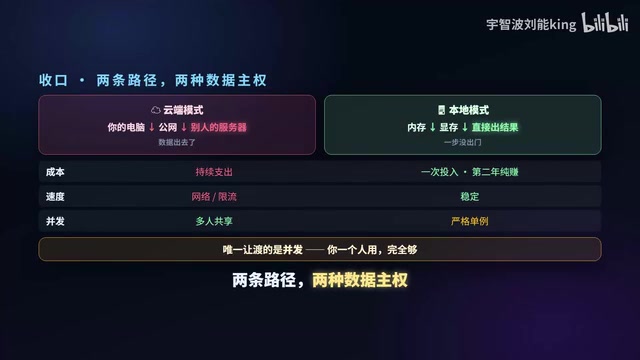
Cloud vs. Local: The Trade-off Between Two Data Paths
The creator wrapped up the three scenarios with a comparison chart. In cloud mode, data travels from your computer over the network to someone else's server; in local mode, data goes straight from memory to VRAM and produces results directly. Two paths correspond to two kinds of data sovereignty.
In terms of cost structure, cloud is ongoing expense, while local is a one-time investment that turns pure profit from year two. On speed, cloud is affected by network and rate limits, while local is stable. The only trade-off is concurrency—Strata runs strictly as a single instance, not suitable for multi-user sharing, but perfectly adequate for one person.
This setup isn't without its barriers—you'll run into various pitfalls during installation and operation. The creator said he'll cover all the installation and operation pitfalls in one go in the next episode, and is soliciting from the comments section the scenarios where people most need local AI. As the title suggests, this is throwing out a brick to attract jade—getting three scenarios working is just the starting point; the real value lies in everyone pushing the boundaries of local AI together.
Cloud API rate limits are typically constrained along two dimensions: requests per minute (RPM) and tokens per minute (TPM). Batch tasks easily hit the quota ceiling, manifesting as queuing, backoff retries, or even errors. Local inference has no such quotas but is limited by single-machine compute: Strata runs strictly as a single instance, meaning requests can only be processed serially, and multiple simultaneous users will queue behind each other. Therefore, the throughput ceiling of local deployment is determined by the GPU's memory bandwidth and model size, not by the provider's policies. Understanding this is essential for judging which scenarios suit local deployment—privacy-sensitive, low-frequency, offline-capable, single-user use—rather than high-concurrency shared services.
Related articles

Random Pruning of the DPO Computation Graph: 1.4x Training Speedup and Lower Peak Memory
DPO training too slow and memory-hungry? This paper proposes a random pruning framework for the DPO computation graph, sampling independently across position, sequence, and branch dimensions; branch pruning achieves a 1.426x step-time speedup and cuts training time by about 30%, with in-depth attribution of memory and time gains.

Why Does JEPA Underperform MLM in Longitudinal EHR Representation Learning?
New study compares JEPA and MLM for longitudinal EHR representation learning on MIMIC-IV: three JEPA variants train stably without collapse but underperform MLM; target size, not heterogeneity, drives prediction error.

Transfer Learning + Visible Light Communication: A New Approach to Energy-Efficient Indoor Positioning
A study proposes a transfer learning-based visible light communication indoor positioning method, achieving 47% accuracy improvement on the BOSCH factory dataset, 67.5% model efficiency under high noise, and introducing the ME composite metric for energy-efficient positioning in energy-constrained industrial IoT scenarios.