One Sentence, One Game: A Teochew Creator Used AI to Build a Beef Ball Hammering Game — and It's Both Stunning and Unsettling

One Teochew creator used a single sentence to make Codex build a complete motion-controlled beef ball game.
A Teochew content creator gave OpenAI's Codex a one-sentence idea and got back a fully playable motion-controlled game simulating the entire Teochew beef ball-making process — from selecting meat to hammering, seasoning, and cooking. The case reveals how AI is collapsing the gap between creative ideas and working prototypes, raising urgent questions about what professional skills will actually be worth in the AI era.
A Teochew Creator's AI Debut: From Idea to Game Prototype
When a powerful new AI model lands in your hands, most people might use it to write code, build a presentation, or draft copy. But one Teochew content creator had a completely different first instinct — he wanted to make a motion-controlled mini-game about hammering beef balls.
What's even more surprising is that he simply described his idea to Codex in plain language: "I want to make a Teochew-style beef ball hammering mini-game" — and the AI actually produced a complete, playable game prototype. This wasn't a bare-bones demo. It was a fully realized, cohesive interactive experience.
About OpenAI Codex: Codex is an AI system built on the GPT family of large language models, fine-tuned specifically for code generation. Trained on billions of lines of public code, it can interpret natural language descriptions and turn them into executable programs. Unlike earlier code-completion tools, Codex has end-to-end "intent understanding" — it doesn't just autocomplete snippets; it can plan an implementation path from a high-level task description and generate a complete project structure. The latest generation of Codex, released in 2025, further integrates multimodal understanding and agentic capabilities, allowing it to autonomously run, debug, and iterate on code within a sandboxed environment — dramatically shortening the path from "one-sentence description" to "working prototype."
What makes this case worth examining isn't the game's technical sophistication. It's what it reveals about a shift already underway: the gap between creative vision and execution is being rapidly closed by AI.
How AI Turned "One Sentence" Into a Playable Game
The level of completeness in this beef ball hammering game is genuinely surprising. Rather than cobbling together random features, the AI faithfully translated the authentic Teochew beef ball-making craft into a series of game stages.
Meat Selection and Preparation
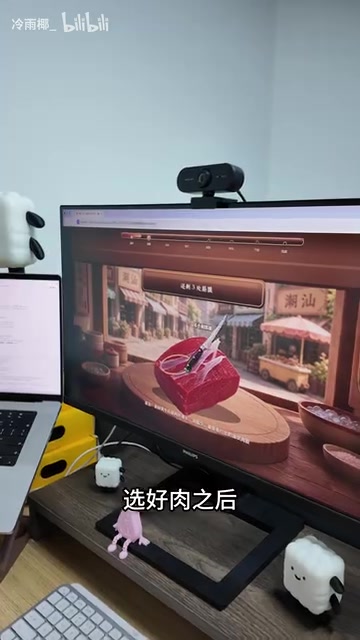
The game opens with a meat-selection phase. Players choose from different cuts of beef and learn which parts are best suited for making beef balls — a step that reflects real cultural knowledge about Teochew cuisine. Not just any cut will produce that signature bouncy texture.
Once you've chosen your cut, you trim away the connective tissue to prepare the meat for pounding.
The Core Hammering Phase: Motion Controls That Make You Feel It
The most compelling part is the central "start hammering" sequence. The game uses your camera to calibrate your movements — within a time limit, you swing both hands, and the in-game hammers strike in response. With each blow, the meat visibly changes, gradually transforming from a solid chunk into a fine, smooth paste.
The real-time feedback creates a genuine sense of involvement and satisfaction, as if you're actually making the beef balls yourself.
The tech behind the motion controls: The camera-based movement calibration draws on Human Pose Estimation from the field of computer vision. Modern browsers can use lightweight frameworks like MediaPipe and TensorFlow.js to detect body keypoints in real time — wrists, elbows, shoulders — without any specialized hardware, mapping a player's physical movements to in-game actions. The barrier to this kind of interaction has dropped dramatically in recent years. What once required a Kinect sensor can now be replicated with an ordinary webcam and a few dozen kilobytes of JavaScript. AI's ability to generate these motion-controlled prototypes is built directly on top of this mature open-source toolchain.
Seasoning and Shaping
After hammering comes the seasoning phase — salt, white pepper, ice water, and other ingredients from the authentic recipe are all represented, with even a vinegar option included. After seasoning, you continue kneading and throwing the paste to develop that characteristic springy texture.

Next comes hand-squeezing the balls into shape — players perform the corresponding motion in front of the camera.
Cooking: A Satisfying Finish to the Full Loop
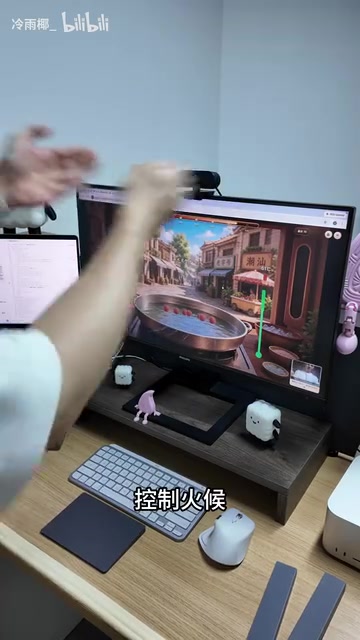
The final stage is the cooking phase. Players fan the flames and control the heat in front of the camera, slowly bringing the beef balls to a perfect cook. From selecting the meat to hammering, seasoning, and finally cooking — the entire process forms a complete, satisfying loop.
What's Truly Stunning Isn't Any Single Feature — It's the Systemic Product Thinking
What left the creator genuinely astonished wasn't any individual feature the AI implemented. It was the holistic, systems-level thinking applied to the entire game.
How levels progress, how players interact, how the screen responds to their actions, the UI design, the overall "beef shop" aesthetic — all of it was considered together. This signals that AI is no longer just a "code generator." It's becoming a comprehensive collaborator that understands product logic, interaction design, and visual aesthetics.
Building a game — even a small prototype — traditionally requires coding skills, UX knowledge, UI design ability, aesthetic sensibility, animation, and a feel for game pacing. That typically means a team working for weeks or months. Conventional indie game development involves clear specialization: programmers handle the engine and logic (often in Unity or Godot), UI designers craft the visual style, interaction designers map out player flows, sound designers handle audio feedback, and game designers architect the level structure. The indie dev community has long struggled with a "rich in ideas, poor in execution resources" problem — even a simple casual game typically takes a team of several people multiple weeks to get from concept to demonstrable prototype.
That's changing: as long as you can articulate your idea clearly, AI can build you a first version. What AI tools are fundamentally doing is compressing a path that once required crossing multiple skill barriers into a single natural-language conversation — bringing the cost of validating a creative idea close to zero.
The Excitement Comes With Real Anxiety: What's Actually Worth Something Now?

Alongside the excitement, this experience brought the creator a genuine sense of unease. He raised a question that no practitioner can afford to ignore:
Now that even game prototypes can be generated this quickly, what's actually going to be worth something in the future? Could the professional skills we're proud of today be entirely replaced by AI overnight?
This case points to several shifts worth paying attention to:
First, the execution barrier is falling — the creative barrier is rising. As "making an idea real" becomes easier and easier, "having a worthwhile idea in the first place" becomes increasingly scarce. Cultural understanding, a distinct perspective, genuine insight — these are precisely what makes this Teochew beef ball game resonate.
It's worth noting that "articulating your idea clearly" — seemingly a simple requirement — actually points directly to the emerging field of prompt engineering. An effective AI prompt requires a clear description of the goal, key constraints, stylistic references, and sufficient domain context. In this case, the creator's cultural understanding of Teochew beef ball craftsmanship formed the essential core of a high-quality prompt. Research suggests that when faced with prompts that are information-dense and rich in domain knowledge, the same AI model produces significantly better outputs than when given vague, generic descriptions. This means "knowing what you want" and "having a unique cultural perspective" are becoming non-negligible sources of competitive advantage in the era of human-AI collaboration.
Second, professional skills aren't disappearing — their value is being restructured. AI can rapidly produce a "first prototype," but the distance between a prototype and a polished product — between "playable" and "genuinely fun" — still requires expert judgment. The gap between people who can use AI effectively and those who can't may not come down to the tools themselves, but to taste and directional sense.
Third, human-AI collaboration is becoming the new normal. The competitive edge in the future may no longer be "I can write code" or "I can do design" — it may be "Can I clearly express what I want, and can I steer AI into making it real?"
Closing Thoughts
A Teochew creator using AI to build a beef ball hammering game might look like a fun little experiment. But it's actually a vivid snapshot of the AI era — both showcasing how rapidly AI's creative and generative capabilities are advancing, and placing a sharp question in front of everyone: where is professional value headed?
Anxiety about technological displacement isn't new. But the speed and scope of this particular wave truly is unprecedented. Maybe the answer isn't "will AI replace me?" — maybe it's "can I identify the unique value that only a human can contribute?" The devotion to the taste of home behind every Teochew beef ball, that deep and personal attachment — that's the one thing AI can never generate from nothing.
Key Takeaways
Related articles

CSS Anchor Positioning: A New UI Positioning Approach Without JavaScript
A deep dive into CSS Anchor Positioning: from anchor-name and position-anchor to the anchor() function, position-area shorthand, position-try-fallbacks, anchor-size, and upcoming anchor queries.

New AI Chart Interaction: Continuous Follow-up Questions and Visualization in Conversation
Explore a new AI interaction method for continuously generating charts in conversation. Use the /visualize command to ask follow-up questions and visualize answers in the same chat window, improving data analysis efficiency.

Cursor Merges Into X Subscription: Paid Plans Share Unified Usage Pool, Grok Model Coding Usage Doubled
Cursor joins The X Subscription with a unified usage pool and doubled Grok coding quota. Third-party models shift to API pricing. Existing users can keep or migrate plans.