ONNX Runtime Explained: A Cross-Platform AI Inference and Training Acceleration Engine

A comprehensive guide to ONNX Runtime as a cross-platform ML inference and training acceleration engine.
This article provides an in-depth exploration of ONNX Runtime, Microsoft's open-source machine learning inference and training acceleration engine. It covers its core architecture including computation graph optimization and the Execution Providers plugin mechanism, training acceleration capabilities with gradient checkpointing and ZeRO optimization, edge/mobile deployment via WebAssembly and WebGPU, and large model inference optimization through quantization and KV Cache management.
What is ONNX Runtime
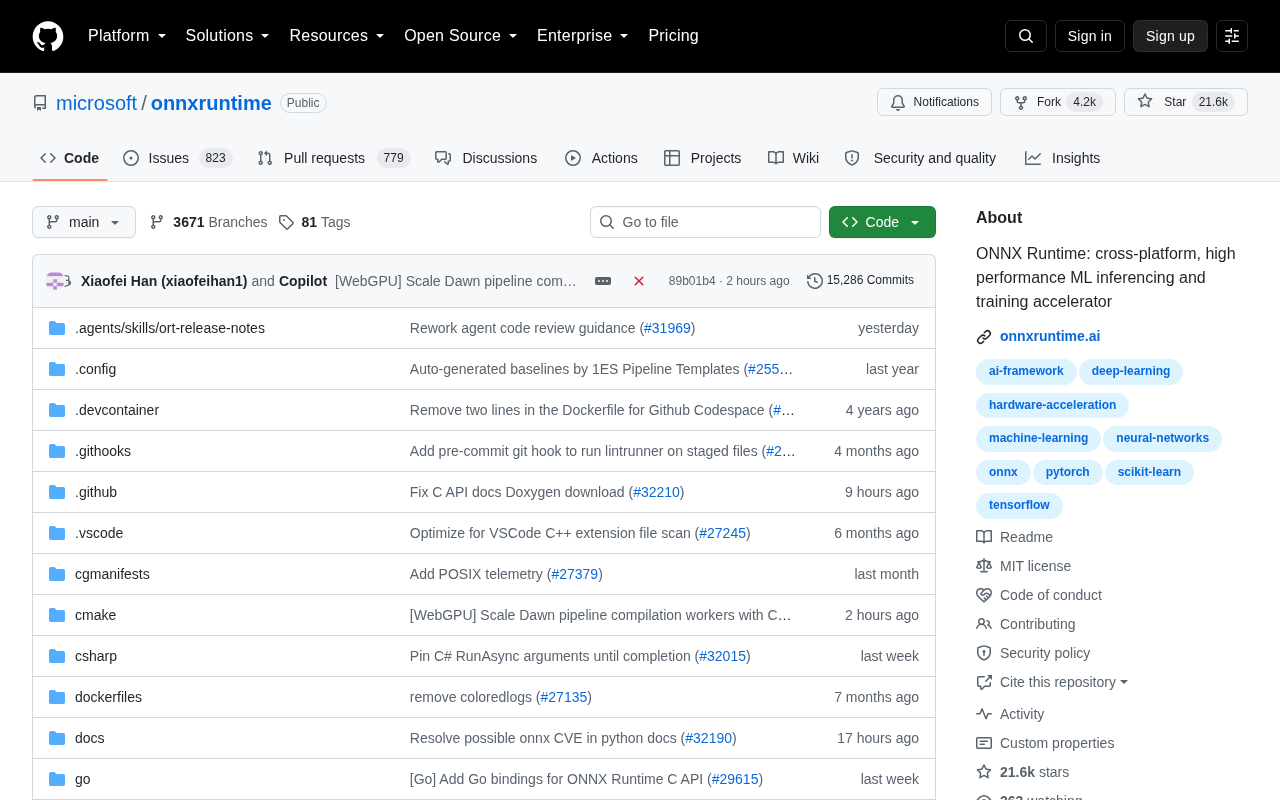
ONNX Runtime is an open-source machine learning inference and training acceleration engine primarily developed by Microsoft. With over 21,500 stars and more than 4,100 forks on GitHub, it stands as one of the most important infrastructure projects in AI deployment. Its core positioning is clear: a cross-platform, high-performance accelerator for machine learning inference and training.
For many developers, completing model training is just the first step—the real challenge lies in efficiently and reliably deploying trained models across various hardware and operating system environments. ONNX Runtime was created to solve this "last mile" problem. It uses ONNX (Open Neural Network Exchange) as a unified model standard, enabling models from different frameworks (such as PyTorch, TensorFlow, Scikit-learn, etc.) to run in a consistent manner.
ONNX was originally co-initiated by Microsoft and Facebook (now Meta) in 2017, and later gained support from companies like AWS, Intel, and NVIDIA. It is now hosted by the LF AI & Data Foundation under the Linux Foundation. ONNX was born from the pain point of deep learning framework fragmentation: different frameworks use different internal representations (IR, Intermediate Representation) to describe computation graphs, making model migration between frameworks extremely difficult. ONNX defines a standardized set of operators (Operator Set) and a computation graph serialization format (based on Protocol Buffers), allowing model structures and weights to be expressed completely and losslessly. The ONNX standard currently covers over 200 standard operators, spanning mainstream operations like convolution, attention mechanisms, and recurrent networks, with continuous version iterations expanding support for new operators.
Core Value: Convert Once, Run Anywhere
Breaking the Barriers Between Frameworks and Hardware
The most fundamental value of ONNX Runtime lies in its "abstraction layer" design philosophy. Developers can complete model training in their preferred deep learning framework, export the model to ONNX format, and then hand it off to ONNX Runtime for execution in production environments. The benefits of this decoupling are obvious: training teams and deployment teams can use their respective best-fit tools without being locked into the same technology stack.
The project itself is primarily written in C++, ensuring high performance and low latency at runtime. It also provides binding interfaces for multiple languages including Python, C#, Java, and JavaScript, covering the full spectrum of application scenarios from server-side to mobile, from cloud to edge.
Computation Graph Optimization: The Core Engine for Inference Acceleration
Before executing inference, ONNX Runtime performs multi-level Graph Optimization on the model's computation graph. A computation graph is a Directed Acyclic Graph (DAG) representation of a deep learning model, where nodes represent operator operations (such as matrix multiplication and activation functions), and edges represent the flow of tensor data.
ONNX Runtime's graph optimization is divided into three levels: Basic optimization includes Constant Folding (computing constant expression results at compile time) and redundant node elimination; Extended optimization includes Operator Fusion—for example, fusing three consecutive operations like MatMul + Add + ReLU into a single kernel call, thereby reducing memory read/write operations and kernel launch overhead; Layout optimization adjusts data storage formats according to the target hardware (such as converting from NCHW to NHWC). These optimizations typically yield 10%-50% inference performance improvements and are completely transparent to users.
Execution Providers (EP) Mechanism
Much of ONNX Runtime's high performance is attributable to its unique Execution Providers (EP) architecture. Through this plugin-based mechanism, the same model can automatically select the optimal hardware acceleration backend based on the deployment environment, including:
- CPU: Default execution backend
- NVIDIA CUDA/TensorRT: GPU-accelerated inference
- Intel OpenVINO: Intel hardware optimization
- AMD ROCm: AMD GPU support
- Qualcomm SNPE: Mobile NPU acceleration
- Windows DirectML: Universal GPU acceleration on Windows
The Execution Provider design is essentially an engineering implementation of the Strategy Pattern. After ONNX Runtime loads a model, it traverses each node in the computation graph and sequentially queries registered execution providers about whether they can handle that node. Each EP "claims" the nodes it can accelerate based on its capabilities, and unclaimed nodes fall back to the default CPU execution backend. This design allows different parts of a model to execute on different hardware—for example, a Transformer's attention layers can be accelerated on GPU via TensorRT, while certain custom post-processing operations run on CPU.
When NVIDIA TensorRT serves as an EP, it further compiles subgraphs into highly optimized engines, leveraging layer fusion, precision calibration, and automatic kernel tuning to achieve throughput approaching the theoretical hardware peak on NVIDIA GPUs. Intel OpenVINO achieves acceleration by mapping operators to Intel CPU's AVX-512 and VNNI instruction sets.
This means developers don't need to rewrite deployment code for each hardware target—ONNX Runtime handles mapping the computation graph to the corresponding acceleration libraries under the hood, extracting maximum hardware performance without sacrificing generality.
Beyond Inference: ONNX Runtime Training Acceleration
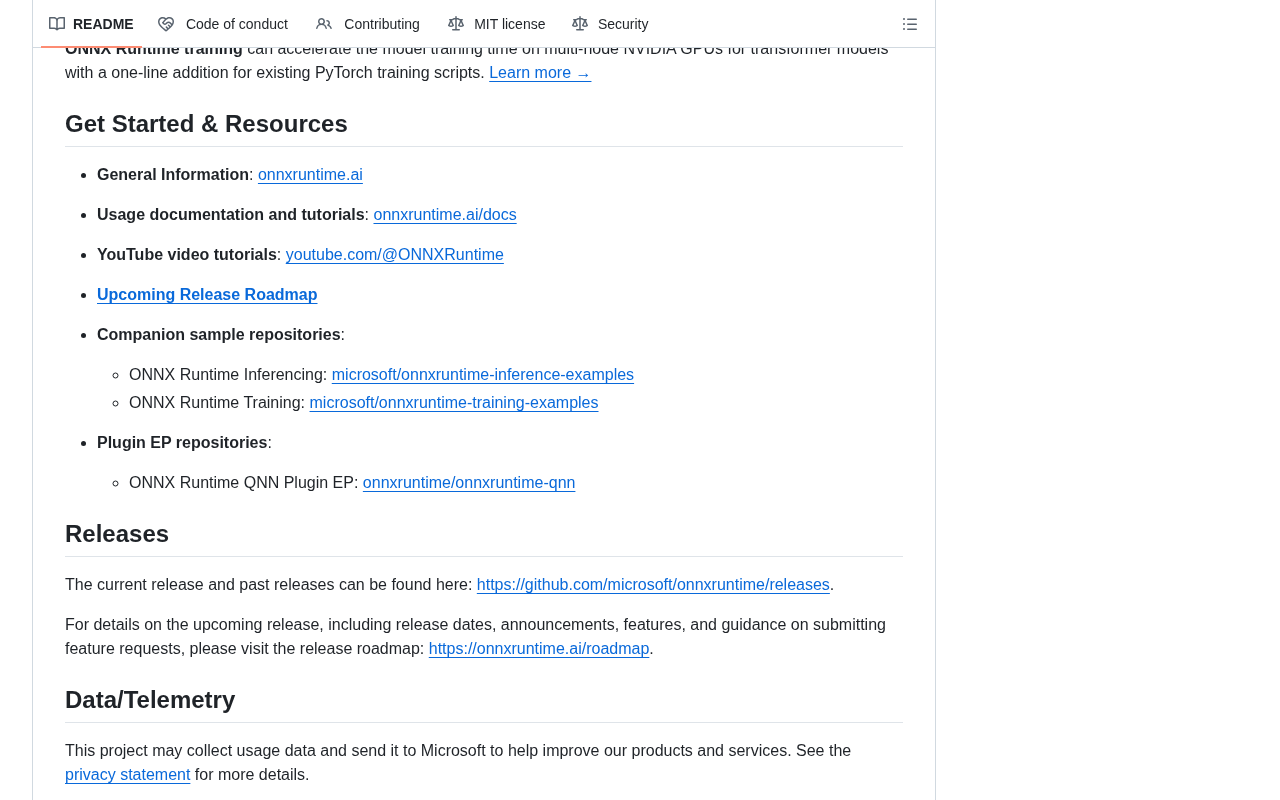
Many people's impression of ONNX Runtime is still limited to "inference engine," but it actually possesses training acceleration capabilities as well. The ORT Training module can optimize large-scale model training processes, particularly excelling in distributed training and memory optimization.
The core optimization techniques of the ORT Training module include memory optimization and computation graph rewriting. For memory optimization, it employs Gradient Checkpointing technology—saving only partial intermediate activation values during forward propagation and recomputing them on-demand during backward propagation, trading time for space to reduce peak memory usage. Additionally, ORT Training implements partial functionality of the ZeRO (Zero Redundancy Optimizer) optimizer, breaking through single-GPU memory bottlenecks by sharding optimizer states, gradients, and parameters across multiple GPUs. At the computation graph level, ORT Training can export PyTorch model forward and backward computation graphs to ONNX format, then apply graph optimization techniques similar to inference (such as operator fusion) to accelerate the training process. Microsoft's DeepSpeed library has deep integration with ORT Training, and their combination enables efficient training of models with tens of billions of parameters on clusters with thousands of GPUs.
For teams needing to fine-tune large language models or vision models, ONNX Runtime's training acceleration can integrate with existing PyTorch workflows, delivering considerable throughput improvements and training cost reductions in certain scenarios. This unified "training + inference" capability allows it to play a role throughout the entire model lifecycle.
Typical Application Scenarios for ONNX Runtime
Edge and Mobile Deployment
As AI capabilities move toward edge devices, running models in resource-constrained environments has become a critical challenge. ONNX Runtime provides specialized mobile and web versions (ONNX Runtime Web, based on WebAssembly and WebGPU), enabling models to run directly in browsers or on phones without relying on cloud computing, balancing both privacy protection and response speed.
ONNX Runtime Web's implementation relies on two key web standard technologies. WebAssembly (Wasm) is a binary instruction format that allows code written in languages like C/C++/Rust to run in browsers at near-native speed. ONNX Runtime compiles its C++ inference kernels into Wasm modules and accelerates CPU-side inference through SIMD (Single Instruction, Multiple Data) extensions and multi-threading support. WebGPU is the next-generation successor to WebGL, providing low-level access to modern GPUs (similar to Vulkan/Metal/DX12), making GPU-accelerated tensor computation possible in browsers. Compared to sending data to the cloud for processing, browser-side inference offers the advantages of zero network latency, fully localized data privacy, and AI functionality without backend infrastructure. This is particularly important for sensitive data processing (such as medical image analysis) and offline scenarios.
Production-Grade Cloud Services
Within Microsoft, ONNX Runtime has been widely deployed in large-scale production services including Office, Bing, and Azure, handling massive daily inference requests. This background of "internal large-scale validation" is an important reason it has earned industry trust—it's not a laboratory toy but a mature infrastructure that has been battle-tested at industrial scale.
Large Model Inference Optimization
In the current generative AI wave, ONNX Runtime actively adapts to the inference needs of large language models, offering graph optimizations for Transformer architectures, quantization (INT8/INT4), and KV Cache management to help reduce memory usage and inference latency for large model deployment.
Quantization is a technique that converts floating-point weights and activation values in models from high precision (FP32) to low precision (INT8 or INT4) representations. The core idea is to trade a small amount of precision for significant memory savings and computational speedup. ONNX Runtime supports two main quantization approaches: Post-Training Quantization (PTQ) and Quantization-Aware Training (QAT). PTQ directly quantizes weights after model training is complete, typically requiring a small batch of calibration data to determine quantization parameters (i.e., scale and zero_point); QAT simulates quantization effects during training, allowing the model to learn to adapt to low-precision representations, usually achieving better accuracy preservation.
For large language models, INT4 quantization (such as GPTQ and AWQ algorithms) has become mainstream practice, reducing model memory usage to 1/8 of the original, enabling models with 70B parameters to run on a single consumer-grade GPU. KV Cache quantization specifically targets autoregressive generation scenarios, compressing the storage space for key-value pairs in attention mechanisms, which is particularly critical for long-context inference.
Ecosystem Support and Developer Onboarding Experience
As a mature open-source project, ONNX Runtime has active community support and comprehensive documentation. It is released under the MIT license, which is friendly to commercial use. The continuously growing star count and fork numbers also reflect its sustained high level of community attention.
For developers encountering it for the first time, ONNX Runtime has a relatively low barrier to entry. Taking Python as an example, you simply install the onnxruntime package via pip, load an ONNX model file, and call InferenceSession to perform inference. For teams pursuing maximum performance, they can dive deeper into configuring execution providers, graph optimization levels, and quantization strategies.
Summary
The significance of ONNX Runtime lies in providing a unified, efficient, cross-platform standardized solution for the fragmented AI deployment ecosystem. Whether it's a startup team quickly validating models or a large enterprise building production-grade AI services, it can significantly reduce deployment complexity and improve runtime efficiency.
In today's landscape of ever-emerging frameworks and diverse hardware platforms, the "universal translation layer" role that ONNX Runtime plays will only become more important. For any developer focused on AI engineering and productionization, it is a core tool worth mastering in depth.
Related articles

Amphibious Transforming Drone: Beyond 100x Power Savings, What Are the Real Needs?
Is the amphibious transforming drone just a gimmick? Starting from the 100x power difference of the M4 Morphobot, explore real application scenarios and thesis topic ideas, analyzing boundary conditions where pure drones and pure ground robots both fail.

Warhound Raises $200 Million: Genetically Engineered "War Dogs" Paired with Anduril Gear
Warhound raises $200M, backed by Ben Lamm and Palmer Luckey, to genetically engineer dogs for military and law enforcement use and equip them with Anduril gear. This article analyzes its technology direction, funding logic, and ethical controversy.

Claude API Comes to Google Cloud: IAM Integration and SDK Access Guide
Anthropic hosts the full Claude API on Google Cloud with IAM-controlled permissions and unified billing. This guide covers the Vertex AI and Anthropic-hosted entry points, IAM role configuration, and SDK access.