Open MicroManipulator: An Open-Source Sub-Micrometer 3D Motion Control Platform

Open MicroManipulator offers an open-source sub-micrometer 3D motion control platform, aiming to break the commercial monopoly on precision control.
Open MicroManipulator is an open-source project discussed on Hacker News, positioned as a reproducible, modifiable sub-micrometer 3D motion control platform. It decomposes a previously closed precision motion control system into hardware design, control algorithms, and software interfaces, released as open source. Sub-micrometer precision relies on high-resolution actuators, low-noise drive circuits, and closed-loop feedback control. The reproduction difficulties for open-source solutions center on error compensation for thermal drift, vibration coupling, and sensor noise. The project's niche lies between scientific instruments and developer tools, with potential users including academic teams needing low-cost micromanipulation platforms and engineers developing automated micromanipulation workflows. Its success depends on documentation quality, the openness of calibration data, and community activity—not mechanical drawings alone.
Open-Source Hardware Enters Precision Control
In precision manufacturing and micromanipulation, sub-micrometer 3D motion control has long been dominated by a handful of commercial vendors. The Open MicroManipulator project offers an open-source alternative to this situation. The project sparked discussion on Hacker News, positioned as a reproducible, modifiable sub-micrometer 3D motion control platform.
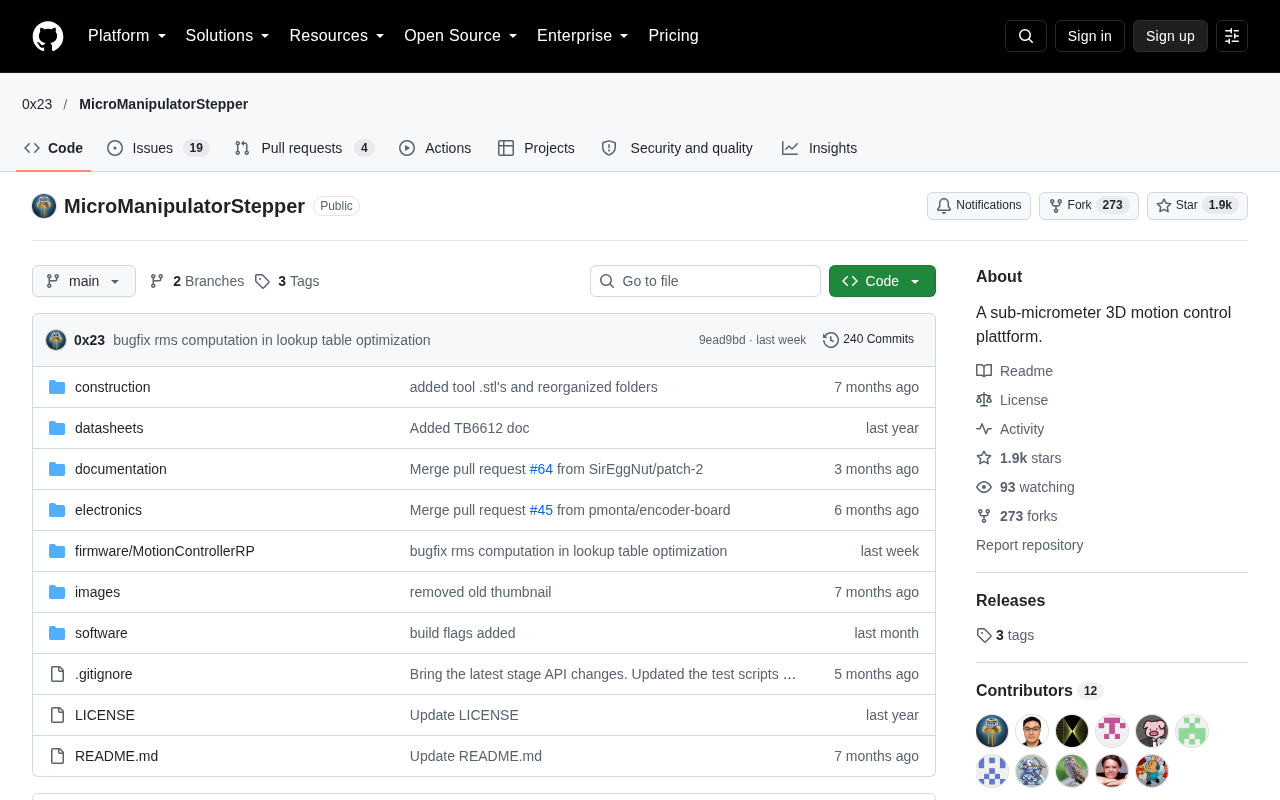
Based on public information, the project's core value lies not in stacking specifications but in decomposing a previously closed precision motion control system into three parts—hardware design, control algorithms, and software interfaces—and releasing them as open source. For research teams and small laboratories that need customized micromanipulation capabilities, this means they no longer have to build from scratch or bear the high cost of purchasing commercial systems.
What Sub-Micrometer Precision Means
Sub-micrometer refers to resolution or positioning accuracy better than 1 micrometer. This magnitude is a basic threshold in scenarios such as biological micromanipulation, micro/nano fabrication, and optical alignment. Achieving this precision typically requires the combination of high-resolution actuators, low-noise drive circuits, and closed-loop feedback control.
The difficulty for open-source solutions at this stage is that thermal drift of mechanical structures, vibration coupling, and sensor noise are hard to fully compensate through software alone. If Open MicroManipulator is to truly reach sub-micrometer specifications, the openness of its hardware design and calibration procedures will directly determine whether the community can reproduce results of the same precision. This is also the technical highlight worth watching: whether it provides a complete error budget and calibration methodology, rather than just a set of mechanical drawings.
Closed-loop feedback control is the core mechanism of precision motion control: the system measures the actuator's actual position in real time through position sensors (such as linear encoders, capacitive displacement sensors, or laser interferometers), compares the measured value with the target value to generate an error signal, and then the controller drives the actuator to eliminate the deviation. Compared with open-loop systems, closed-loop control can compensate for uncertainties such as mechanical backlash, thermal drift, and load disturbances. Sub-micrometer closed-loop systems impose strict requirements on sensor resolution, control loop bandwidth, and sampling delay—for example, if sensor noise reaches tens of nanometers, the controller may treat the noise as a real deviation and repeatedly adjust, thereby introducing jitter. Therefore, allocating the error budget (how much is attributed to the actuator, sensor, structure, and electronics) is the starting point for designing such systems.
Error budget is a systematic analysis method in precision engineering: it decomposes the total accuracy specification layer by layer into individual error sources, including Abbe error (cosine error caused by the measurement axis and motion axis not being collinear), thermal expansion, vibration, sensor nonlinearity, and actuator resolution, and assigns an acceptable upper limit to each. A reproducible open-source precision platform must disclose its error budget table; otherwise, reproducers cannot determine which components can be substituted and which must be strictly matched. This is also a key basis for evaluating the depth of Open MicroManipulator's documentation.
The Ecological Niche of Open-Source Motion Control Platforms
Open-source projects in precision motion control are rare, because this field relies heavily on accumulated engineering experience. Most open-source robotic arm or CNC projects remain at millimeter-level precision, and sub-micrometer open-source practices are relatively scarce. Open MicroManipulator is positioned between scientific instruments and developer tools, and may attract two types of users: academic teams that need to build micromanipulation platforms at low cost, and engineers who want to develop automated micromanipulation workflows on top of it.
The project's success depends on documentation quality and community activity. The reproduction barrier for precision hardware projects is far higher than for pure software projects; without detailed assembly instructions, calibration steps, and troubleshooting guides, open-source designs can easily remain at the stage of "looks good but unusable."
Actuators are the executing elements of precision motion platforms. Common types include piezoelectric ceramic actuators (resolution down to the nanometer level, but with a stroke of only tens of micrometers), stepper motors with precision lead screws (large stroke but resolution limited by screw lead and microstepping drive), voice coil motors (balancing stroke and resolution), and flexure hinge mechanisms (no backlash, no friction, suitable for micro/nano manipulation). Sub-micrometer platforms usually adopt hybrid solutions: large strokes are driven by motors or voice coils, and fine adjustment is performed by piezoelectric actuators, with the two connected in series to form coarse and fine positioning stages. Different types of actuators differ significantly in stiffness, response speed, heat generation, and cost. Open-source designs need to clearly state the chosen solution and its applicable boundaries; otherwise, reproducers may apply it in the wrong scenarios.
Directions Worth Watching
Developers interested in micromanipulation and precision control can start by evaluating reproducibility from the project repository's hardware design files and control software interfaces. If the project subsequently discloses calibration data and measured precision reports, its practical value will increase significantly. Against the backdrop of persistently high commercial system prices, a well-documented, community-active open-source sub-micrometer control platform has the potential to become a low-cost starting point for laboratory-grade precision manipulation.
One-line Summary
Open MicroManipulator provides an open-source sub-micrometer 3D motion control platform, attempting to break the commercial monopoly on precision control.
Paragraph Summary
Open MicroManipulator is an open-source project discussed on Hacker News, positioned as a reproducible, modifiable sub-micrometer 3D motion control platform that decomposes a previously closed precision motion control system into hardware design, control algorithms, and software interfaces, released as open source. Sub-micrometer precision relies on the combination of high-resolution actuators, low-noise drive circuits, and closed-loop feedback control. The reproduction difficulties for open-source solutions center on error compensation for thermal drift, vibration coupling, and sensor noise. The project's niche lies between scientific instruments and developer tools, with potential users including academic teams needing low-cost micromanipulation platforms and engineers developing automated micromanipulation workflows. Its success depends on documentation quality, the openness of calibration data, and community activity—not mechanical drawings alone.
Related articles

Random Pruning of the DPO Computation Graph: 1.4x Training Speedup and Lower Peak Memory
DPO training too slow and memory-hungry? This paper proposes a random pruning framework for the DPO computation graph, sampling independently across position, sequence, and branch dimensions; branch pruning achieves a 1.426x step-time speedup and cuts training time by about 30%, with in-depth attribution of memory and time gains.

Why Does JEPA Underperform MLM in Longitudinal EHR Representation Learning?
New study compares JEPA and MLM for longitudinal EHR representation learning on MIMIC-IV: three JEPA variants train stably without collapse but underperform MLM; target size, not heterogeneity, drives prediction error.

Transfer Learning + Visible Light Communication: A New Approach to Energy-Efficient Indoor Positioning
A study proposes a transfer learning-based visible light communication indoor positioning method, achieving 47% accuracy improvement on the BOSCH factory dataset, 67.5% model efficiency under high noise, and introducing the ME composite metric for energy-efficient positioning in energy-constrained industrial IoT scenarios.