Open-Source Coding Agent fx Comes to T3 Code: Full Support for Web, Desktop, and Mobile
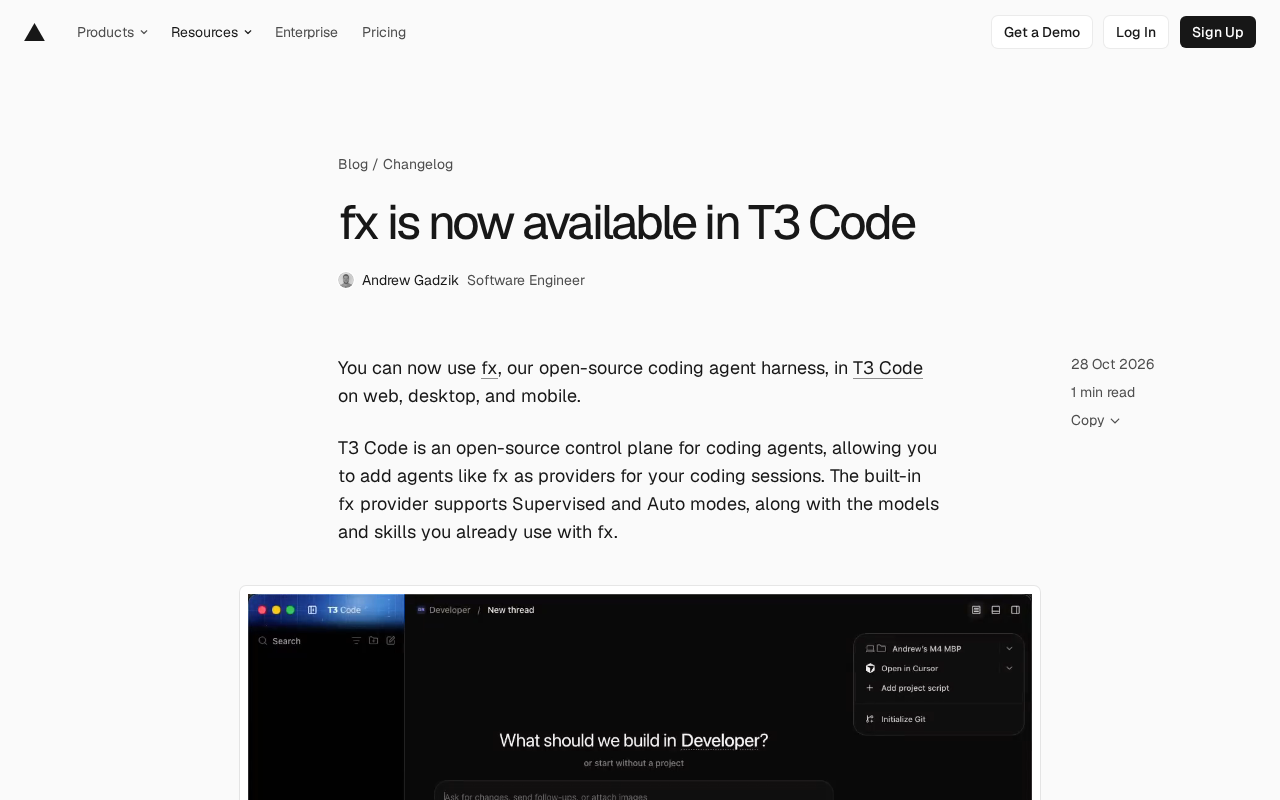
Open-source coding agent fx is now integrated into T3 Code, supporting web, desktop, and mobile.
The open-source coding agent fx has been officially integrated into T3 Code, available on web, desktop, and mobile. T3 Code connects fx via a built-in provider mechanism with Supervised and Auto modes, compatible with existing fx models and skills. Setup: install fx, configure a model provider, then add fx in T3 Code under Providers > Add provider.
The open-source coding agent tool fx has now been officially integrated into T3 Code, allowing users to use this coding agent across web, desktop, and mobile. As an open-source control plane for coding agents, T3 Code lets developers add agents like fx as providers for coding sessions, further expanding the use cases for coding agents.
How fx Integrates with T3 Code
According to official information, T3 Code provides built-in provider support for fx, including two modes—Supervised and Auto—and is compatible with the models and skills users already use in fx. This means developers can call fx directly within T3 Code for coding tasks without reconfiguring models or skills.
The integration path is clear: first install fx and set up a model provider, then download T3 Code and add fx via "Providers > Add provider" in settings. This process lowers the barrier for new users and makes it easy for existing fx users to migrate quickly.
T3 Code's Positioning and Value
T3 Code is described as "the open-source control plane for coding agents," with its core role being to uniformly manage and orchestrate multiple coding agents. By connecting fx as a provider, T3 Code enhances its usefulness as a control plane, letting developers switch between different agents or modes within a single interface without jumping between multiple tools.
This design caters to the current trend of fragmentation in the coding agent ecosystem—developers often need to use multiple agent tools simultaneously, and the control plane model promises to simplify workflows and improve efficiency.
Coding Agent Control Plane is an analogy borrowed from the "control plane" concept in the cloud-native space: just as Kubernetes' control plane handles scheduling and orchestration without directly executing business workloads, a coding agent control plane handles unified access, switching, and orchestration of multiple underlying coding agents, without being tied to any single agent implementation. It typically provides unified session management, authentication, model and skill configuration, and cross-platform interfaces, enabling developers to swap or combine different agent backends without changing their working habits. The value of this architecture lies in decoupling the "interaction layer" from the "execution layer," avoiding the need to relearn a toolchain every time a new agent is introduced.
Use Cases and Mode Selection
fx offers two modes in T3 Code: Supervised and Auto. Supervised mode likely emphasizes human oversight and intervention, suitable for coding tasks requiring fine-grained control; Auto mode leans toward automated execution, suitable for repetitive or standardized tasks. Users can switch flexibly based on task complexity.
Additionally, the built-in provider supports users' existing models and skills, avoiding the hassle of duplicate configuration. For developers already using fx, migration costs are low, allowing them to quickly continue their existing working habits in T3 Code.
The difference between Supervised and Auto essentially corresponds to levels of autonomy for agents. In Supervised mode, the agent requires human confirmation before writing files, executing commands, or committing changes—a "human-in-the-loop" approach suitable for tasks involving production code, sensitive repositories, or unclear requirements; Auto mode allows the agent to execute multiple steps consecutively and decide tool calls on its own, reporting results only at the end—suitable for scenarios with clear boundaries such as boilerplate generation, batch refactoring, and test completion. In practice, the higher the autonomy, the greater the demands on the agent's contextual understanding and error recovery capabilities, so most teams dynamically switch based on task risk rather than fixing on one level.
Synergy in the Open-Source Ecosystem
Both fx and T3 Code are open-source projects, and this integration reflects the collaborative trend in the open-source community within the coding agent space. Through open integration, the two projects can leverage each other: fx gains a broader entry point, while T3 Code enriches its agent supply, creating a virtuous cycle.
Contributors Pranit Sharma, Esteban Suárez, and Ben Sabic participated in this integration work. The public and transparent contributor list of open-source projects also enhances the project's credibility.
For developers, they can now follow the official guidance to install fx, configure a model provider, and download T3 Code to add fx, experiencing cross-platform coding agent collaboration.
The Provider mechanism is a key abstraction for the extensibility of such control planes. It encapsulates "how an agent is invoked" into a unified interface, including session creation, streaming output, tool permission declarations, and resolution of model/skill configuration. Third-party projects only need to implement this interface and register to be recognized by the control plane, without modifying core code. The direct benefit of this plugin-based design is that new agents don't have to wait for a control plane release, and integrators can evolve independently; the cost is that the interface contract must remain stable, otherwise providers can easily break due to version drift.
One-line Summary
Open-source coding agent fx is now officially integrated into T3 Code, supporting web, desktop, and mobile
Paragraph Summary
The open-source coding agent tool fx has been officially integrated into the open-source control plane T3 Code, allowing users to use it across web, desktop, and mobile. T3 Code connects fx through a built-in provider mechanism, offering Supervised and Auto modes and remaining compatible with users' existing models and skill configurations in fx without re-setup. The integration path is: install fx and configure a model provider, then download T3 Code and add fx via Providers > Add provider in settings. This integration gives fx a broader entry point and enriches T3 Code's agent supply, reflecting the open-source community's collaborative trend in the coding agent space; contributors include Pranit Sharma, Esteban Suárez, and Ben Sabic.
Related articles

T3 Code: The Open-Source AI Coding Assistant's Comeback Story
T3 Code is an open-source AI coding assistant that unifies subscriptions like Codex and Claude, with powerful remote control and parallel task management.

Never Elected, Yet Ruled New York for 30 Years: The Ultimate Case Study in the Mechanics of Power
Robert Caro's biographies reveal how unelected Robert Moses ruled New York for 30 years through legal drafting and public authorities, and how Lyndon Johnson built leverage as a "powerless" Senate Majority Leader. Unpacking the underlying logic of accumulating and sustaining power.

The CPython 3.10 Recursion Trap and Synthetic Recovery in TokenGuard, an LLM Circuit Breaker
TokenGuard's author recounts a recursion crash caused by OrderedDict.pop in CPython 3.10 and introduces v0.3.0's Loop Nudge synthetic recovery, inline DLP scanning, and other new LLM agent circuit-breaker capabilities.