Open-Source Desktop Robot watcherobot0.5 Adds Face Tracking
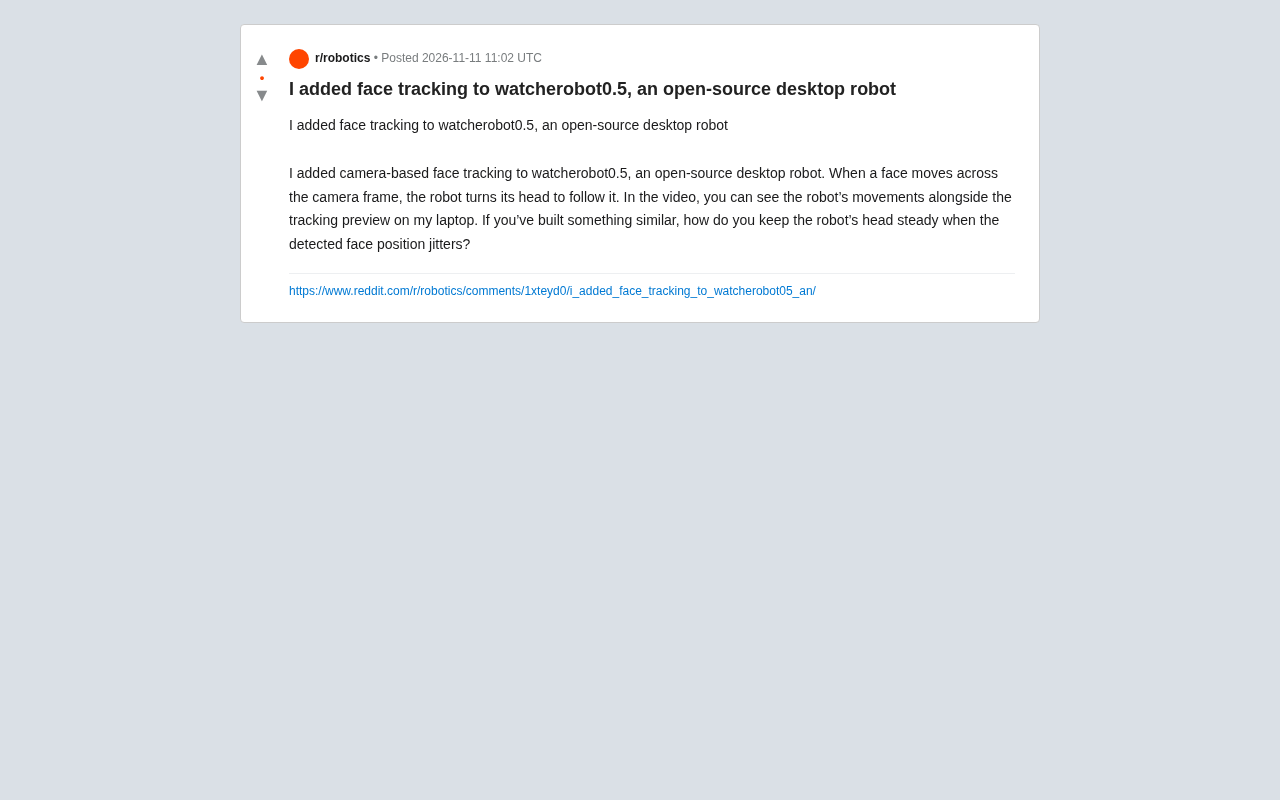
Open-source desktop robot watcherobot0.5 adds camera-based face tracking and publicly seeks jitter suppression solutions.
The open-source desktop robot project watcherobot0.5 adds camera-based face tracking: when a face moves within the frame, the robot's head turns to follow it. The author posted a demo video on Reddit and raised a key engineering question: face detection coordinates jitter across consecutive frames, causing unstable head motion. The article analyzes the causes and outlines common mitigation approaches, including moving average or low-pass filtering, deadband thresholds, limiting servo angular velocity, and prediction models that add latency. Choosing an approach requires balancing the low inertia and fast response of desktop robots against limited tuning space. The author's candid question invites the community to jointly validate different strategies, reflecting the collaborative rhythm of open-source hardware projects: get a minimum feature working first, then expose edge-case problems.
The open-source desktop robot project watcherobot0.5 has recently gained a new capability: camera-based face tracking. When a face moves within the frame, the robot turns its head to follow the target. The author shared a demo video on Reddit showing both the robot's motion and a tracking preview on a laptop, while raising an engineering detail question—how to suppress jitter in the detected face position so the head moves more smoothly.

From a Static Desktop to Dynamic Following
Desktop robots have long been stuck in the "moves but doesn't see" stage, with most products relying on preset motions or voice commands to trigger feedback. This update to watcherobot0.5 brings visual perception into the motion control loop: the camera captures frames, face detection outputs position coordinates, and the robot's head adjusts its orientation accordingly.
This closed loop looks simple but actually involves coordination across image capture, object detection, coordinate mapping, and servo control. The author did not disclose the specific algorithm choice, but from the description that "head turning is triggered when the face moves within the camera frame," the system appears to operate in real time or near real time, and latency directly affects the tracking experience.
The open-source nature makes such attempts more valuable as references. Desktop robot hardware costs are relatively manageable, and developers can add vision modules on top of existing platforms without building an entire machine from scratch. watcherobot0.5's approach provides a reusable feature slice for similar projects.
The Jitter Problem: A Small Detail Behind a Control Challenge
The question the author raised at the end of the post deserves elaboration: the position coordinates from face detection are not always stable, and the same stationary face may jitter slightly across consecutive frames. Driving the head directly with these coordinates results in "twitching" or "overshoot." This is not a defect unique to watcherobot0.5 but a common challenge for visual servoing systems.
Common mitigation approaches include applying temporal smoothing filters to the detection coordinates, such as moving average or low-pass filtering; setting a deadband so that rotation is not triggered when position changes fall below a threshold; and limiting servo angular velocity to mask input noise with motion constraints. More complex solutions introduce prediction models that estimate the next frame's position based on historical trajectories, but this adds extra latency.
Which approach to choose depends on the robot's mechanical characteristics and use case. Desktop robots have low inertia and fast response; too much filtering makes tracking feel sluggish, while too little leaves noticeable jitter, and the tuning space is not generous. By asking publicly, the author is effectively inviting the community to jointly validate the trade-offs among different strategies.
Visual Servoing refers to a closed-loop control method that uses visual sensors (such as cameras) to obtain target position information and accordingly controls actuators (such as servos or robotic arms) in real time. It is generally divided into two categories: image-based (IBVS) and position-based (PBVS). The former computes control values directly in the image coordinate system, while the latter converts image coordinates into 3D spatial coordinates before control. watcherobot0.5's face tracking is essentially a simplified instance of visual servoing—the camera provides the pixel coordinates of the face in the frame, and the system maps them to target angles for the head servo. The core difficulty of visual servoing lies in latency, noise, and mismatched sampling rates in visual feedback, which is precisely the root cause of the jitter problem and the background for the author's question to the community.
Deadband in control systems refers to a deliberately set range in which input changes do not produce a response: when the magnitude of input change is below the threshold, the system produces no output action. In a face tracking scenario, if the difference between the detected face center coordinates in two consecutive frames is smaller than a preset pixel threshold, the servo target angle is not updated. A deadband can effectively filter out small jitter from the detector on stationary targets, avoiding frequent micro-adjustments of the head. However, if the deadband is too large, tracking develops a "stepped" feel or response lag; if too small, it cannot suppress noise. In engineering practice, deadbands are often combined with low-pass filtering to balance smoothness and tracking sensitivity.
The Value of Open-Source Collaboration
The watcherobot0.5 update reflects the typical rhythm of open-source hardware projects: first get a minimum viable feature working, then expose edge-case problems to the community. Face tracking itself is not a new topic, but applying it to a specific desktop robot surfaces constraints different from a pure software environment—field of view, mounting angle, and servo precision all change how the algorithm performs.
The way the author asked the question is also noteworthy: rather than claiming the solution is perfect, the author clearly points to an unresolved engineering pain point. This honesty tends to attract more effective feedback in technical sharing and helps newcomers avoid detours.
For developers who want to reproduce similar functionality, watcherobot0.5 provides a starting point. The real effort often lies not in calling the detection algorithm but in the "glue layer" details such as coordinate mapping and motion smoothing.
One-line Summary
Open-source desktop robot watcherobot0.5 adds camera-based face tracking, and the author publicly seeks jitter suppression solutions.
Paragraph Summary
The open-source desktop robot project watcherobot0.5 adds camera-based face tracking: when a face moves within the frame, the robot's head turns to follow it. The author posted a demo video on Reddit and raised a key engineering question: face detection coordinates jitter across consecutive frames, and driving the head directly with them causes unstable motion. The article analyzes the causes and outlines common mitigation approaches, including moving average or low-pass filtering of detection coordinates, setting deadband thresholds, limiting servo angular velocity, and introducing prediction models at the cost of latency. Choosing an approach requires weighing the low inertia and fast response of desktop robots against limited tuning space. By asking candidly, the author invites the community to jointly validate different strategies, reflecting the collaborative rhythm of open-source hardware projects: get a minimum feature working first, then expose edge-case problems.
Related articles

Gemini 4 Dual Models Exposed, Genie 4 World Model Launches, AI R&D Self-Accelerates
November 19 AI evening news roundup: DeepMind Gemini 4 Sodium rumors surface, Cursor launches Gemini 4 Neon scoring 63.7% on CursorBench 4.1; Genie 4 world model goes live with real-time editing and native audio; WorkBuddy integrates GPT-6.2 series; OpenAI discloses AI chip design efficiency gains and RSI research metrics.
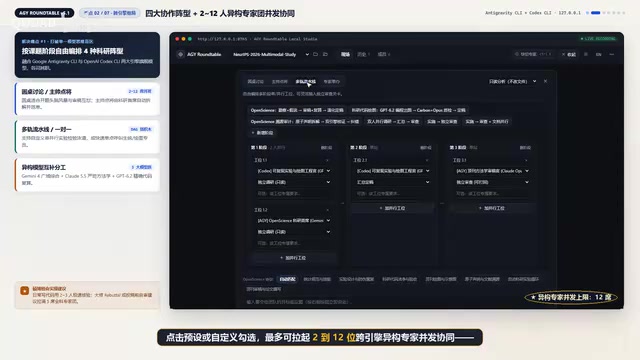
HY Roundtable: A Local Open-Source Multi-Agent Roundtable Where Multiple LLMs Blind-Review and Challenge Each Other's Papers
HY Roundtable is a local open-source multi-agent roundtable tool that brings Gemini 4, Claude Opus 5.5, and GPT 6.2 into a local seminar room to blind-review, cross-examine, and recompute code before submission, with built-in Open Science protocols for statistics and figures.

GPT 6.2, Fable 5.2, Gemini 4 Tested: Which Builds the Best Game UI from a Single Image?
Bilibili creator tests GPT 6.2, Fable 5.2, and Gemini 4 generating full game UI from one image: all work functionally, but fidelity and interaction quality differ sharply. Fable 5.2 looks best but caused infinite-loop crashes; GPT 6.2 is balanced but drifts from icons; Gemini 4 looks cheap. Includes LGUI Agent workflow and engine export details.