Open-Source Firmware Cracks Feetech Servos, Significantly Boosting SO-ARM Robot Precision

Open-source firmware cuts SO-ARM101/102 positioning error from 35mm and 25mm to 10mm and 0–2mm, no hardware swap needed.
In the open-source robotics community, SO-ARM robotic arms are popular for their low cost and educational friendliness, but Feetech STS32XX servo positioning errors have long troubled users. The GitHub project STS32XX-Firmware modifies servo firmware—rewriting the position loop algorithm and optimizing encoder filtering and linearization—dramatically improving precision without hardware replacement: SO-ARM101 end-effector error drops from 35mm to 10mm, SO-ARM102 from 25mm to 0–2mm. The article covers error sources, technical approach, measured data, and community significance, noting that firmware optimization cannot overcome physical limits like gear backlash and encoder resolution; it best suits education, maker, and small automation prototyping scenarios.
From 35mm to 10mm: The Precision Leap Brought by a Single Firmware Patch
In the open-source robotics community, the SO-ARM series robotic arms have attracted considerable attention for their low cost and educational friendliness. However, the Feetech STS32XX series servos they use have a long-criticized problem: positioning error. According to project information shared in the Reddit community, a developer has nearly eliminated this error by writing custom open-source firmware. On the SO-ARM101, positioning error dropped from 35mm to 10mm; on the SO-ARM102, the error was compressed from 25mm to 0–2mm. This improvement requires no hardware replacement—an order-of-magnitude precision gain achieved purely through software optimization.
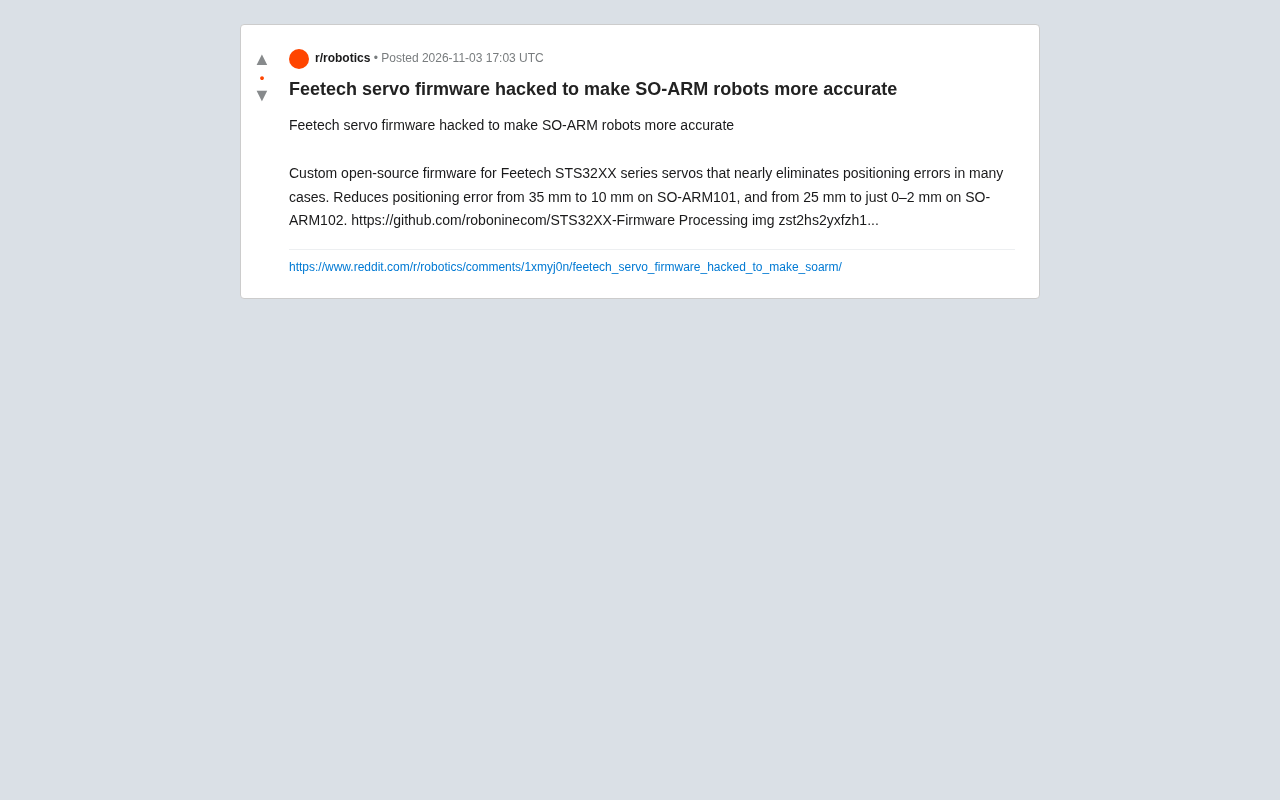
This achievement comes from the open-source project STS32XX-Firmware on GitHub, maintained by user roboninecom. The project directly modifies the firmware of the Feetech STS32XX series servos, addressing defects in the stock firmware's position feedback and control logic. For users relying on SO-ARM for teaching, prototyping, or lightweight automation tasks, this means they can obtain more reliable repeat positioning performance without increasing costs.
The Root Cause of Positioning Error: What Does the Stock Firmware Do?
To understand the value of this improvement, one must first understand the source of servo positioning error. Feetech STS32XX series servos obtain position information through internal magnetic encoders, with closed-loop control handled by firmware. The stock firmware leans conservative in response speed and filtering strategy, causing noticeable deviation between actual and target positions during rapid motion or load changes. In addition, some firmware versions handle encoder readings with insufficient nonlinear correction, further amplifying the error.
The serial joint structure of the SO-ARM robotic arm accumulates these single-joint errors onto the end effector. On the SO-ARM101, a 35mm end-effector error is enough to cause fine grasping tasks to fail; while the SO-ARM102's 25mm error is slightly smaller, it still struggles to meet precision-demanding scenarios. The custom firmware significantly reduces single-joint following error by redesigning the control loop and encoder data processing logic, thereby achieving substantial precision improvement at the whole-arm level.
Magnetic encoder is a sensor inside the servo used to measure the output shaft angle, typically consisting of a radially magnetized magnet and a Hall/magnetoresistive chip. The magnet is fixed on the motor shaft, and the chip detects changes in magnetic field direction and outputs corresponding angle signals. Compared to traditional potentiometers, magnetic encoders have no contact wear and higher resolution, but their readings are susceptible to magnet installation eccentricity, temperature drift, and external magnetic field interference, thus requiring firmware linearization correction and filtering. The Feetech STS32XX series servos rely on magnetic encoders for position feedback; if the stock firmware provides insufficient correction, nonlinear errors will appear at the angle extremes or in the middle range, further affecting the robotic arm's end-effector positioning precision.
Technical Approach and Measured Data of the Open-Source Firmware
According to the project description, the core changes of STS32XX-Firmware are concentrated at the firmware level rather than hardware modification. The developer rewrote the position loop control algorithm, optimized the filtering and linearization processing of encoder signals, and adjusted the feedback frequency in the communication protocol. These changes enable the servo to respond more quickly to position commands while reducing steady-state error.
The measured results directly demonstrate the improvement:
- SO-ARM101: Positioning error reduced from 35mm to 10mm—a clear improvement, though not yet sub-millimeter.
- SO-ARM102: Positioning error reduced from 25mm to 0–2mm, nearly eliminating perceptible end-effector deviation.
The SO-ARM102's performance is particularly outstanding, which may be related to its mechanical structural rigidity and joint configuration. The 0–2mm error range is already approaching the practical precision threshold of consumer-grade robotic arms, enabling the SO-ARM102 to handle more delicate operational tasks such as small part assembly and experimental sample handling.
Position loop control is the innermost loop of servo closed-loop control, whose task is to make the motor's actual position follow the target position command quickly and without steady-state error. Typical digital servos use proportional-integral-derivative (PID) control or simpler proportional control, with control periods usually between 1ms and 10ms. To suppress jitter and reduce power consumption, stock firmware often sets the proportional gain low and the filter time constant large, resulting in response lag and steady-state error. The custom firmware, by increasing control frequency, retuning gains, and introducing feedforward compensation, can significantly improve following performance without substantially increasing motor heat—this is precisely the key to compressing the SO-ARM102's error to 0–2mm.
Significance for the Open-Source Robotics Community
The value of this work lies not only in the data itself but in the path it demonstrates for extracting performance from low-cost hardware. The design philosophy of the SO-ARM series is to make robotics technology accessible to more people, but the precision limitations of stock servos have constrained its application scope to some extent. Through open-source firmware, community users can flash the firmware themselves, achieving performance improvements at zero hardware cost.
The GitHub project page provides firmware files and flashing instructions, lowering the technical barrier. For users with basic embedded development experience, the flashing process is not complicated; for beginners, the community is gradually accumulating tutorials and Q&A. This collaborative model is exactly the typical advantage of the open-source hardware ecosystem: one developer's improvement can quickly benefit the entire user base.
Limitations and Applicable Scenarios
That said, firmware improvements cannot break through the physical limits of the hardware itself. Gear backlash, motor torque ripple, and encoder resolution remain the ultimate constraints on precision. The SO-ARM101 still has 10mm error after improvement, indicating that its mechanical structure or individual servo variations may become new bottlenecks. Additionally, firmware flashing carries certain risks—improper operation may cause the servo to malfunction, so users should evaluate carefully.
In terms of applicable scenarios, this improvement is best suited for users who require repeat positioning precision but have limited budgets, such as educational experiments, maker projects, and small automation prototypes. For industrial applications requiring sub-millimeter precision, higher-spec servo systems should still be chosen.
Conclusion: The Insight of Software-Defined Precision
The Feetech servo firmware cracking case once again confirms a trend: against the backdrop of converging hardware performance, software optimization can unlock considerable additional value. For open-source robotics platforms like SO-ARM, community-driven firmware improvements not only enhance product competitiveness but also enrich learning resources. As more users participate in testing and feedback, such open-source firmware is expected to continue iterating, further narrowing the precision gap between low-cost robotic arms and professional equipment.
One-line Summary
Open-source firmware reduces SO-ARM101/102 positioning error from 35mm and 25mm to 10mm and 0–2mm respectively, without hardware replacement.
Paragraph Summary
In the open-source robotics community, the SO-ARM series robotic arms are widely noticed for their low cost and educational friendliness, but the positioning error of their Feetech STS32XX servos has long troubled users. The GitHub open-source project STS32XX-Firmware modifies servo firmware, rewriting the position loop control algorithm and optimizing encoder filtering and linearization, substantially improving precision without hardware replacement: SO-ARM101 end-effector error drops from 35mm to 10mm, and SO-ARM102 from 25mm to 0–2mm. The article analyzes the source of the error (conservative filtering and insufficient correction in stock firmware), the technical approach, measured data, and community significance, while noting that firmware optimization cannot overcome physical limits such as gear backlash and encoder resolution—the solution is best suited for budget-limited scenarios like education, maker projects, and small automation prototypes.
Related articles

Qwen 3.8 Beats Opus at Coding—But Can Your Mac Run It?
Open-source Qwen 3.8 beats Opus 4.6 at coding at just 18GB, but how much Mac memory do you need? 24GB crashes; 32GB is the sweet spot. Full config guide inside.

Claude Code + Agent: Building a Fully Automated AI Testing Loop
Bilibili course breakdown: how test developers can use Claude Code terminal-based Agents to build a fully automated AI testing loop. Compares permission boundaries of terminal vs. device Agents, explains why enterprise projects choose Claude Code over Open Claude-type tools, and outlines the Node.js environment setup and DeepSeek model integration path.

Working with AI Agents Requires Nerves of Steel
The more autonomous AI agents become, the heavier the user's psychological burden. Drawing from a Hacker News discussion, this article analyzes black-box anxiety, behavior drift, and monitoring fatigue in agent collaboration, and offers practical approaches like sandbox isolation, permission control, and task granularity management to reduce cognitive load.