Open-Source Models in Real-World Android Development Testing: 50% Task Completion Rate Matches Previous-Gen Proprietary Models

Open-source models hit 50% on Android Bench, making local AI-assisted Android development viable.
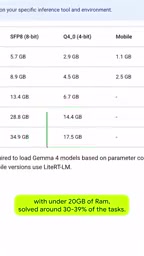
Google's Android Bench reveals that frontier open-weight models now solve 50-60% of real Android development tasks, matching previous-generation proprietary models. Mid-size models like Gemma 4 handle 30-39% of tasks while requiring only 20GB RAM, enabling local deployment on consumer hardware. With Android Studio supporting external model integration, local AI-assisted Android development is now a practical reality offering privacy, cost savings, and offline capability.
Google's Android Bench benchmarking platform recently published performance data for open-weight models on real-world Android development tasks. The results show that frontier open-source models have already achieved capabilities comparable to previous-generation proprietary models, making local AI-assisted development a genuinely viable option.
Frontier Open-Source Models Tested: 50%-60% Task Completion Rate
Since Android Bench was released, the developer community's biggest question has been: how do the latest open-weight models actually perform on real Android tasks? After all, not everyone is willing or able to rely on cloud-based inference services — many developers prefer running models on their personal machines or local workstations.
First, let's clarify a concept: open-weight models are models whose training weights — the specific numerical values of billions of parameters in the neural network — are publicly released, allowing anyone to download and run inference locally. This differs from fully open-source: open-weight models typically release weights and inference code, but don't necessarily share training data, training code, or complete reproduction pipelines. Meta's LLaMA series, Google's Gemma series, and Mistral all fall into this category. This approach lets developers use powerful language models without relying on cloud APIs, while model providers retain a degree of commercial flexibility and intellectual property protection.

The test results delivered an encouraging answer: frontier open-source models can solve an average of 50% to 60% of Android development tasks. This performance is already comparable with prior generation proprietary models, meaning the open-source ecosystem is rapidly closing the gap with commercial models.
It's worth noting that Android Bench is not a general-purpose code benchmark. Unlike general programming evaluations such as HumanEval or MBPP, Android Bench is a benchmark suite specifically designed by Google to evaluate AI model performance on real Android development tasks. It focuses on development scenarios unique to the Android ecosystem, including Kotlin/Java code writing, Jetpack Compose UI construction, Gradle build configuration, and Android SDK API calls. This domain-specific benchmark better reflects a model's true capabilities in actual Android development workflows, avoiding the "high scores, low real-world ability" problem that general benchmarks can produce. As such, the 50%-60% task completion rate carries significant practical reference value.
For development teams prioritizing data privacy, offline availability, or cost control, this is an important milestone. Open-source models are no longer just "barely usable" alternatives — they're becoming tools with real productivity value.
Mid-Size Models Impress: Gemma 4 Needs Only 20GB RAM
Even more noteworthy is the performance of mid-size models. Represented by Google's own Gemma 4, these models solved approximately 30% to 39% of tasks on Android Bench.
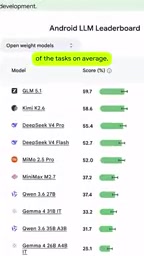
Gemma is a lightweight open-source model series from Google DeepMind, drawing on the technical foundations of the Gemini large model but heavily optimized for local deployment and resource-constrained environments. Gemma 4, the latest iteration in the series, uses a Mixture of Experts (MoE) architecture — meaning that while the total parameter count is large, only a subset of expert networks is activated during each inference pass, dramatically reducing actual computational overhead and memory usage. This is why it can run with less than 20GB of RAM: the active parameters are far fewer than the total model parameters.
These numbers might not look as impressive as the frontier models, but the key factor is the barrier to entry: these models can run on local hardware with less than 20GB of RAM. This means a moderately configured development laptop or workstation can host these models — no expensive GPU clusters or cloud API calls required. Taking the current mainstream MacBook Pro (with Apple Silicon and unified memory architecture) as an example, even the base 24GB memory configuration can run Gemma 4 smoothly. On Windows/Linux workstations, a consumer-grade GPU (such as an NVIDIA RTX 4070 Ti with 16GB VRAM combined with system memory offloading) can also handle the job.
From a practical standpoint, a 30%-39% task completion rate already covers a wide range of everyday development scenarios — code completion, layout suggestions, API usage queries, and other high-frequency tasks. For independent developers and small teams, this kind of "good enough and free" solution is extremely attractive.
Local AI-Assisted Android Development Becomes Reality
These test results send a clear signal: local and offline AI-assisted Android development is now a genuinely viable option.
Android Studio already supports external model integration, allowing developers to plug open-source models directly into their IDE workflows. Whether driven by network restrictions, data compliance requirements, or simply cost considerations, local deployment offers a viable path. In practice, developers can load open-weight models through local inference frameworks like Ollama, llama.cpp, or vLLM, then connect to Android Studio or other IDE plugins via local service endpoints compatible with the OpenAI API format — the entire pipeline is already quite mature.
The implications for the broader Android development ecosystem are profound:
- Privacy protection: Code and project data never need to leave your machine for third-party servers — especially critical for industries like finance, healthcare, and government with strict data compliance requirements
- Cost control: Deploy once, use unlimited — no per-token charges. At current mainstream cloud API pricing, an active development team's monthly AI-assisted coding costs can reach hundreds or even thousands of dollars, while the marginal cost of local deployment is essentially zero
- Offline availability: AI assistance remains available in network-restricted environments — invaluable for developers working on planes, in remote areas, or within air-gapped networks
- Customization flexibility: Open-source models can be fine-tuned for specific projects or frameworks — for example, making a model more familiar with your team's internal coding standards, custom component libraries, or domain-specific API patterns
Android Bench Testing Methodology and Environment Configuration
Google also put considerable thought into the test environment design. To ensure each model could perform at its best, the testing team adopted the following strategies:

- Used default settings for each model type to ensure fair comparison
- Supported maximum context windows so models could process as much code context as possible
- Enabled high reasoning for models that support advanced inference modes, unlocking their full potential
Regarding context windows — this is a critical technical parameter for large language models, referring to the maximum number of tokens a model can process in a single inference pass. In code assistance scenarios, the context window size directly determines how much code context the model can "see" — including the current file, related dependencies, project configurations, and more. A larger context window means the model can understand cross-file code relationships and grasp overall project architecture, leading to more accurate suggestions. Current frontier models have expanded their context windows from the early 4K-8K tokens to 128K or even 1M tokens — essential for handling large Android projects that typically contain hundreds of files and complex module dependencies.
High reasoning mode is a special inference strategy supported by some next-generation models. Its core concept stems from Chain-of-Thought and test-time compute scaling techniques. In this mode, the model engages in longer internal "thinking" before generating its final answer, using step-by-step reasoning, self-verification, and backtracking to improve accuracy on complex tasks. OpenAI's o1/o3 series, DeepSeek-R1, and Gemini 2.5 Flash/Pro all support this type of mode. The trade-off is significantly increased inference latency and token consumption, but for programming tasks requiring multi-step logical reasoning, the accuracy improvements are often substantial. Android Bench chose to enable high reasoning for models that support it precisely to test each model's capability ceiling.
The complete test results, including detailed scores, inference costs, and token consumption for each model, are publicly available at developer.android.com/bench, where developers can browse the leaderboard and make their own comparisons.
Conclusion: Open-Source Models Are Reshaping the Android Development Landscape
Based on Android Bench test data, open-weight models have reached a practical level of capability for Android development tasks. Frontier open-source models are approaching proprietary model performance, while mid-size models like Gemma 4 deliver impressive assistance capabilities at extremely low hardware requirements.
As open-source models continue to iterate and Android Studio's support for external models keeps improving, local AI-assisted development will become a standard workflow for an increasing number of Android developers. Open-source models aren't just catching up to proprietary ones — they're carving out their own differentiated path: more open, more controllable, and closer to developers' actual needs. From a broader perspective, this also reflects an important trend across the entire AI industry: the "democratization" of model capabilities is accelerating. Top-tier AI capabilities that were once accessible only to large tech companies are now being made available to every developer through open-weight models.
Related articles

WebMCP in Practice: How MakeMyTrip Is Reshaping the Travel Booking Experience
India's largest OTA platform MakeMyTrip uses WebMCP to standardize AI Agent interactions with web apps, replacing fragile DOM scraping with natural language-driven test automation and simplified complex booking scenarios.

Deep Dive into the EYG Programming Language: A New Portable Programming Paradigm Designed for Humans
Deep analysis of the EYG programming language's core design, including algebraic effects, program state persistence, and cross-platform portability, exploring how it addresses modern software fragmentation.

WebMCP in Practice: How MakeMyTrip Is Reshaping the Travel Booking Experience
India's largest OTA platform MakeMyTrip uses WebMCP to standardize AI Agent interaction with web apps, solving DOM scraping fragility, enabling natural language test automation, and simplifying complex international flight bookings.