Open-Source Powerhouse Tracer: Enabling Multiple AI Agents to Collaborate on Coding

Tracer lets a frontier model orchestrate cheap local agents — the quality gap over solo runs is dramatic.
A tech blogger tested Tracer Desktop, an MIT-licensed open-source multi-agent orchestration tool that lets a high-end model act as an orchestrator, delegating subtasks to cheaper sub-agents while reusing the user's existing OpenAI and Anthropic subscriptions. Using Fable 5 to orchestrate a locally running Qwen 3.6 27B, the orchestrated version of a browser flight simulator was far more playable than the solo run — despite Fable writing only 1–2 lines of code itself, it caught and fixed ~30 defects through external review. The experiment highlights why "large models orchestrating small models" is becoming the go-to approach for balancing quality and cost.
A tech blogger has put Tracer AI's open-source multi-agent orchestration tool through its paces, showcasing a workflow that's rapidly gaining traction: using a larger, more expensive model as an orchestrator to break down tasks and delegate them to smaller, cheaper sub-agents for execution. The entire process runs within Tracer's desktop application, and the experience is remarkably smooth.
What Exactly Is Tracer
Tracer is an open-source multi-agent orchestration tool released under the MIT license. Its core value lies in enabling multiple AI coding agents to communicate, coordinate, and complete tasks together within a unified interface. In the demo, the blogger had GPT-5.6 (Sol mode) simultaneously dispatch tasks to multiple sub-agents — DeepSeekAd V4 Flash running in OpenCode on one side, and Sonnet 5 via Cloud Code on the other — to generate performance analysis and build a companion website for an Arduino ray-tracing render cluster repository.
Throughout the workflow, the user only needs to interact with the main orchestrator agent, which automatically spawns sub-agents using different coding tools and distributes subtasks accordingly. This "single entry point, multi-party collaboration" model is arguably Tracer's most compelling feature.
Multi-Agent Orchestration is an architectural pattern where complex tasks are decomposed and handed off to multiple specialized AI agents working in concert. Its core philosophy draws from the "divide and conquer" principle in software engineering: an Orchestrator agent understands the goal, formulates a plan, and assigns subtasks, while Sub-Agent/Worker agents focus on specific operations like code generation, document retrieval, or API calls. This layered design offers significant economic advantages — high-capability but expensive frontier models only intervene when reasoning and decision-making are required, while the bulk of repetitive code generation is handled by lower-cost models. OpenAI, Anthropic, and other major platforms have formally defined such architectures in their documentation. Common implementation frameworks in the industry include LangGraph, AutoGen, and CrewAI, while Tracer packages this pattern into a ready-to-use desktop application.
Key Features
Bring Your Own Agent (BYOA)
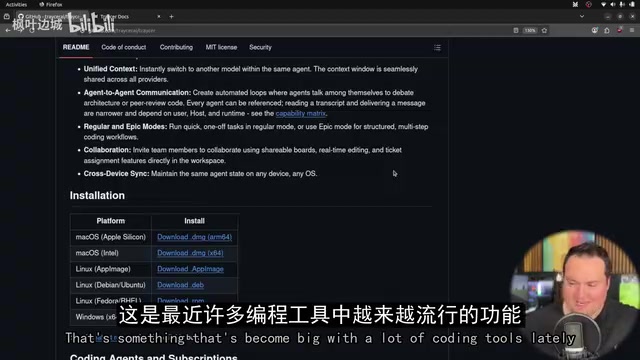
The feature the blogger appreciated most is "Bring Your Own Agent." GPT-5.6, Sonnet 5, and other agents shown in the interface all reuse the user's locally installed Codex and Cloud Code instances directly — all authorization and authentication flows through the user's own OpenAI and Anthropic subscriptions. This means you don't need to purchase additional tokens from Tracer. It simply orchestrates the agents you already have locally, dramatically lowering the barrier to entry.
Agent-to-Agent Communication
Another highlight is that agents can establish automated loops and coordinate with each other directly. All collaboration takes place within the same task window, and sub-agents spawned by the main agent are presented in a clear hierarchical structure. The documentation also provides a compatibility matrix listing which agents can trigger these capabilities. The blogger noted that sub-agents need a reasonable level of intelligence for these features to work properly — plugging in a local agent based on an outdated llama model may cause issues.
Cross-Device Sync and Multi-Platform Support
Tracer supports cross-device synchronization, allowing you to switch between different machines seamlessly. Its software support is also broad — beyond macOS, it offers packages for Ubuntu, other Linux distributions, and Windows. The blogger ran the demo directly on Ubuntu and gave the wide OS compatibility high marks.
Useful Interface Details
Tracer's UI borrows interaction logic from web browsers, letting users drag agents and artifacts as tabs or split them into separate windows. Several thoughtful design choices stand out:
- Shared artifacts: Agents can write information to a shared artifacts area, acting as a collaborative sticky-note board or TLDR scratchpad for the team.
- Usage monitoring: A performance-monitor-style panel displays real-time quota consumption for each coding agent — such as GPT Codex weekly session usage and the current session percentage consumed by Cloud Code.
- System resources: Clicking the CPU icon reveals local resource stats including CPU, memory, and VRAM usage.
- Development utilities: A built-in terminal, Git diff viewer, and file tree are included, with the ability to share projects with team members via GitHub account or email.
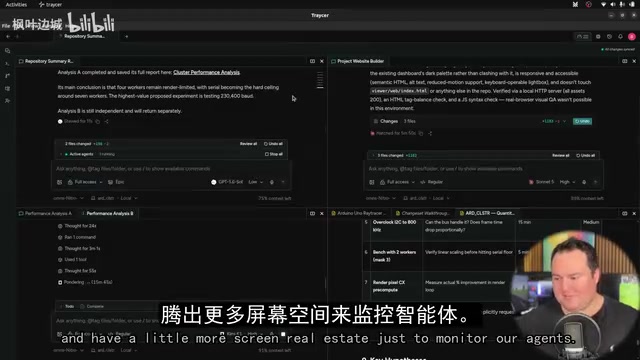
Tracer also distinguishes between two modes: Regular mode, where you work directly with a specific agent, and Epic mode, which wraps a structured planning layer on top of the coding agent. In the demo, GPT-5.6 Sol serving as orchestrator ran in Epic mode, while the delegated sub-agents operated in Regular mode.
The Core Experiment: A Large Model Orchestrating a Local Small Model
The blogger's most valuable test involved having a state-of-the-art large model orchestrate a locally running small model — Qwen 3.6 27B (BF16, running on a Blackwell 6000 Pro GPU with a context length of 131,072). The task was to build a realistic browser-based flight simulation game, with the large model serving only as a "technical advisor" — no direct code writing.
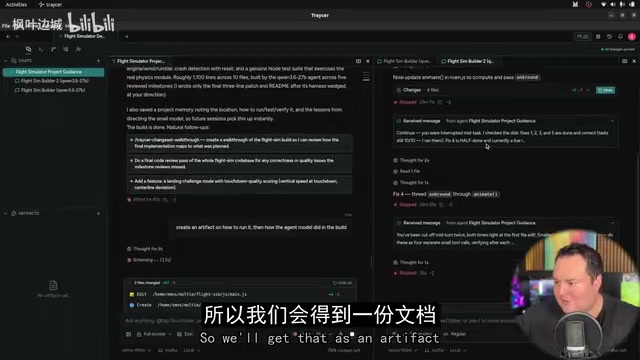
He chose Fable 5 (high thinking mode) as the orchestrator. Rather than dumping the entire game spec onto the small model at once, Fable adopted a "milestone-by-milestone with acceptance criteria" strategy: first a static world (sky, lighting, terrain, runway, instrument bar), then flight physics and takeoff, followed by the cockpit and instruments, and finally scene details and polish. After each milestone, Fable personally reviewed the code for verification.
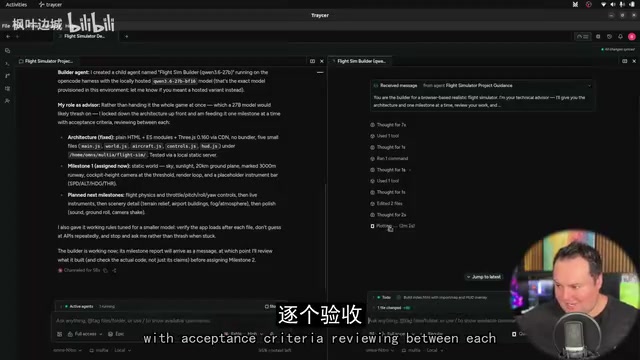
Several interesting details emerged during the process. First, when designing the flight physics, Fable provided a point-mass velocity model with a set of near-realistic parameters (60-ton jet aircraft, 240 kN thrust, quadratic drag, etc.), reasoning that a 27B model designing aerodynamics independently was prone to "collapse." Second, when one of Fable's instructions contained an error, the Qwen small model didn't blindly follow it — instead, it implemented the correct behavior based on real instrument principles. Fable praised this, noting it was exactly the kind of judgment it wanted to preserve.
The local model wasn't without hiccups, however. It hit the context length limit at one point, prompting Fable to spawn a new agent with a fresh context to handle the remaining minor changes. Later, the local Qwen instance repeatedly froze — the blogger acknowledged this was a network or configuration issue specific to his local environment. Crucially, because a smarter orchestrator was there to cover for failures, even when a sub-agent dropped the ball, the large model could personally push the project to completion — effectively forming a fault-tolerance mechanism.
The Blackwell 6000 Pro is a professional-grade GPU from NVIDIA based on the Blackwell microarchitecture. Its large VRAM configuration in BF16 (Brain Float 16) precision enables it to run large language models with tens of billions of parameters locally. BF16 is a 16-bit floating-point format that shares the same exponent bit width (8 bits) as FP32, halving memory usage while preserving a wide dynamic range — making it the mainstream precision choice for local inference today. A context length of 131,072 (128K tokens) means the model can "remember" roughly 100,000 Chinese characters or hundreds of thousands of lines of code in a single conversation, which is critical for coding tasks that require continuously tracking an entire codebase. It's worth noting that longer contexts significantly increase VRAM consumption and latency during inference — which is the direct reason the local model ultimately hit its context limit in this experiment.
A/B Comparison: The Orchestrator Makes an Enormous Difference
To validate the value of orchestration, the blogger ran a control experiment: the same Qwen 3.6 27B model working completely independently on the same task from start to finish. About 32 minutes later, it delivered a result — the terrain looked more detailed, but nearly all controls like the throttle were non-functional, there was no audio, and the overall product was basically unplayable.
By contrast, the version orchestrated by Fable — which was explicitly instructed to "guide but not write code" — produced something far more polished. While the cockpit model wasn't particularly refined, it achieved physics and control logic much closer to real-world behavior: speed and acceleration felt plausible, rather than the aircraft instantly teleporting to top speed as in the solo run. According to the blogger's notes, Fable itself only modified one or two lines of code — virtually all of the code was written by Qwen — yet the final quality was markedly better. The output also included a scorecard evaluating "how Qwen performed as a builder," noting approximately 30 substantive defects across the entire build process. These were fixed across four rounds of revision, with none surviving to the final version — and critically, every single defect was discovered through external verification, never proactively flagged by the model itself.
This A/B experiment reveals a pervasive phenomenon known as the "Verification Gap": language models generating code typically lack the ability to perform real functional tests on their outputs, and tend to produce code that appears syntactically and structurally sound but contains logical defects at runtime. The roughly 30 substantive defects recorded in this experiment were all discovered through external verification (i.e., the orchestrator Fable actively reading and reviewing the code), never proactively flagged by the model itself. This aligns with the conclusions of several recent benchmarks: a model's "self-correction" capability is far weaker than its generation capability. Introducing an external verification loop — whether another model or an automated testing framework — is one of the most effective methods for improving code quality. The orchestrator effectively serves as a code reviewer in a continuous integration pipeline, not merely a task dispatcher.
Conclusion: Orchestration Is the Future
This hands-on test confirms a direction that's rapidly taking shape: as high-end models become smarter but also more expensive, the pattern of "use less of the expensive, more of the cheap, and let the expensive orchestrate the cheap" will only become more prevalent. Tracer Desktop makes this kind of multi-agent collaboration remarkably smooth — a freely draggable interface, support for a wide variety of agent types, automatic sub-agent spawning, and convenient comparison of different model combinations. The blogger believes that if someone wanted to run a systematic evaluation of "how the same Qwen model performs under different orchestrators (like Fable 5 vs. Opus)," Tracer would make it effortlessly straightforward — and that's a direction well worth exploring.
Related articles

Random Pruning of the DPO Computation Graph: 1.4x Training Speedup and Lower Peak Memory
DPO training too slow and memory-hungry? This paper proposes a random pruning framework for the DPO computation graph, sampling independently across position, sequence, and branch dimensions; branch pruning achieves a 1.426x step-time speedup and cuts training time by about 30%, with in-depth attribution of memory and time gains.

Why Does JEPA Underperform MLM in Longitudinal EHR Representation Learning?
New study compares JEPA and MLM for longitudinal EHR representation learning on MIMIC-IV: three JEPA variants train stably without collapse but underperform MLM; target size, not heterogeneity, drives prediction error.

Transfer Learning + Visible Light Communication: A New Approach to Energy-Efficient Indoor Positioning
A study proposes a transfer learning-based visible light communication indoor positioning method, achieving 47% accuracy improvement on the BOSCH factory dataset, 67.5% model efficiency under high noise, and introducing the ME composite metric for energy-efficient positioning in energy-constrained industrial IoT scenarios.