Open-Source Replication of Anthropic Mythos: Autonomous Vulnerability Discovery Framework Analysis

Open-source project replicates Anthropic's Mythos autonomous vulnerability discovery using an 8-phase AI pipeline at $1/run.
A new open-source project called mythos-research replicates Anthropic's Mythos Preview (Project Glasswing) from an outside-in perspective. Built on Claude Opus 4.7, it uses an eight-phase sink-guided pipeline for autonomous vulnerability discovery at roughly $1 per run. The project supports coordinated disclosure and represents the democratization of AI-driven security research tools.
Overview
Recently, a notable open-source project appeared on GitHub — mythos-research — which attempts to replicate Anthropic's Mythos Preview (also known as Project Glasswing) from an outside-in perspective. The project builds an autonomous vulnerability discovery scaffold based on Claude Opus 4.7, employing an eight-phase sink-guided pipeline that costs approximately $1 per run and supports open-source self-scanning and coordinated disclosure.
The emergence of this project signals that AI-driven security research tools are moving toward open-source accessibility and democratization — something worth watching for both security researchers and AI practitioners.
What Is Anthropic Mythos Preview?
Background
Anthropic's Mythos Preview (Project Glasswing) is an internal research project that leverages large language models for autonomous vulnerability discovery. Its core philosophy is to have an AI agent systematically analyze codebases and identify potential security vulnerabilities, much like a human security researcher would.
This class of projects represents an important direction in AI security research: using AI to discover security issues in AI systems themselves and in other software systems, forming a closed loop of "AI attacking AI."
Significance of the Open-Source Replication
The mythos-research project adopts an "outside-in replication" approach, meaning the developers did not base their work on Anthropic's internal code. Instead, they independently implemented a similar functional architecture based on publicly available information and technical inference. This practice is common in academia and the open-source community, helping to validate technical feasibility and advance the field.
Technical Architecture Analysis
Eight-Phase Sink-Guided Pipeline
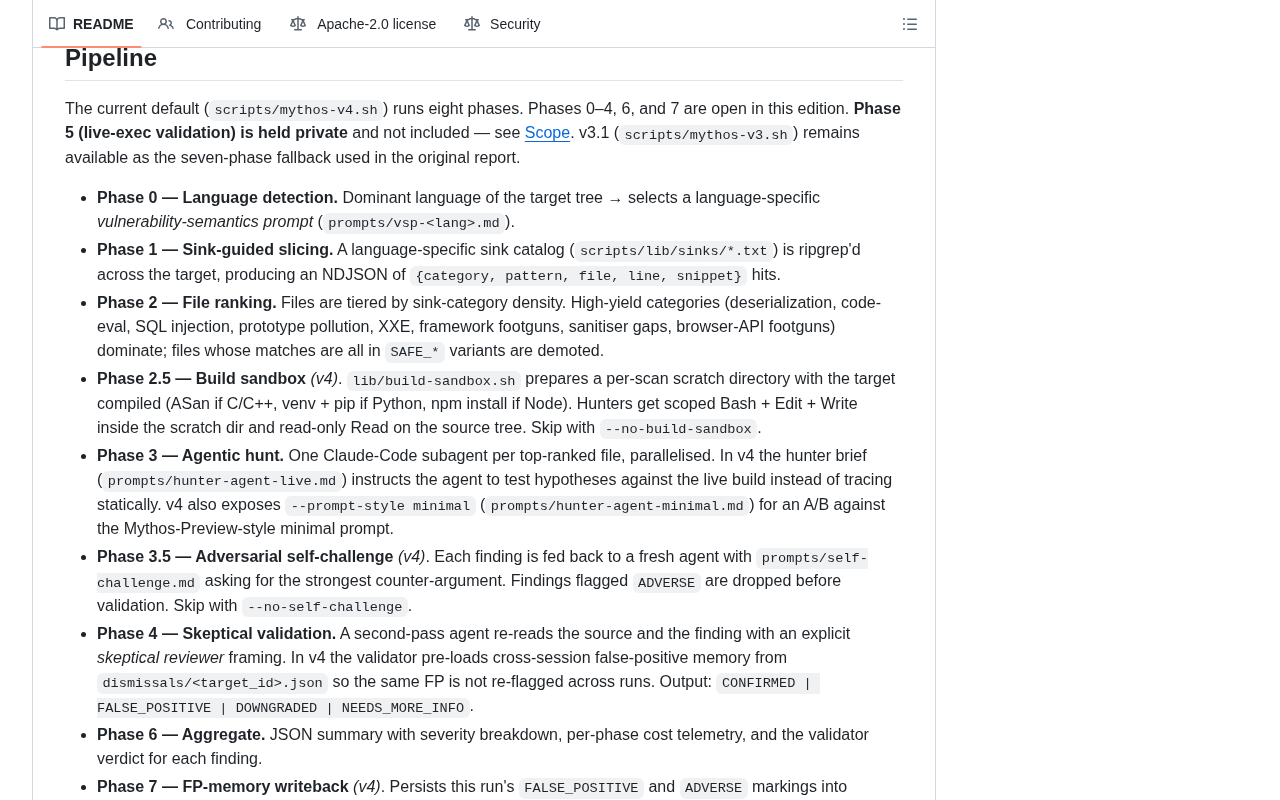
At the core of this project is an eight-phase sink-guided pipeline. "Sink-guided" is a classic methodology in security analysis — starting from data sinks and tracing data flows backward to find paths that attackers could potentially exploit.
Combining this methodology with an LLM agent means the system can:
- Automatically identify critical sinks in code (such as database queries, system calls, network requests, etc.)
- Progressively narrow the search scope through multi-phase analysis
- Leverage Claude Opus 4.7's reasoning capabilities to assess exploitability of vulnerabilities
- Generate structured vulnerability reports
Cost Efficiency
The project claims a cost of approximately $1 per run, which is an extremely attractive figure. Traditional automated security scanning tools are free but often suffer from high false-positive rates and insufficient depth. Manual security audits are precise but easily cost tens of thousands of dollars. AI-driven vulnerability discovery at $1 per run, if the accuracy is acceptable, would dramatically lower the barrier to security research.
Tech Stack
The project is primarily written in Shell, indicating it functions more as an orchestration layer responsible for coordinating the execution flow across analysis phases, while the core vulnerability analysis logic is delegated to Claude Opus 4.7. This lightweight architectural design makes the project easy to understand, modify, and extend.
Coordinated Disclosure Mechanism
Notably, the project explicitly mentions support for "coordinated disclosure." This means that when the system discovers real vulnerabilities, it follows responsible security disclosure practices — first notifying affected project maintainers, allowing time for fixes, and then publicly disclosing vulnerability details.
This design reflects the project author's commitment to security ethics and is a necessary condition for AI security tools to become practically viable.
Potential Impact and Risks
Positive Impact
- Lowering the barrier to security research: Small open-source projects can afford automated security audits
- Accelerating vulnerability discovery: AI agents can work 24/7 without interruption
- Promoting transparency in AI security research: Open-source implementations allow more people to understand and improve these technologies
Potential Risks
- Double-edged sword effect: The same tools could be used by malicious actors to discover and exploit vulnerabilities
- False positive issues: LLMs may produce "hallucinated vulnerabilities" that appear plausible but don't actually exist
- Accountability: The legal and ethical boundaries of AI-discovered vulnerabilities in disclosure processes remain unclear
Conclusion
Although mythos-research currently has only a modest number of stars (7), it represents an important trend: AI-driven autonomous security research tools are transitioning from internal projects at large companies to the open-source community. As large language model capabilities continue to improve and costs continue to decline, tools like these are poised to become an important component of the software security ecosystem.
For security researchers, this is a direction worth watching and contributing to. For software developers, it means that future security audits may become significantly more automated and widespread.
Related articles
 Tech Frontiers
A Rare Quiet Day in AI: Recursive Self-Improvement Stirs Beneath the Surface
A rare quiet day in AI sees multiple sources go silent simultaneously. Behind the calm, Recursive Self-Improvement (RSI) research continues. What this means for the industry.
 Tech Frontiers
Reve 2 vs. Ideogram 4: A Deep Dive into Layout Control in AI Image Generation
A deep comparison of Reve 2 and Ideogram 4's layout control capabilities, covering technical approaches, real-world use cases, and industry trends for designers and creators.
 Tech Frontiers
In the Weights: Check Your Influence Score in the AI World
In the Weights is an AI influence search engine that quantifies your presence in the AI world with a score. Explore how it evaluates practitioners and what it means for digital identity.