Open-Source Research Agent: Attaching Confidence Scores and Real Sources to Every Conclusion

A developer open-sourced a transparent research Agent that uses a four-stage architecture and multi-dimensional weighted confidence scores to make AI spell out how certain it is.
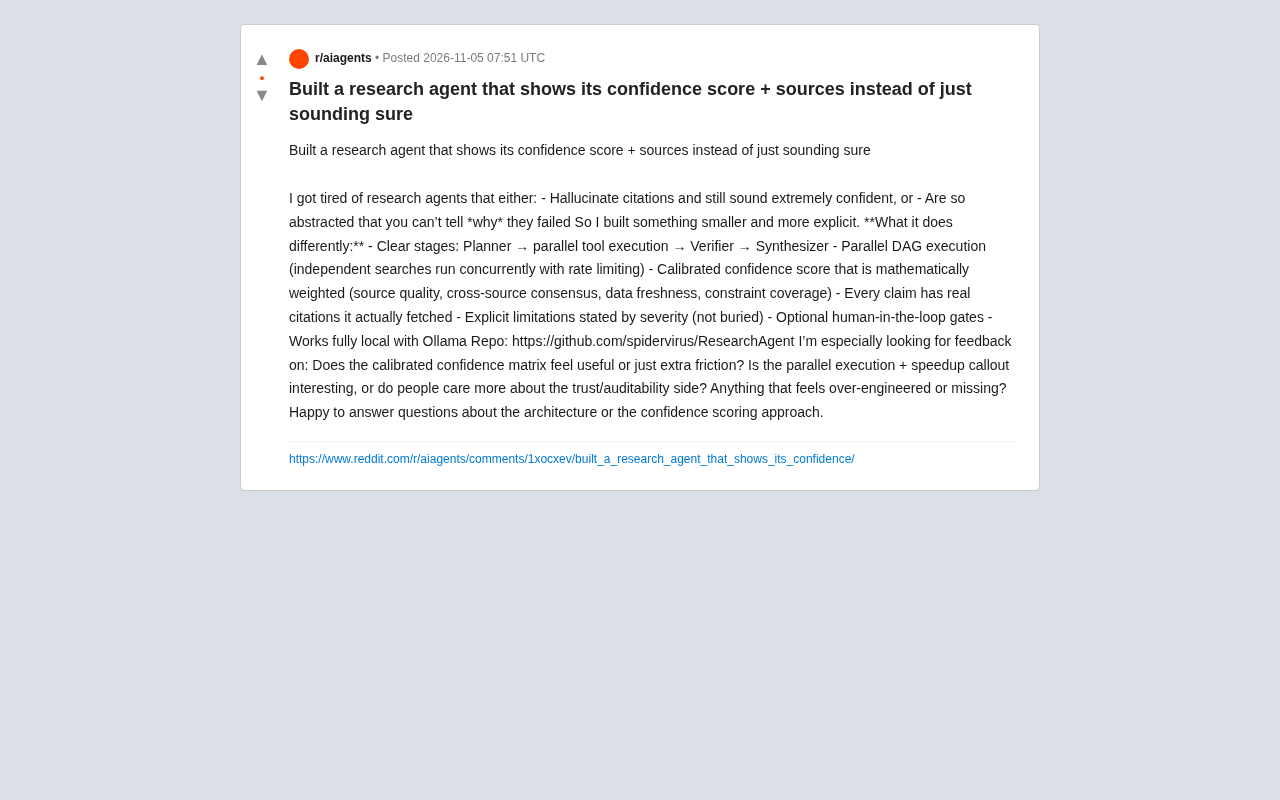
The article introduces an open-source research Agent (spidervirus/ResearchAgent) shared on Reddit, whose core idea is to explicitly present uncertainty rather than mask errors with a confident tone. It uses a four-stage architecture—Planner, parallel tool execution, Verifier, Synthesizer—with the parallel part based on a DAG and rate limiting, and each step independently auditable. The confidence score is mathematically weighted from source quality, cross-source consensus, data freshness, and constraint coverage; every conclusion has real retrieved citations and limitations listed by severity. It supports Ollama local operation and optional human-in-the-loop checkpoints. The developer solicits feedback on whether the confidence matrix is useful and whether speed or auditability matters more.
From "Sounds Confident" to "Spelling Out How Confident"
Today's AI research assistants generally fall into two extremes: either they fabricate citations while speaking with unwavering certainty, leading users to believe conclusions are reliable; or their internal processes are a complete black box, leaving no direction for troubleshooting when things fail. A developer shared his solution on Reddit—a smaller, more transparent research Agent whose core idea is to put "uncertainty" front and center.
The project's starting point is simple: since the model can't guarantee correctness every time, let users see how confident it is in its own judgments, and what real retrieved materials those judgments are built on. According to the developer's description in the Reddit post, every conclusion the Agent produces comes with actually retrieved citations, rather than literature the model "recalled" from memory.
Architecture Breakdown: Four Stages and a Parallel DAG
The Agent's execution flow is divided into four clearly auditable stages: Planner → parallel tool execution → Verifier → Synthesizer. This explicit staged design allows the input and output of each step to be inspected individually, rather than cramming all the logic into a single large model call.
Parallel execution uses a DAG (directed acyclic graph) structure—independent search tasks run concurrently, while rate limiting controls the load on external services. The developer specifically asked the community: is the speedup from parallel execution interesting enough, or do people care more about trustworthiness and auditability? From a technical standpoint, the answer depends on the use case—batch research values throughput, while decision-support scenarios value whether each conclusion can be traced.
The Agent supports fully local operation via Ollama, which is a practical selling point for data-sensitive users: neither retrieved content nor generated results need to leave the local environment.
Directed acyclic graph (DAG) is a data structure in computer science consisting of nodes and directed edges with no cyclic paths. In task orchestration, a DAG expresses dependencies between tasks: a node represents a task, and an edge represents "A must be completed before B can start." Because there are no cycles, a DAG naturally supports topological sorting, which the scheduler uses to find all currently executable tasks and run them concurrently. When a task completes, its dependent successor tasks are unlocked. This structure is especially well suited to research Agents—individual search threads are often independent and can be launched simultaneously, while the verification and synthesis stages must wait for prior results. Compared with a linear pipeline, a DAG maximizes parallelism without violating dependency constraints, while making execution order and bottlenecks immediately clear, which aids auditing and debugging.
What Makes Up the Confidence Score
The most discussion-worthy design in this project is the "mathematically weighted" confidence score. According to the developer, the score is determined jointly by four dimensions:
- Source quality: the authority and relevance of the cited material
- Cross-source consensus: whether multiple independent sources point to the same conclusion
- Data freshness: the temporal validity of the material
- Constraint coverage: how well the conclusion satisfies each constraint in the original question
This weighting approach strips "trustworthiness" away from the model's subjective tone and turns it into a comparable numeric value. However, the developer himself is also soliciting feedback: is this calibrated confidence matrix actually useful, or does it add extra burden for users? This question hits the mark—if users don't understand what the weights mean, an isolated score may be more confusing than no score at all.
Model calibration refers to how well a model's output confidence matches its actual accuracy rate. A well-calibrated system that claims "80% confidence" should, over the long run, be correct about eight times out of ten; an overconfident system gives high scores despite low accuracy. Large language models generally suffer from overconfidence, and their tone of generation is not tied to factual accuracy. This is precisely the motivation for replacing the model's subjective tone with a multi-dimensional weighted score: strip confidence out of linguistic expression and instead construct it from verifiable external evidence (source quality, cross-source consensus, etc.). However, the weighted score itself also needs calibration validation—whether the weights were set based on labeled data and whether the score range corresponds to true accuracy determines whether this number is a trustworthy signal or just another form of subjective scoring.
Explicit Limitations and Human Intervention
Beyond confidence, the Agent also clearly lists its own limitations by severity, rather than burying them in a corner of a long output. This is especially critical for research tasks: users need to know under what conditions a conclusion might fail in order to judge whether to trust it.
The project also offers optional human-in-the-loop checkpoints, allowing human confirmation to be inserted at key stages. For high-risk decision scenarios, this design is more pragmatic than a fully automated pipeline.
Human-in-the-loop (HITL) is a design pattern in automated systems that pauses the machine process at key decision points and hands it to a human for review, correction, or approval before continuing. It differs from a fully automated pipeline and also from purely manual operation; its core value is concentrating human judgment on the highest-risk, least reliable links. In Agent scenarios, HITL checkpoints are usually placed before plan confirmation, high-risk tool calls, or conclusion publication. The cost is added latency and human effort, so checkpoint placement requires trade-offs: too few and they lose their gatekeeping value, too many and they cancel out the automation gains. For research tasks, placing a human confirmation before the synthesis stage often intercepts the most serious errors without significantly slowing the process.
Diverging Community Priorities
The questions the developer raised reflect a dividing line in today's AI Agent field: one side believes execution efficiency and architectural elegance are the core metrics, while the other believes auditability and real citations are the lifeline of research tools. Judging from the direction of the discussion in that thread, at least in this developer's vision, the latter carries more weight—he chose to sacrifice generality in exchange for the ability to trace every conclusion.
The project is small in scale, but the questions it raises are universal: as AI becomes increasingly good at "sounding certain," how to also teach it to "spell out how certain it is" may be a necessary step for research Agents to become practically usable.
The project is open source on GitHub (spidervirus/ResearchAgent), and the developer says he is willing to answer questions about the architecture and the confidence scoring method.
One-line Summary
A developer open-sourced a transparent research Agent that uses a four-stage architecture and multi-dimensional weighted confidence scores to make AI spell out how certain it is.
Paragraph Summary
The article introduces an open-source research Agent (spidervirus/ResearchAgent) shared by a developer on Reddit, whose core idea is to explicitly present uncertainty to users rather than letting the model mask errors with a confident tone. The Agent uses a four-stage architecture—Planner → parallel tool execution → Verifier → Synthesizer—with the parallel portion based on a DAG and rate limiting, and each step's input and output independently auditable. The confidence score is mathematically weighted from four dimensions: source quality, cross-source consensus, data freshness, and constraint coverage; every conclusion comes with actually retrieved citations, and limitations are listed by severity. The project supports local operation via Ollama and offers optional human-in-the-loop checkpoints. The developer actively solicits community feedback: whether the confidence matrix is useful, and whether speed or auditability matters more.
Related articles
 Tech Frontiers
Gemini Omni 1.2 Flash: AI Video Moves Toward Draft-Style Editing
Google's Gemini Omni 1.2 Flash update enables conversational, draft-style editing of the same video—swap scenes while keeping products, adjust lighting while keeping characters. Clips up to 15s, 720p costs 30% less than the previous Flash—ideal for e-commerce ads, previs, and short-asset production.

Codex Tutorial: One-Command Install and Run Your First Task
Codex tutorial: one-command install and run your first task. Covers the four Codex forms, sandbox and approval guardrails, AGENTS.md and MCP configs, cloud network policy, and the iron rule of human review—everything you need to get started with this autonomous coding agent.
 Tech Frontiers
Localix: An Open-Source Agentic Development Environment with Multi-Model and Local AI Integration
Localix is an MIT open-source Agentic Development Environment (ADE) supporting seamless Claude Code plugin loading, multi-model cloud and local execution, Mini Apps extensions, and agent context management—an open AI collaboration workbench for developers.