Open-Source Tool Agent Harness Lab: Experimentally Validating Coding Agent Instruction Improvements
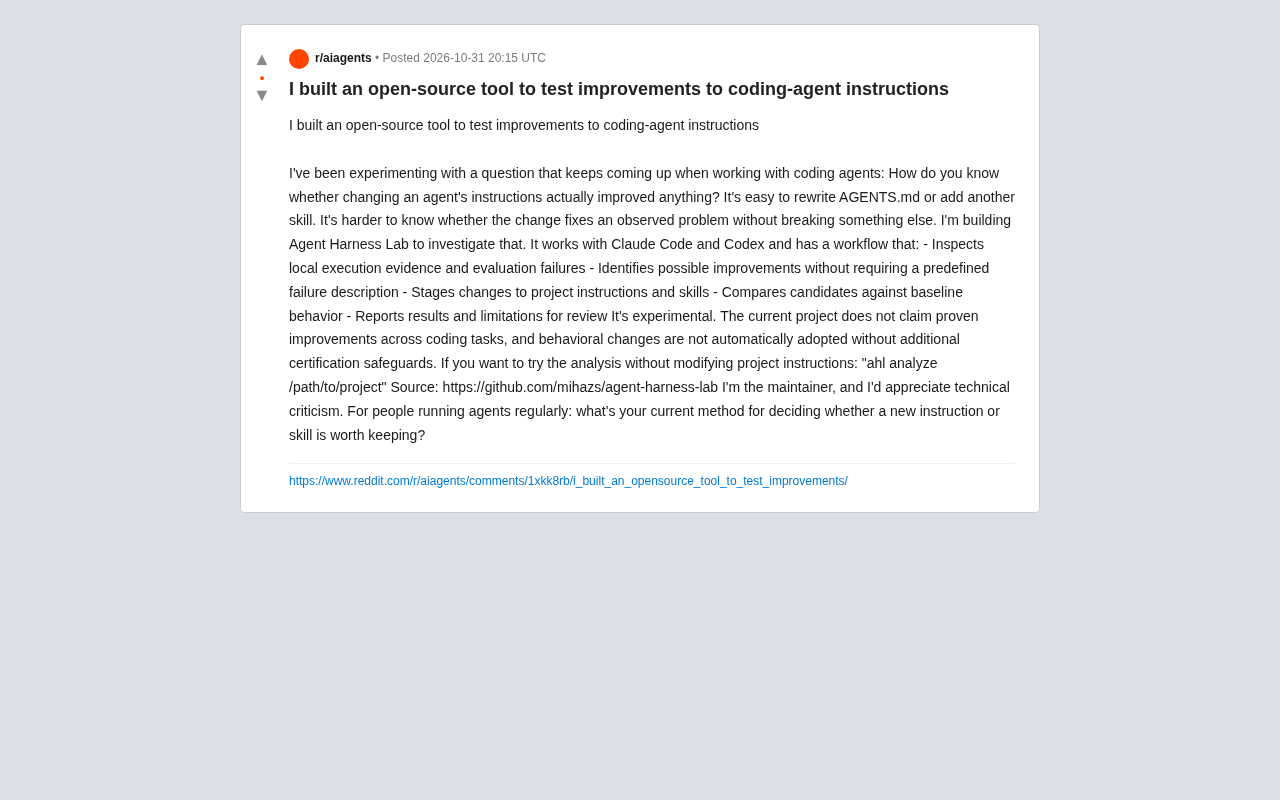
Open-source tool Agent Harness Lab provides a repeatable evaluation process for coding agent instruction optimization.
Agent Harness Lab is an open-source experimental tool designed to solve the problem of determining whether modifications to coding agent instruction files (such as AGENTS.md) truly bring improvement. It supports Claude Code and Codex and provides a structured evaluation workflow: inspecting local execution evidence, automatically identifying improvement points, staging instruction changes, comparing candidate solutions against baseline behavior, and reporting results and limitations. Users can run analysis without modifying the project via the `ahl analyze` command. The maintainer emphasizes that the tool has not yet proven broad effectiveness and that behavioral changes require human review. The tool transforms "changing instructions by feel" into "evidence-based iteration," offering new ideas for engineering the AI programming toolchain, though its maturity still needs community validation.
Why Instruction Improvements for Coding Agents Need Scientific Validation
In the field of AI programming, the capabilities of coding agents (such as Claude Code and Codex) depend heavily on the quality of their instruction files (such as AGENTS.md or various skills). However, many developers face a common pain point: how do you determine whether modifying instructions actually brings improvement? According to a developer's post on Reddit, simply rewriting AGENTS.md or adding new skills isn't hard—what's hard is confirming that these changes solve known problems without introducing new defects.
To address this, the developer built the open-source tool Agent Harness Lab, designed to provide a repeatable testing process for instruction optimization of coding agents. The tool is currently in an experimental stage, supports Claude Code and Codex, and is open-sourced on GitHub (https://github.com/mihazs/agent-harness-lab).
Coding Agent refers to an AI system capable of understanding natural language instructions, autonomously planning and executing tasks such as code writing, debugging, and refactoring. Unlike traditional code completion tools, coding agents typically possess multi-step reasoning and tool-calling capabilities, allowing them to read project files, run commands, analyze errors, and iterate on modifications. Claude Code and Codex are two representative types of coding agents today: the former was launched by Anthropic and is deeply integrated into the development environment; the latter is OpenAI's early series of code models, which later evolved into the foundation for products like GitHub Copilot. The behavior of such agents depends not only on the underlying large model but is also strongly constrained by instruction files (such as AGENTS.md) and skills—instruction files define the agent's role, workflow, and constraints, while skills are reusable task modules. Therefore, even small changes in instruction quality can significantly affect agent output, which is the fundamental reason why scientific validation of instruction improvements is needed.
Agent Harness Lab's Core Workflow
Agent Harness Lab designs a structured evaluation process to help developers systematically validate the effects of instruction changes. Its workflow includes the following steps:
- Inspect local execution evidence and evaluation failures: The tool analyzes logs and failure cases from local agent runs to identify potential problem patterns.
- Automatically identify improvement points: Without pre-defined failure descriptions, the tool can infer possible improvement directions from execution data.
- Stage project instruction and skill changes: Candidate modifications are staged for later comparison.
- Compare candidate solutions against baseline behavior: Run the pre- and post-modification versions under identical conditions to quantify behavioral differences.
- Report results and limitations: Output comparison results and clearly identify the limitations of the current evaluation for human review.
The key to this process is that it requires no pre-defined failure descriptions, lowering the barrier to use, while emphasizing a cautious attitude toward changes—behavioral changes are not automatically adopted and require additional certification safeguards.
Baseline, in software engineering and machine learning evaluation, refers to a set of unmodified system behaviors or performance metrics used as a reference standard. In the context of Agent Harness Lab, baseline behavior is the agent's performance when executing tasks under the original instruction files, including success/failure patterns, output quality, and execution paths. Comparing candidate solutions against baseline behavior means running the pre- and post-modification agents under controlled variables (such as the same task set, same model version, and same runtime environment) and quantifying the differences in key metrics between the two. This comparison method draws on the ideas of A/B testing and regression testing: A/B testing is used to determine whether a change brings a statistically significant improvement, while regression testing ensures that a change does not break existing functionality. For coding agents, because outputs are non-deterministic, a single run is insufficient to draw conclusions—typically multiple repeated experiments combined with human review are needed to distinguish real improvements from random fluctuations.
How to Use and Current Limitations
For users who want to try analysis without modifying project instructions, they can run the command: ahl analyze /path/to/project. This command only performs analysis and does not make any changes to project files.
The maintainer explicitly states that the project is currently experimental and does not claim to have proven improvement effects on coding tasks. This means the tool provides an evaluation method, not a silver bullet that guarantees optimized results. Developers need to interpret reports in the context of their own scenarios and decide for themselves whether to adopt changes.
Experimental, in the context of open-source software and tool releases, usually indicates that the project is in an early development stage, that APIs and workflows may undergo significant changes, and that it has not yet been validated in large-scale production environments. The maintainer's statement that it "does not claim to have proven improvement effects on coding tasks" is a responsible technical stance: it distinguishes between "providing an evaluation method" and "guaranteeing optimization results"—two different levels. The former means the tool can help developers systematically collect evidence and compare behavioral differences; the latter requires rigorous controlled experiments, statistical analysis, and multi-scenario reproduction to establish. For users, this means Agent Harness Lab should be viewed as a framework to assist decision-making, not an automated optimizer. Before adopting any instruction changes, users should still consider the specific needs of their project, manually review the limitations described in the report, and bear the risks of changes themselves.
Community Interaction: What's Your Method for Evaluating Instructions?
In the Reddit post, the maintainer asked developers who frequently use agents: How do you currently decide whether a new instruction or skill is worth keeping? This question sparked discussion about best practices in agent instruction engineering. For teams that use coding agents daily, establishing a lightweight A/B testing or regression testing process may become necessary. Agent Harness Lab attempts to fill this gap, but the tool's maturity still needs to be tested by the community.
Summary and Outlook
Agent Harness Lab provides an experimental framework for instruction optimization of coding agents, and its value lies in transforming "changing instructions by feel" into "evidence-based iteration." Although the current version has not yet proven broad effectiveness, its open-source nature and support for Claude Code and Codex offer new ideas for the engineering of the AI programming toolchain. Interested developers can visit the GitHub repository, try the analysis feature, and provide technical feedback.
Related articles
GitHub Daily · November 05: Skills Ecosystem Explodes, Agents Begin to Take Over the Desktop
GitHub Daily Nov 5: Skills ecosystem explodes with five 'skills' repos trending; vercel-labs' agent-desktop and agent-browser build agent limbs; Rust dominates agent infrastructure.

Deleted Reddit Post Sparks Debate Over AI Content Moderation
A Reddit post removed with only a 'Removed by Reddit' notice highlights AI content moderation's transparency gaps, misjudgment risks, and appeal challenges for platforms and creators.

DSH + Ollama Local LLM Deployment in Practice: Free Chat with Da Fei Yu
Bilibili creator tests DSH + Ollama local LLM deployment end to end: Ollama install, Xunlei-accelerated downloads, ModelScope GGUF model import, DSH custom API address setup, and a comparison of Qwen 3.5 4B, 8B, Gemma, and other models on 8GB VRAM, with advice on choosing local deployment vs. API calls.