Open-Source Tool StepFork: Record and Replay AI Agent Executions So Debugging No Longer Relies on Luck

Open-source tool StepFork brings record, replay, fork, and minimization to AI Agent debugging and is openly soliciting contributors.
StepFork is an open-source AI Agent debugging tool released by developer utsab345 on Reddit, currently at v0.2.1. It brings the traditional software engineering paradigm of record—replay—fork—minimize—regression test into the Agent space, supporting trace inspection, offline failure reproduction, fix experimentation, failure-scene compression, and regression test generation. Unlike tools such as LangSmith that focus on tracing and monitoring, StepFork emphasizes replay and fork experiments. The author's recent focus has shifted to testing, documentation, and release reliability, and the project is openly soliciting clearly scoped contributions such as cross-platform CI, CLI error handling, integration tutorials, and trace-redaction regression tests, while asking the community what else is needed to truly simplify Agent workflow debugging.
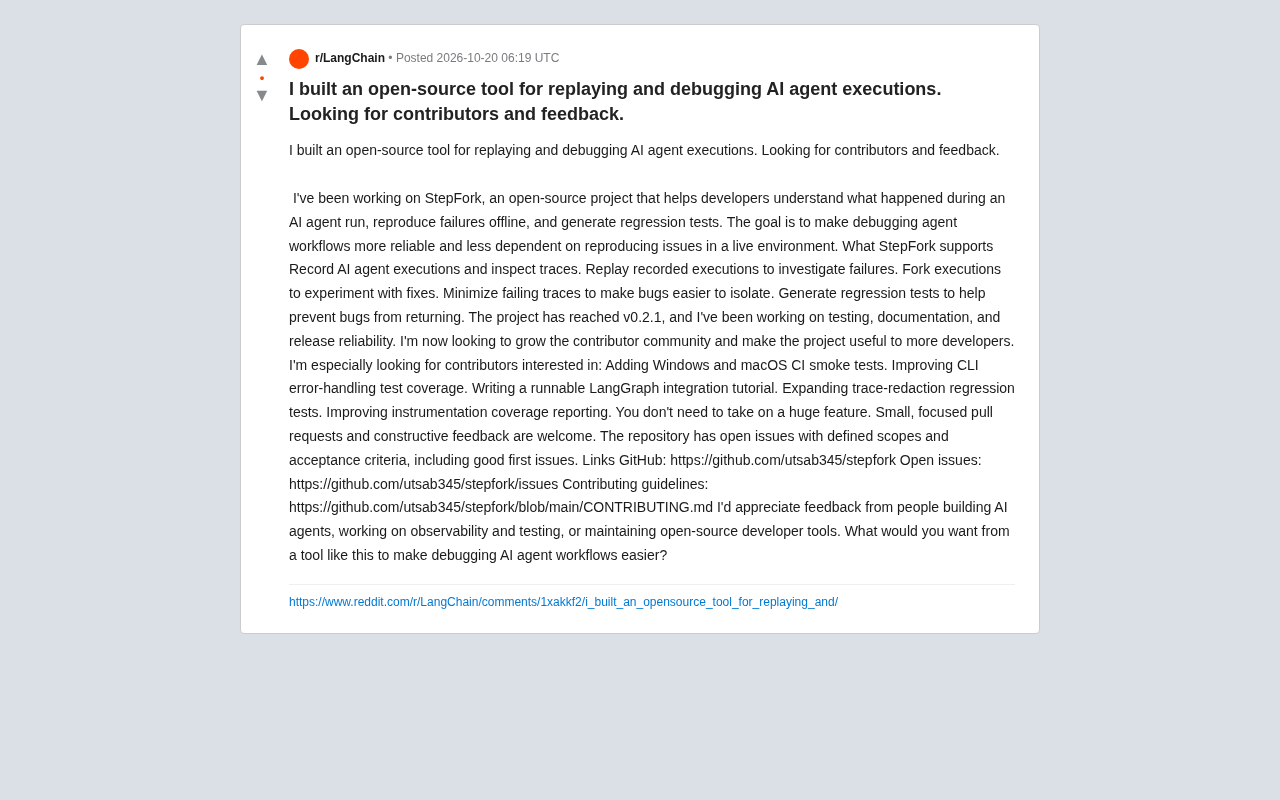
Debugging AI Agent failures often feels like a detective game: problems occur sporadically in production, logs are scattered, and reproduction is difficult. Developer utsab345 released an open-source tool called StepFork on Reddit, aiming to bring the mature software engineering debugging paradigm of "record—replay—fork—minimize—regression test" into the AI Agent space. The project is currently at v0.2.1, and the author is openly soliciting contributors and feedback.
What Problem Does StepFork Solve
An AI Agent's execution chain typically involves multiple model calls, tool uses, and state changes, and the cause of failure may be hidden in any step. The traditional approach is to rerun the entire flow and hope for the best, or to repeatedly trial and error in production. StepFork's core idea is to make Agent execution recordable, replayable, and intervenable.
According to the author, the tool supports five capabilities: recording Agent execution and inspecting traces; replaying recorded executions to investigate failures; forking executions to experiment with fixes; minimizing failed traces to make bugs easier to isolate; and generating regression tests to prevent similar issues from recurring. These five capabilities form a closed loop from discovering problems to locking in safeguards.
From an engineering perspective, "trace minimization" is one of the more distinctive elements. Compressing a long sequence of execution steps down to the minimal set required to trigger the failure can significantly reduce the cost for developers to read and understand the failure scene. This is also a common technique in traditional distributed system debugging.
Trace minimization borrows from the delta debugging idea in software testing: when a long execution sequence causes a failure, the system automatically tries removing or merging steps until it finds a minimal subset that still triggers the failure. For AI Agents, this means stripping out the truly relevant few steps from dozens of model calls and tool calls, excluding irrelevant retrieval, formatting, or retry operations. This not only shortens the time developers spend reading logs, but also makes failure patterns clearer—for example, exposing that a specific tool returning a malformed response is the root cause, rather than the multiple model retries that preceded it. Implementation typically requires deterministic replayable traces and a reduction strategy, which is also why StepFork treats replay as a foundational capability.
v0.2.1 Stage: From Features to Reliability
The project is currently at v0.2.1, and the author says recent work has focused on testing, documentation, and release reliability. This indicates that the tool has moved past the early "it runs" stage and has begun addressing the engineering gaps common to open-source projects.
The author lists the current priority contribution areas, covering cross-platform CI, CLI error handling, integration tutorials, trace-redaction regression tests, and instrumentation coverage reports. What these issues share is clear boundaries and explicit acceptance criteria, making them suitable for new contributors to get started.
What Kind of Contributions Does the Community Need
For developers who want to contribute to open source but worry about the barrier to entry, StepFork's positioning is relatively friendly. The author explicitly states that large feature development is not required; small, focused pull requests and constructive feedback are equally welcome. The repository already has an issue list with clear scope and acceptance criteria, including entry-level tasks labeled as good first issue.
From a tech stack perspective, notable contribution points include: CI smoke tests for Windows and macOS, which affect whether the tool can run stably in mainstream development environments; CLI error-handling test coverage, which directly impacts the developer experience when troubleshooting; and a runnable LangGraph integration tutorial, since such tutorials often determine whether new users can complete their first effective trial within ten minutes.
Trace-redaction regression tests are also worth noting. Agent traces may contain user input, API keys, or internal business data, and if redaction logic regresses, the consequences are more serious than an ordinary feature bug. The author lists this as a separate contribution area, showing the team's attention to this risk.
How Does It Differ from Similar Tools
In the current AI Agent observability space, there are already solutions such as LangSmith, Langfuse, and AgentOps, most of which focus on trace recording and monitoring dashboards. StepFork's differentiator is that it treats "replay" and "fork experiments" as first-class citizens: it not only shows what happened, but also replays it in an offline environment and tries different fix paths.
This design is similar in spirit to time-travel debugging. For teams maintaining complex Agent workflows, offline reproduction capability means they can validate fix hypotheses without touching production, reducing the risk of side effects during debugging. However, the tool's actual effectiveness still depends on the completeness of instrumentation coverage, which is one reason the author includes "instrumentation coverage reports" among the contribution areas.
Time-travel debugging originated as a concept in the debugger world, referring to the ability of developers to move forward or backward through a program's execution history and inspect variable state and call stacks at any point in time. In traditional development, it relies on runtime recording of the full execution trace (such as rr or WinDbg's TTD). Mapped to the AI Agent context, because each model call and tool use is a discrete event, recording these events and replaying them in order in an offline environment lets developers "return" to any step before the failure occurred and observe context changes. StepFork's forking capability further allows changing inputs or tool return values when replaying to a certain step, thereby validating "what would have happened if a different handling approach had been used at that time" without affecting production data.
Questions the Author Poses to the Community
At the end of the post, the author raises an open question: for people building AI Agents, working on observability and testing, or maintaining open-source developer tools, what else does a tool like this need in order to make debugging Agent workflows easier?
This question itself points to the current stage's limitations: StepFork has not yet formed a mature user feedback loop, and feature trade-offs still need to rely on the real pain points of early users. For potential contributors, participating in discussions and filing issues is as valuable as writing code.
The project address and contribution guide have been made public in the original post. The repository is github.com/utsab345/stepfork, and both the issue list and CONTRIBUTING document are directly accessible.
One-line Summary
Open-source tool StepFork brings record, replay, fork, and minimization to AI Agent debugging and is openly soliciting contributors.
Paragraph Summary
StepFork is an open-source AI Agent debugging tool released by developer utsab345 on Reddit, currently at v0.2.1. It brings the traditional software engineering paradigm of record—replay—fork—minimize—regression test into the Agent space, supporting inspection of execution traces, offline reproduction of failures, experimentation with fixes, compression of failure scenes, and generation of regression tests. Unlike tools such as LangSmith that focus on tracing and monitoring, StepFork emphasizes replay and fork experiment capabilities. The author's recent focus has shifted to testing, documentation, and release reliability, and the project is openly soliciting clearly scoped contribution areas such as cross-platform CI, CLI error handling, integration tutorials, and trace-redaction regression tests, while asking the community what additional capabilities the tool needs to truly simplify Agent workflow debugging.
Related articles

Chain of Thought Isn't Just for AI: How Humans Can Use CoT to Improve Thinking Quality
Chain of Thought isn't just a prompt trick for large models. Starting from a Hacker News discussion, this article analyzes why CoT works for human thinking too, breaks down actionable ways to transfer it, and highlights the key differences between human CoT and machine CoT.
Cloudflare Teams Up with OpenAI: Closi…
Cloudflare Teams Up with OpenAI: Closing the Loop from Vulnerability Discovery to Defense with AI
Cloudflare uses OpenAI Daybreak to investigate security vulnerabilities and generate reviewable remediation plans, while developers use Codex to boost coding efficiency and quality.

Orca Multi-Agent Orchestration in Practice: A Guide to Parallel Collaboration with Claude and Codex
Orca is Stable AI's free open-source agent workbench supporting 34 agents like Claude Code and Codex in parallel. Learn its Git worktree isolation, multi-model orchestration, and mobile management.