Open-Source Tool Turns DeepSeek into a Motion Graphics Video Generator: UltraTex and Ideagram 4.6 Highlights
OpenMotion, UltraTex, and Ideagram 4.6 are pushing AI generation into production pipelines.
This article reviews three updates in AI video and 3D content generation. OpenMotion reverse-engineered promo videos from 100+ companies into 300+ motion templates and 152 design systems, supports DeepSeek Harness, and turns motion design into template matching—lowering the barrier for small teams but producing a promo-style look. UltraTex reduces texture discontinuities via multi-view understanding and distinguishes reflection rules for metals, plastics, wood, and ceramics. Ideagram 4.6 supports native 4K and fine local editing, but testers found color shifts and noise after 200 iterations. The author observes tools shifting from "can generate" to "can enter production pipelines," templating trading diversity for stability, and long-iteration stability becoming a new evaluation dimension.
The AI video and 3D content generation space has seen several interesting updates in recent days: an open-source tool trying to turn motion design into an AI "fill-in-the-template" exercise, a texture generation technique bringing PBR materials of 3D models closer to physical realism, and a native 4K image model taking local editing one step further. Here is my breakdown and analysis of these three developments.
OpenMotion: Turning Promo Videos from 100+ Companies into AI-Ready Motion Templates
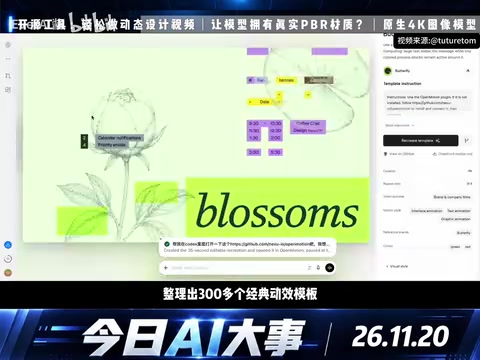
According to the AI daily report by Bilibili creator "Ever AI," OpenMotion has announced that it now supports DeepSeekAd Harness. Its approach is rather clever—it reverse-engineered product promo videos from over 100 companies, distilled 300+ classic motion templates and 152 design systems, and lets AI directly produce motion videos based on the content users provide.
The essence of this approach is to reduce "motion design" from creative work to retrieval and orchestration: the model doesn't need to understand motion curves from scratch—it only needs to match the most suitable solution from an existing template library. For small teams lacking professional motion designers, this kind of tool can significantly lower the production barrier.
But its boundaries are also clear. Template-driven means the output tends to carry a "promo video feel." The 152 design systems and 300+ templates cover validated, common styles, so when a scenario calls for original visual language, AI's room to maneuver is limited. Being open-source and supporting DeepSeek Harness is its advantage—local deployment, controllable costs, and suitability for users who are sensitive about data privacy or want deep customization.
DeepSeek Harness here refers to a localized runtime and invocation framework built around the DeepSeek series of models, designed to let third-party tools access model capabilities and complete inference orchestration. For a motion generation tool like OpenMotion, supporting such a framework means users can complete the entire pipeline—from content understanding to template matching—in a local environment, without uploading assets to cloud services. This is especially important for teams handling undisclosed product information or client materials, while also making inference costs more controllable and allowing developers to deeply customize specific template libraries.
UltraTex: Giving AI-Generated 3D Models a "Physically Correct" Exterior
To give AI-generated 3D models realistic PBR materials, the physical plausibility of textures is key. UltraTex is a high-precision PBR texture generation technique whose core approach is to understand object surfaces from multiple viewing angles, thereby reducing texture discontinuities—a common issue when generating textures from a single view.
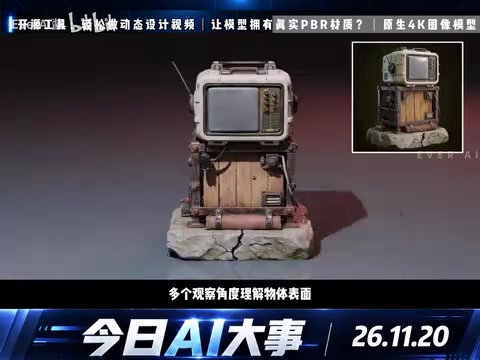
One more detail worth noting is its differentiation of material reflection behavior: metals, plastics, wood, and ceramics are assigned different reflection behaviors in UltraTex to reinforce the physical plausibility of materials. This directly addresses a pain point in current 3D-generated content—many AI models can produce shapes, but the surfaces look "like plastic" or are simply blurry, precisely because they lack modeling at the BRDF (Bidirectional Reflectance Distribution Function) level.
From an application perspective, the physical correctness of PBR textures directly determines whether a model can enter pipelines that demand realism, such as game engines, e-commerce showcases, or industrial visualization. If UltraTex can perform consistently on multi-view consistency and material classification, it would be a practically valuable addition to the 3D content production pipeline. Currently, the materials do not disclose its accuracy metrics or open-source status, so actual performance still needs more testing to verify.
PBR (Physically Based Rendering) is a rendering framework in computer graphics that simulates real light-material interaction. Its core idea is to describe how materials reflect light using physical parameters, rather than relying on artists to manually tune colors. A complete PBR material typically includes multiple maps such as Albedo, Metallic, Roughness, and Normal, and the renderer uses these to calculate how the surface behaves under different lighting. Precisely because the parameters have physical meaning, the same material set can maintain consistent appearance across different engines and lighting environments—which is why PBR has become the de facto standard in game engines and industrial visualization pipelines.
BRDF (Bidirectional Reflectance Distribution Function) describes how light energy hitting a surface from a given incident direction is distributed across outgoing directions. Metals have concentrated, colored reflections; plastics have a white specular layer overlaid on diffuse reflection; wood and ceramics differ in roughness and subsurface scattering characteristics. For AI texture generation to be truly "physically correct," it essentially needs to make the generated map parameters conform to the BRDF rules of the corresponding material, rather than just "painting" the surface based on visual appearance.
Ideagram 4.6: Progress in Native 4K and Local Editing, but Iteration Stability Is Questionable
The native 4K image generation model Ideagram 4.6 has been released, with two main selling points: support for fine-grained local editing, and reduced alteration of non-edited regions across multiple modifications. For designers and post-production professionals, the latter may be more important than resolution—"change this and break that" during local editing has long been a chronic problem with AI image tools.

This update also improves text layout capabilities and consistency of image details, both of which greatly affect the usability of commercial assets such as posters and banners.
However, some testers have found that during 200 iterations of modification, 4.6 exhibits noticeable color shifts and noise.
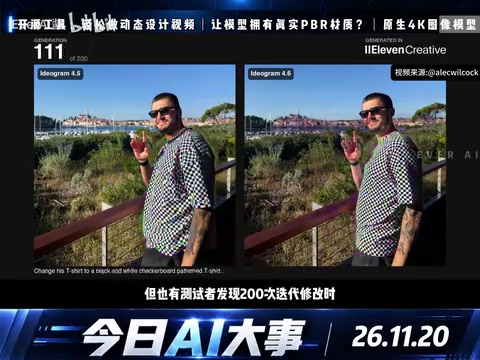
This feedback deserves attention: it indicates that the model still accumulates errors in long-chain, high-frequency editing scenarios. For everyday use requiring only one or two rounds of local adjustment, this issue may not be obvious; but for commercial projects that need repeated polishing, color drift will bring additional color-correction costs.
Three Observations
Looking at these three pieces of news together, a common orientation among current AI content tools becomes apparent: shifting from "can generate" to "can enter the production pipeline." OpenMotion addresses standardized delivery of motion graphics, UltraTex addresses the physical credibility of 3D materials, and Ideagram 4.6 addresses the controllability of image editing. All three are bridging the gap between generated content and professional workflows.
The second observation is the tension between templating and originality. OpenMotion's template library and UltraTex's material classification essentially use prior knowledge to constrain the generation space, trading diversity for stability and usability. This trade-off is reasonable at the tooling stage, but in the long run, whoever can make "constraints" more fine-grained and more adjustable will get closer to the real needs of professional creators.
Third, long-iteration stability is becoming a new evaluation dimension. The problems exposed by Ideagram 4.6 after 200 iterations remind us that evaluating AI tools cannot rely solely on single-output quality; we also need to look at their degradation curves in real workflows. This applies to image, video, and 3D generation tools alike.
The above content is compiled based on the AI daily report by Bilibili creator "Ever AI." For specific tools' open-source addresses and version details, please refer to their official releases.
One-line Summary
OpenMotion, UltraTex, and Ideagram 4.6 are pushing generative capabilities into the production pipeline.
Paragraph Summary
This article reviews three recent updates in AI video and 3D content generation. OpenMotion reverse-engineered promo videos from over 100 companies to compile 300+ motion templates and 152 design systems, supports DeepSeek Harness, and turns motion design into a template-matching task—lowering the production barrier for small teams, though output tends to carry a promo video feel. UltraTex reduces texture discontinuities by understanding object surfaces from multiple views and distinguishes reflection behavior for metals, plastics, wood, and ceramics, reinforcing the physical plausibility of PBR materials. Ideagram 4.6 supports native 4K and fine-grained local editing while reducing alteration of non-edited regions, but testers found color shifts and noise after 200 iterations. The author draws three observations: tools are shifting from "can generate" to "can enter the production pipeline," templating trades diversity for stability, and long-iteration stability is becoming a new evaluation dimension.
Related articles

ChatGPT Plus Subscription Pitfall Guide: Go/Plus/Pro Tier Comparison and Quick Activation
A complete ChatGPT Plus subscription guide based on a Bilibili tutorial: from registering an account, comparing Go/Plus/Pro tiers, to the practical steps for quickly completing your subscription.

GPT-6.2 Sol/Astra Released! A Step-by-Step ChatGPT Plus Subscription Guide and Tier Comparison
GPT-6.2 Sol/Astra is out—here's a ChatGPT Plus subscription guide: register an account, compare Go/Plus/Pro tiers, and subscribe in a minute.

Comparing Three Channels for Subscribing to GPT Plus in China: Is Website Top-Up the Easiest?
How to subscribe to GPT Plus in China? This article compares website top-up, credit card, and mobile top-up channels—process, cost, and risk—with steps and tips to help you choose wisely.