Open Weights in Production: Five Practical Lessons from DeepSeek to Intercom

Open-weight production requires recalculating costs, replacing leaderboards with A/B tests, and planning hardware and trust escape routes.
Based on Chain of Thought podcast discussions, this article distills five practical lessons for running open-weight models in production. The core idea: open model value isn't leaderboard scores but real cost per task, verifiable customer value, and the parts outside model weights. Lessons cover recalculating inference budgets after DeepSeek R1, Intercom's $250K/month savings with fine-tuned Qwen, CUDA lock-in risks, Block's Goose local agent, and enterprise trust before parameters.
Open-weight models win applause easily, but running them profitably is hard. The questions that really determine success are: what does each task cost, what do you need to prove to customers, and how much of the system runs outside the model weights. Leaderboards alone can't answer these. This article distills five practical lessons for developers from the Chain of Thought podcast's series on open-source AI.
After the Price Shock, Recalculate Your Inference Budget
The week DeepSeekAd R1 launched, Chain of Thought recorded an episode while the news was still unfolding. For developers, that timing itself is a valuable signal — it captures how a group of people redefined what an open model should be worth.
R1's release forced the industry to rethink the price floor for open models and what that means for how models get built. Export controls and "agents-as-a-service" came up as second-order concerns, but the immediate developer action was simpler: re-run your inference budget assumptions and revisit your agent feature roadmap.
One detail worth noting: the episode tied heavier agent stacks to the need for agent behavior evaluation beyond single-turn demos. If you're adding tools, memory, or multi-step flows, plan how to measure agent performance before you scale traffic. The episode paired R1's shock with agent evaluation, the guardrail layer that complexity demands.
Agent Evaluation refers to systematically measuring the effectiveness of AI agent systems that have tool-calling, multi-step planning, and memory capabilities. Unlike single-turn Q&A evaluation, agent evaluation must focus on full task-chain success rates, correctness of intermediate steps, tool-call accuracy, and failure recovery. Common evaluation dimensions include: task completion rate (hard resolve rate), partial completion quality (soft resolve rate), average steps, tool misuse rate, and hallucination rate. In practice, agent evaluation typically requires building task sets from real scenarios and judging them via human annotation or automated graders (such as LLM-as-Judge). It is the necessary guardrail before scaling an agent system — agent stacks without evaluation fail in unpredictable ways in production.
When the Task Is Narrow Enough, Open-Source Fine-Tuning Can Beat the API Bill
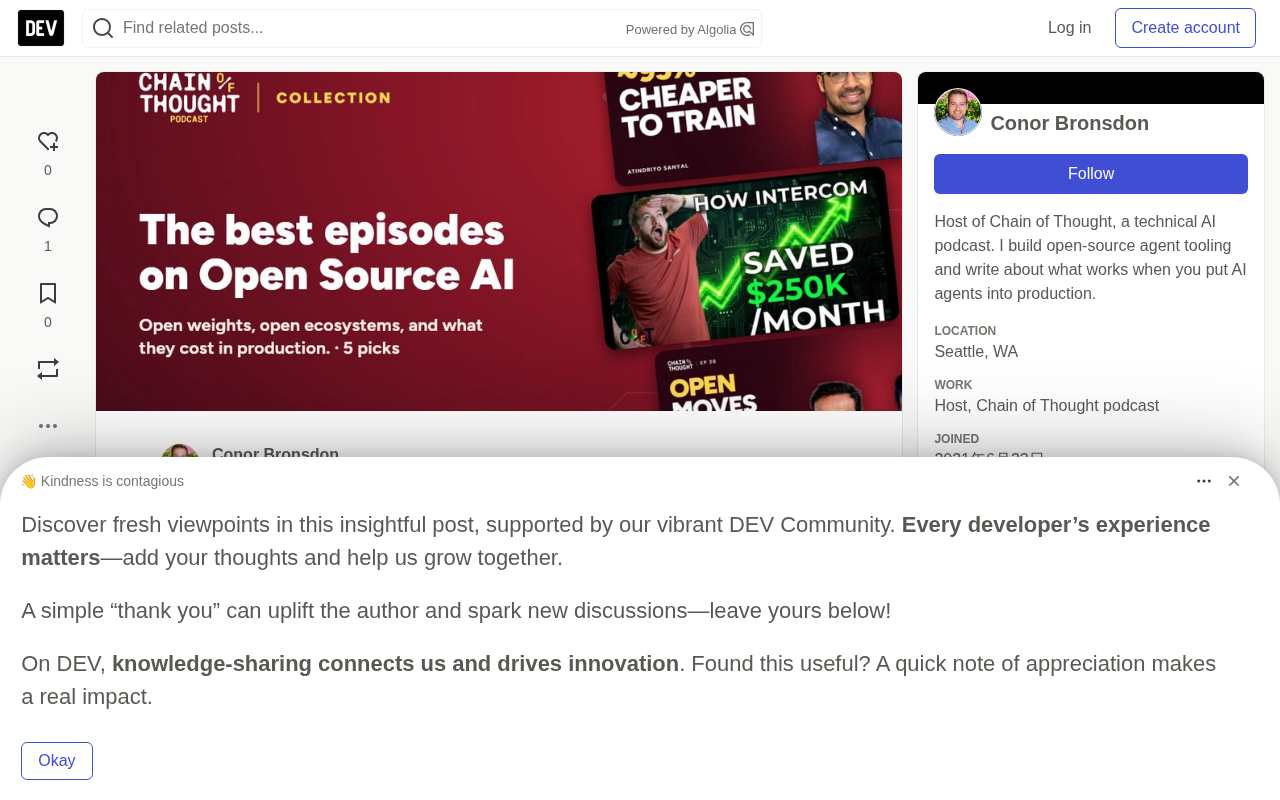
Intercom's case is the most concrete open-weight production story in the Chain of Thought episodes. They were spending $250,000 per month on GPT for a single summarization task, then migrated to a fine-tuned 14B Qwen model and saved nearly all of it.
But don't just copy the "swap the model, save money" conclusion and ignore the systems engineering around it. When Fergal Reid told the story of Fin on the show, he mentioned that resolve rates went from about 30% to nearly 70%, and most of that gain came from custom rerankers, retrieval models, and query normalization — not from swapping out the frontier LLM alone.
Benchmarks can lie in production (the episode explicitly mentioned Goodhart's Law), so Intercom relied on A/B testing, validating results with soft and hard resolve rate definitions. The decision rule to borrow: first isolate the task with the standout monthly bill, then judge whether a smaller open model plus fine-tuning can beat API spend. If the task is narrow enough (summarization, normalization), test it in production before committing — don't just look at leaderboards.
Also remember the latency issue Reid described: slower responses sometimes improved resolve rates, which breaks the intuition of optimizing only for speed.
Goodhart's Law originally states: "When a measure becomes a target, it ceases to be a good measure." In AI benchmarking, this shows up as models overfitting to leaderboard metrics, performing far below their benchmark scores on real production tasks. For example, a model might lead on MMLU or a specific summarization benchmark but underperform on enterprise-specific summarization styles, domain terminology, or long-tail inputs. That's why teams like Intercom replace trust in leaderboards with production A/B testing — A/B tests directly measure resolve rate changes in real user scenarios, unaffected by benchmark overfitting. Developers should treat public leaderboards as a screening tool, not a selection basis.
The Open Ecosystem Bet: Figure Out Your Escape Hatch First
The AMD-challenges-NVIDIA episode leaned hardware, but the lesson for developers is about lock-in. Anush Elangovan positioned AMD's MI350 series, built on the CDNA 4 architecture, including what he called "mind-blowing" 20 petaflops FP4 performance, as part of a full-stack push paired with ROCm 7 and AMD Developer Cloud, with Day Zero support for frontier models.
Sharon Zhou's segment was about making contributions real: providing smooth paths for community work, teaching, listening to developers, and treating open source as something beyond a press release. For application teams, the point is knowing where your escape hatch is. If your training or serving depends on a vendor's CUDA-specific path, your open-model strategy can still die on infrastructure bills or portability. Before hardening assumptions, ask whether your stack has a credible second home.
CUDA Lock-In and the ROCm Alternative Path: CUDA is NVIDIA's proprietary parallel computing platform, and the vast majority of deep learning frameworks and optimization libraries prioritize CUDA support, creating de facto ecosystem lock-in. ROCm is AMD's counterpart open stack, supporting mainstream frameworks like PyTorch, but still lags in operator coverage, library maturity, and community documentation. When evaluating portability, developers need to check: whether training code depends on CUDA-specific operators (such as particular FlashAttention implementations), whether the inference engine is bound to TensorRT, and whether deployment depends on NVIDIA-specific hardware features. AMD Developer Cloud and Day Zero support mean new models can run on ROCm at launch, but teams still need to actually verify the migration cost for their own workloads.
Local Open-Source Agents: Security Boundaries and Team Psychological Safety
Block's Rizel Scarlett discussed Goose on the show — Block's local open-source agent for automating engineering work, starting with migration tasks for Block employees. Block also partnered with Anthropic on MCP, which reminds us that open-source agents still live within ecosystems built by others. What it gives you is the ability to inspect and adapt more of the stack.
Scarlett connected open-source agent tooling to developer safety, including psychological safety for junior developers, as well as responsible and ethical use and community engagement when building developer tools. Practical approach: within policy limits, default sensitive work to local agents, document what agents can touch, and treat openness as a reason to bring the community into review while keeping your guardrails.
MCP (Model Context Protocol) is a protocol proposed and open-sourced by Anthropic to standardize how AI models interact with external tools and data sources. It defines a structured interface for how models discover tools, call tools, and receive results, enabling agent systems to plug into file systems, databases, APIs, and other resources in a pluggable way. For local open-source agents, MCP's value is that developers can reuse community-built MCP servers instead of writing custom integrations for every tool; at the same time, MCP's local execution characteristics help keep sensitive data from leaving the boundary. Block's Goose extends its capabilities through MCP while confining sensitive operations to the local environment.
Enterprise Selection: Trust Before Parameters
Chain of Thought's first episode framed open versus proprietary models as an "enterprise trust problem," not a benchmark race. Writer CEO May Habib discussed implementing generative AI at scale and the challenges of productionization.
I'd put trust artifacts before parameter counts: who is accountable for outputs, how humans stay in the loop, and what deployment failures never seen in demos look like. Regulation and election-era policy appeared in the episode's framing, but the developer question from her segment is: open weights or not, can your customers depend on this system in production?
Below is an illustrative sketch for comparing paths (for illustration only, not Intercom's production pipeline):
def should_explore_open_weights(task):
    gates = {
        "monthly_api_spend": task.api_usd_per_month,
        "task_narrow": task.is_single_purpose,
        "eval_in_prod": task.has_ab_not_only_benchmarks,
        "trust_requirements": task.enterprise_checklist_done,
    }
    return gates["monthly_api_spend"] > 0 and gates["eval_in_prod"]
Developer Checklist
- After an open-model price shock (such as an R1-level event), recalculate your inference budget, and add agent evaluation before scaling tool-using flows.
- For a single high-spend task, follow Intercom's pattern: fine-tune open weights plus retrieval, reranking, and normalization, and replace trust in leaderboards with production A/B testing.
- Before committing to a training pipeline, map out hardware and software lock-in (CUDA-specific paths vs. open stack options like ROCm and developer cloud Day Zero support).
- Ship open-source agents like Goose: clear local boundaries, MCP integration where needed, and explicit safety practices for dense junior developer teams.
- For enterprise buyers, lead with trust and productionization experience before open-source ideology.
One-line Summary
Running open-weight models in production requires recalculating costs, replacing leaderboards with production A/B testing, and planning escape routes at the hardware and trust layers.
Paragraph Summary
Based on Chain of Thought podcast discussions, this article distills five practical lessons for running open-weight models in production. The core idea: the value of open models isn't in leaderboard scores but in the real cost per task, verifiable customer value, and the parts of the system outside the model weights. Specifically: after price shocks like DeepSeek R1, recalculate inference budgets and plan agent evaluation early; Intercom replaced GPT with a fine-tuned 14B Qwen to save about $250,000 per month, but most gains came from peripheral systems like retrieval, reranking, and normalization; AMD's open ecosystem bet reminds teams to watch for CUDA lock-in and portability; Block's Goose agent shows how local open-source agents can balance automation with developer safety; and enterprise selection should prioritize trust artifacts and productionization experience.
Related articles

Gaussian Process Bandit Optimization: Exploration Strategies and Inference Regret Guarantees
Cumulative regret guarantees in Bayesian optimization fail to reflect final recommendation quality. This article examines a new study that provides inference regret guarantees for Gaussian process bandit optimization through exploration query strategies and fill distance analysis, validated on hyperparameter optimization and control tasks.

The Most Detailed Codex Guide on Bilibili: From Installation to Real-World Practice
The most detailed Codex guide on Bilibili: from app store installation to daily work mode configuration, with a real coffee shop project demonstrating file organization, data extraction, dashboard creation, and other practical tasks. Learn to use Plan Mode and desktop pets to leverage Codex efficiently.

Appearance Compensation in Volume Rendering: Why RGB Accuracy Cannot Guarantee Density Correctness
Volume rendering research reveals that volumetric data perfectly reproducing external RGB views may still contain density errors: appearance compensation can double central density and keep external rays unchanged even when L2 error exceeds 14.52%. Density recovery depends on appearance capacity, spatial resolution, and measurement design.