OpenAI Ads Red Flags: Data Discrepancies, Unreachable Support, and Unauthorized Charges — A Real User's Story

A user spent nearly $1,000 on OpenAI Ads and got trapped in data lies, account lockouts, and an AI support death loop.
A Reddit user documented a failed OpenAI Ads experience: the platform claimed dozens of clicks and leads, but Google Analytics showed almost nothing and no real clients came through the ads. Worse, multiple accounts caused a login loop that blocked dashboard access while charges continued to accumulate — nearly $1,000 in total. AI support repeatedly asked for information the user couldn't access, going nowhere across 10 days and 4 attempts. The incident exposes clear weaknesses in data credibility, account management, and edge-case support handling for new AI ad services.
A Reddit user recently published a detailed account of their company's disastrous experience with OpenAI Ads: severe data mismatches with Google Analytics, nearly $1,000 in charges with virtually no real conversions, getting trapped in an account login loop, and an AI support system stuck in a useless cycle. The post sparked broader discussion about the reliability of new AI advertising services and the limits of AI-powered customer support automation.
From High Hopes to Complete Disappointment
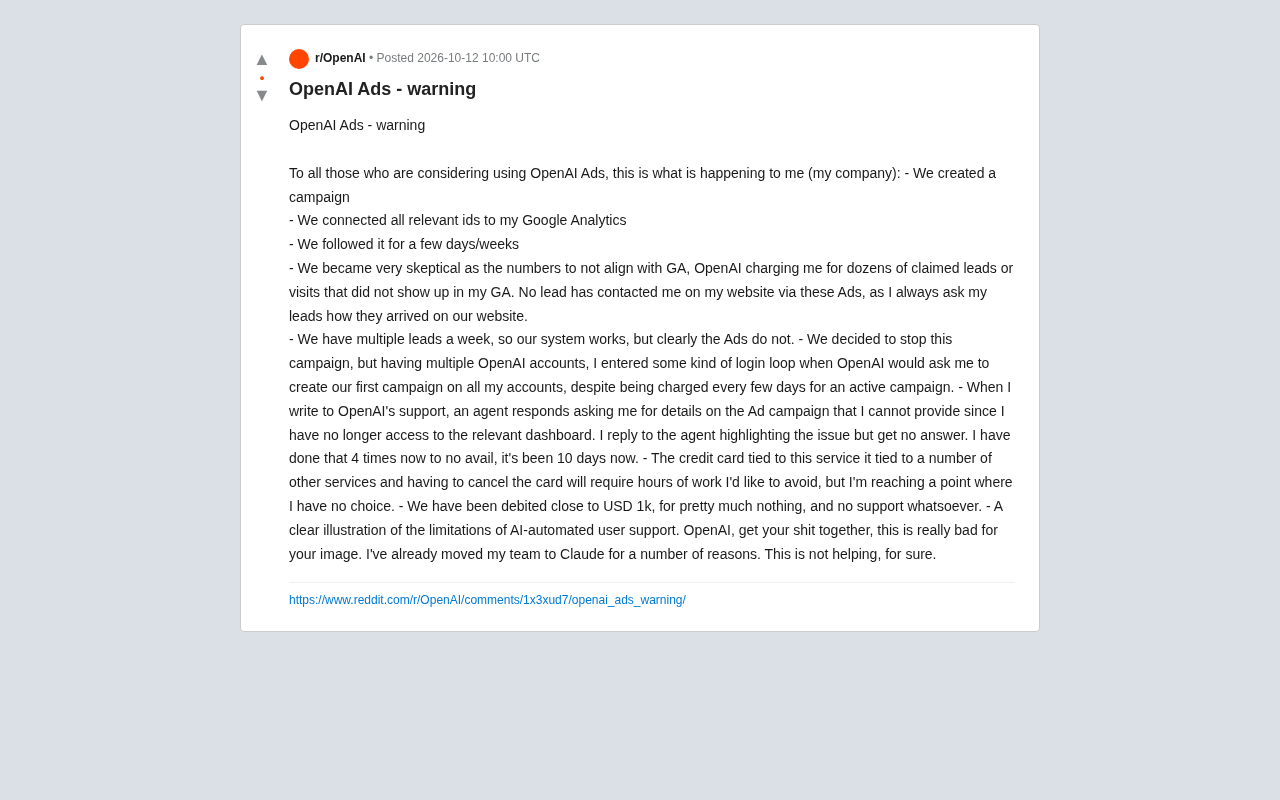
According to the poster, the process started normally enough. Their company created an ad campaign, connected all relevant IDs to their Google Analytics (GA) account, and monitored results over the course of several days to weeks.
Problems surfaced quickly. The OpenAI Ads dashboard claimed to have generated dozens of clicks and leads, but none of this activity could be found anywhere in GA. The poster stressed that their company's lead generation system was otherwise working fine — they received multiple genuine leads every week and routinely asked each new client how they'd found the website. Not a single one reported discovering the business through these ads. In other words, the "traffic" they paid for left almost no trace in the real world.
This severe divergence between platform-reported data and third-party analytics (GA) is the most alarming signal in the entire episode. For any business running ads, the accuracy of attribution data is the foundation of ROI measurement. Once a platform's own numbers can't be cross-verified by independent tools, your ad budget effectively loses any credible measuring stick.
A note on ad attribution: Attribution is a core concept in digital advertising — it refers to the process of crediting a conversion (such as a purchase, sign-up, or lead submission) to a specific ad channel or touchpoint. Google Analytics tracks this independently by using GA tags or UTM parameters embedded in web pages, recording where users came from and what actions they took. Discrepancies between a platform's self-reported clicks and third-party data are not unusual in the industry; they can stem from different attribution window settings, cross-device identification logic, or a platform's "loose counting" practices — for instance, some platforms credit conversions that happen within a certain time window after an ad impression. But when the gap is so extreme that GA records virtually no traffic at all, it goes well beyond normal variance and typically points to one of two things: serious traffic quality issues (such as invalid clicks) or a fundamental failure in tracking configuration.
The Worse Problem: Unable to Stop the Charges
When the poster decided to shut down the campaign, the real nightmare began. Because they had multiple OpenAI accounts, the system trapped them in a strange login loop: OpenAI kept prompting them to "create your first campaign," as if they had never run any ads — while their credit card continued to be charged every few days.
This meant they couldn't access the billing ad dashboard, and they couldn't close it from the entry point either. The account state and the billing state were completely decoupled. For small businesses or agencies managing multiple accounts, this is a very real pitfall: if the account-switching logic breaks down, users can lose all control over the services they're actively paying for.
The AI Support Death Loop: An Awkward Irony
The poster then contacted OpenAI support — and the response was almost darkly comic. The support agent (apparently automated) asked them to provide detailed information about their ad campaign. The problem? They couldn't access their dashboard, which was precisely why they couldn't provide that information. They explained this contradiction in their reply and received no further response.
"I've done this four times now with zero results. It's been 10 days."
The user spelled it out directly: this is a clear illustration of the limits of AI-powered customer support automation. When a customer's very problem is "I can't access the system," an automated support bot that only knows how to follow a script and request system-level information becomes completely incapable of solving anything. The irony, of course, is that this is happening at OpenAI — a company celebrated for its AI capabilities.
On the "Catch-22 loop" in customer service: This predicament has a well-known name in the industry — the Catch-22 Loop: the system requires the user to provide information A in order to resolve problem B, but problem B is the exact reason the user cannot obtain information A. Automated support systems — whether rule-based chatbots or LLM-powered AI agents — are typically designed around structured decision trees: collect an account ID, order number, or screenshot, then match it against a knowledge base to deliver an answer. This works efficiently in standard scenarios, but in edge cases like "the user has lost access to the system entirely," these systems lack the ability to break out of their scripts and escalate to a human agent with direct backend access. For an AI company, the irony runs deep: OpenAI, whose mission is to build artificial general intelligence, repeatedly failed in front of a user who provided complete and coherent context — a reflection of a widespread weakness in how current AI support products handle abnormal resolution paths.
Nearly $1,000 Down the Drain — Team Has Switched to Claude
By the time of posting, the company had been charged close to $1,000 with almost nothing to show for it and no meaningful support received. Making matters worse, the credit card being charged was also linked to numerous other services — canceling it to cut losses would mean hours of work re-linking accounts elsewhere, a step the poster had been desperate to avoid but was being pushed toward.
The poster didn't hold back at the end of their post: "OpenAI, get your act together — this is really bad for your image." They also revealed that their team had already switched to Claude for a number of reasons, and that this experience "obviously didn't help OpenAI's case."
Practical Takeaways for Anyone Considering New AI Ad Services
Setting aside the frustration, this case offers several concrete lessons for businesses thinking about trying new AI advertising products:
- Always cross-check with independent analytics tools: Never rely solely on the numbers a platform reports about itself. Reconciling with GA or another third-party attribution tool is a non-negotiable baseline.
- Understand the account-switching and billing logic before using multiple accounts: Before operating multiple accounts under the same service, confirm that the platform clearly separates account states from billing states.
- Use a dedicated, controlled payment method: Bind new services to a separate virtual credit card with a limited balance — not your primary card shared across critical services. This dramatically reduces the cost of damage control if something goes wrong.
- Run a small-budget test before scaling: For any newly launched ad product without an established track record, run a small budget through the full cycle — including the shutdown process — before committing more spend.
It's worth noting that this article is based on a single Reddit user's personal account and cannot be taken as representative of OpenAI Ads' overall performance, nor has it been confirmed by an official OpenAI response. That said, firsthand feedback from real paying users is often more informative when assessing a new service's maturity than any official marketing material.
Related articles

Amphibious Transforming Drone: Beyond 100x Power Savings, What Are the Real Needs?
Is the amphibious transforming drone just a gimmick? Starting from the 100x power difference of the M4 Morphobot, explore real application scenarios and thesis topic ideas, analyzing boundary conditions where pure drones and pure ground robots both fail.

Warhound Raises $200 Million: Genetically Engineered "War Dogs" Paired with Anduril Gear
Warhound raises $200M, backed by Ben Lamm and Palmer Luckey, to genetically engineer dogs for military and law enforcement use and equip them with Anduril gear. This article analyzes its technology direction, funding logic, and ethical controversy.

Claude API Comes to Google Cloud: IAM Integration and SDK Access Guide
Anthropic hosts the full Claude API on Google Cloud with IAM-controlled permissions and unified billing. This guide covers the Vertex AI and Anthropic-hosted entry points, IAM role configuration, and SDK access.