OpenAI Agents Python SDK v0.22.3: Fixes and Security Hardening — Full Breakdown

openai-agents-python v0.22.3 delivers stability and security patches across tool calls, sessions, and dependencies.
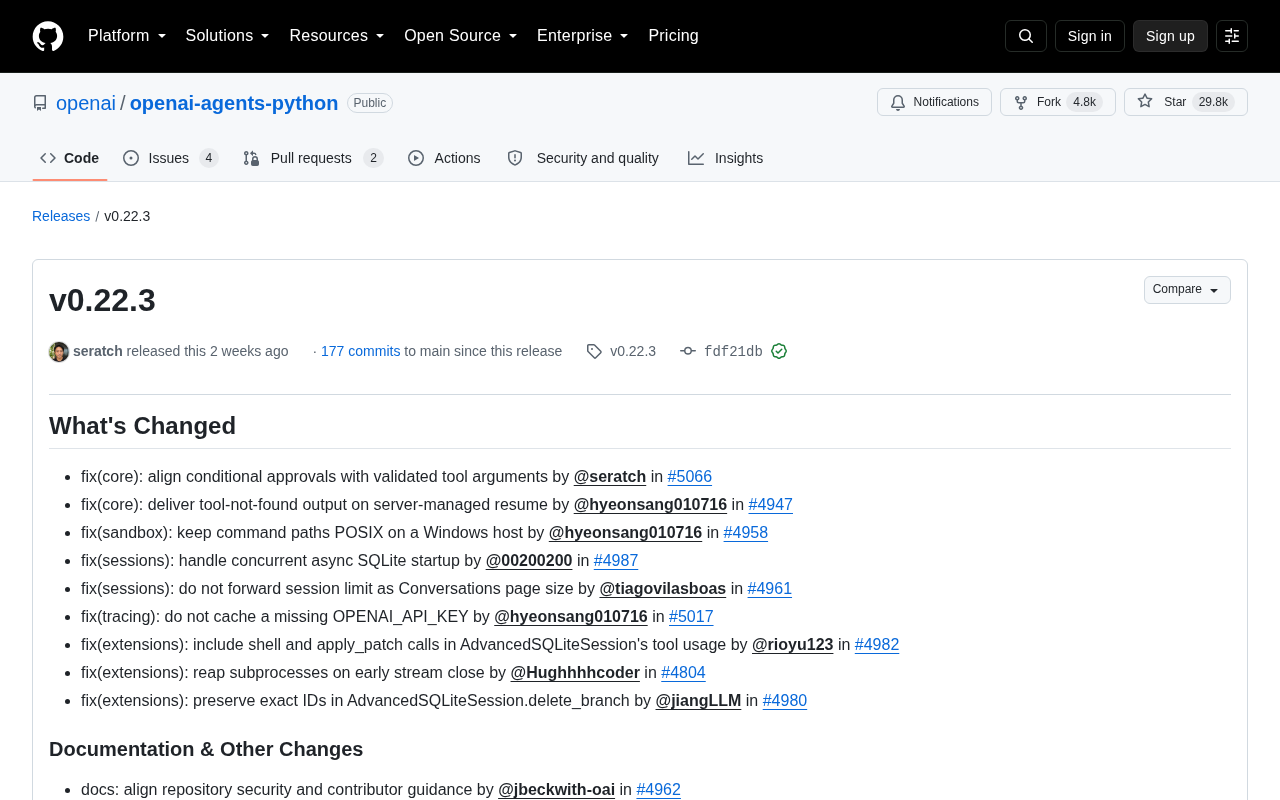
OpenAI's openai-agents-python SDK releases v0.22.3, a patch update that improves stability and security without breaking API changes. Key fixes include aligning conditional approvals with validated tool arguments, resolving tool-not-found output during server-managed session resumption, and fixing async SQLite race conditions. On the security front, vulnerable dependencies are updated without touching public interfaces, and CodeQL scanning plus Dependabot cooldowns are introduced as governance measures. The cryptography library jumps to 50.0.0 — regression testing is advised. Five new contributors joined this release.
OpenAI's officially maintained openai-agents-python has released version v0.22.3. With nearly 30,000 stars and over 4,800 forks, this SDK is the core toolchain for building OpenAI agent applications. While this is a patch release, it covers fixes across multiple dimensions — core logic, session management, sandbox execution, and dependency security — making it worth the attention of any developer working with this framework.
Core Functionality Fixes: Tightening Tool Call Reliability
Several fixes in the core module directly affect the reliability of agent tool calls. The most notable is fix(core): align conditional approvals with validated tool arguments (#5066, by @seratch). This fix ensures that the conditional approvals mechanism aligns with validated tool arguments — in other words, when an agent requires human approval before executing a tool, the parameters shown for review are guaranteed to be the already-validated version. This closes a security gap where the approved parameters could differ from the ones actually executed.
Another fix, deliver tool-not-found output on server-managed resume (#4947), addresses the output delivery issue when a tool is not found during server-managed session resumption. For applications that rely on server-side session state management, handling these edge cases correctly is critical to conversation flow robustness. This is also the first contribution from @hyeonsang010716.
Conditional Approvals are a Human-in-the-Loop mechanism in agent frameworks: when an agent is about to call a high-risk tool (such as file writes, code execution, or external API calls), the system pauses execution and presents the tool name and parameters to a human reviewer, who decides whether to allow it. The security premise of this mechanism is that the parameters shown in the approval UI must be exactly the same as those used at execution time. If the approval is based on raw, unvalidated parameters while execution uses type-coerced or default-filled values, a "what you see is not what gets executed" blind spot emerges — and this fix closes exactly that vulnerability.
Session Management and Cross-Platform Support
Two session-related fixes address classic concurrency and pagination issues. handle concurrent async SQLite startup (#4987) fixes a race condition when async SQLite is initialized concurrently — a common pitfall in high-concurrency agent services. Meanwhile, do not forward session limit as Conversations page size (#4961) corrects a bug where the session limit parameter was incorrectly passed as the Conversations pagination size, preventing data retrieval errors caused by semantic confusion.
On the cross-platform front, keep command paths POSIX on a Windows host (#4958) fixes sandbox command path formatting on Windows hosts, ensuring POSIX-style paths are handled correctly. For teams running agents in mixed OS environments, this kind of detail fix can save considerable debugging time.
Race Conditions are a classic concurrency problem: when multiple async tasks simultaneously attempt to initialize the same SQLite connection, the lack of proper locking can cause the database file to be created multiple times, table schemas to be written concurrently, or even data corruption. SQLite is a lightweight, single-writer/multi-reader database that requires additional serialization protection in async frameworks like asyncio. The typical fix involves introducing an
asyncio.Lockor a singleton initialization pattern to ensure the startup sequence runs only once — this is especially critical when multiple agent instances are spun up concurrently within the same process.
Extensions and Tracing Capabilities
The extensions module received concentrated fixes for AdvancedSQLiteSession, reflecting the project's ongoing investment in persistent session capabilities:
include shell and apply_patch calls in AdvancedSQLiteSession's tool usage(#4982): Adds shell and apply_patch calls to tool usage tracking for more complete observability;preserve exact IDs in AdvancedSQLiteSession.delete_branch(#4980): Preserves exact IDs when deleting branches to prevent accidental deletion;reap subprocesses on early stream close(#4804): Reaps subprocesses when a stream closes early, preventing zombie process accumulation.
On the tracing side, do not cache a missing OPENAI_API_KEY (#5017) fixes a bug where a missing API key would be incorrectly cached — meaning you can now add the environment variable later without restarting, which is a nice developer experience improvement.
Dependency Security and Engineering Governance
A significant portion of this release is dedicated to dependency security and repository governance, with a notable series of contributions led by @jbeckwith-oai. update vulnerable dependencies without changing SDK APIs (#4963) updates vulnerable dependencies without breaking public SDK interfaces — a textbook approach to enterprise-grade project maintenance that balances security fixes with API stability.
Accompanying governance measures include: enabling Python Dependabot with release-age cooldowns (#4964), adding CodeQL security scanning for Python and Actions (#4974), and establishing code ownership and release review standards (#4965, #5058). This combination reflects OpenAI's push to further standardize and harden the SDK's maintenance processes.
The dependency upgrade list is substantial, covering version bumps for fastapi, uvicorn, sqlalchemy, cryptography, starlette, typing-extensions, and more — most submitted automatically by Dependabot. Notably, cryptography jumped from 45.0.7 to 50.0.0, a major version leap; developers using cryptography-related features should run regression tests after upgrading.
CodeQL is GitHub's static code analysis tool that scans codebases for potential security vulnerabilities, including SQL injection, command injection, and unsafe deserialization. Dependabot is GitHub's automated dependency update bot that monitors security advisories (CVEs) and automatically submits upgrade PRs. Configuring "release-age cooldowns" means Dependabot won't immediately chase freshly published versions — it waits for the community to validate stability before proposing an upgrade, balancing security responsiveness with upgrade risk. The cryptography library jumping from 45.x to 50.0.0 spans multiple major versions and may include removal of deprecated APIs; code using the low-level
hazmatinterfaces should be carefully audited for compatibility.
Community Activity and Upgrade Recommendations
This release welcomes 5 new contributors (@hyeonsang010716, @jbeckwith-oai, @00200200, @jiangLLM, @tiagovilasboas), a sign of a healthy open-source ecosystem. Looking at the full changelog from v0.22.2 to v0.22.3, this is a maintenance release focused on stability and security, with no breaking API changes.
For teams already running this SDK in production, upgrading to v0.22.3 is recommended — especially if your use case involves conditional approvals, server-managed session resumption, concurrent SQLite sessions, or sandbox execution on Windows, as these are exactly the areas this release addresses. Projects with sensitive cryptography requirements should pay attention to potential compatibility impacts from the major version jump in the cryptography library after upgrading.
Related articles

AI Reverse-Engineers Monitor Firmware in 15 Minutes — Has the Hacking Barrier Been Flattened?
A security researcher used AI to reverse-engineer Dell monitor firmware in 15 minutes—entropy analysis, key extraction, MD5 verification—revealing encryption design flaws.

Mistral Voxtral 3: Real-Time Voice at 4 Cents per Minute, Challenging OpenAI
Mistral Voxtral 3 cuts real-time voice agent costs to 4 cents per minute, bundling three speech recognition models, a speech generation model, and a real-time voice toolkit, supporting 50+ languages and self-hosting. This article analyzes its pricing structure, sub-second response performance, and its strategic divergence from OpenAI and Gemini on data privacy versus out-of-the-box convenience.

WebMCP: Every Website as Its Own MCP Server, So AI Agents No Longer Rely on Screenshots
WebMCP lets websites expose tools via the document.modelcontext API, becoming directly callable MCP servers. This article explains its architecture, the Claude Code remote-debugging demo, Chrome's current support stage, and its impact on the agent ecosystem.