OpenAI Agents Python SDK v0.23.0 Release Breakdown: Security Hardening and Stability Improvements

OpenAI Agents SDK v0.23.0 focuses on security hardening, sandbox permission tightening, and multi-agent state isolation.
OpenAI Agents Python SDK v0.23.0 is a polish-focused release centered on security hardening and stability improvements. New features like configurable MCP pagination, Docker deletion protection, and memory consolidation rounds are designed as opt-in controls for enterprise users. Security fixes cover sensitive data redaction across tool failures, streaming tracebacks, and Realtime error events, plus tighter sandbox permission checks and mandatory encrypted session history envelopes. Stability improvements address nested agent tool state isolation and streaming edge cases, while the default STT model switches to gpt-transcribe. Projects involving sandbox execution, sensitive data, or multi-agent orchestration will benefit most — but default behavior changes should be validated before upgrading.
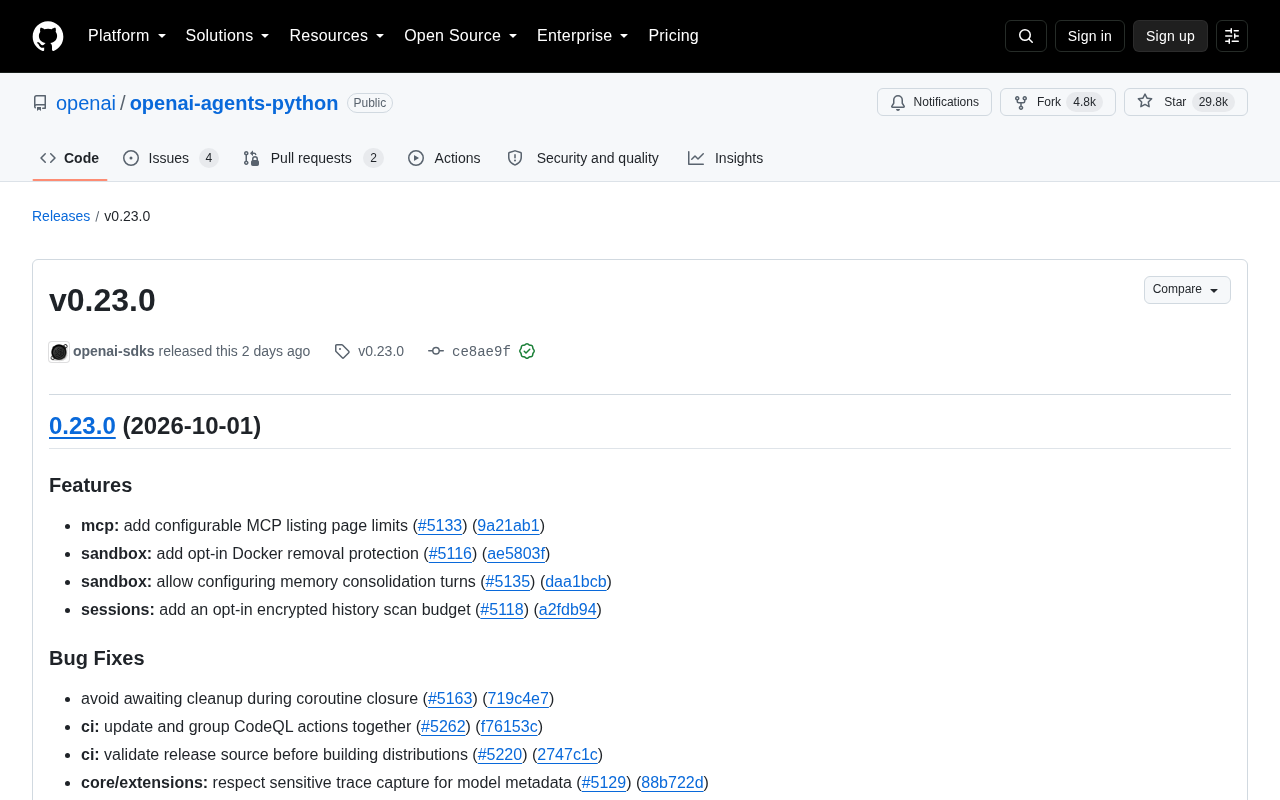
OpenAI recently released v0.23.0 of its Agents Python SDK. With nearly 30,000 stars and over 4,800 forks on GitHub, this SDK is a core toolchain for building agent applications powered by OpenAI models. While this update doesn't introduce any groundbreaking new features, it delivers a concentrated round of fixes and hardening across security sandboxing, session management, and real-time voice — signaling that OpenAI is actively pushing the Agent framework toward production-grade readiness.
New Features: Configurable Controls for Sandboxes and Sessions
The Features section in this release is modest but focused — it's all about giving developers finer-grained control over their runtime environments.
- Configurable MCP list pagination limit (#5133): When fetching tool or resource lists via the Model Context Protocol (MCP), you can now configure a pagination cap, preventing excessive loading that could strain performance or memory.
- Docker deletion protection (opt-in) (#5116): An optional container deletion protection mechanism for sandbox environments, guarding against accidental removal of active workspaces.
- Configurable memory consolidation rounds (#5135): Developers can now configure the number of memory consolidation rounds, allowing them to balance context compression frequency against fidelity based on their use case.
- Encrypted history scan budget (opt-in) (#5118): Session history now supports a configurable scan budget in encrypted mode, balancing privacy protection with performance overhead.
What these features share is a "configurable" and "opt-in" philosophy — rather than enforcing a one-size-fits-all policy, OpenAI is carving out tuning space for enterprise users alongside sensible defaults.
Model Context Protocol (MCP) is an open standard proposed by Anthropic in late 2024 and subsequently adopted by multiple AI vendors. It standardizes the interface between AI models and external tools or data sources — essentially the "USB port" of the AI world. Tool providers implement a single standard protocol, and models can uniformly discover and invoke those tools without per-model integrations. In the OpenAI Agents SDK, MCP servers expose available tool lists to agents. When the number of tools is large, this list is fetched via pagination. Previously, the lack of a configurable limit could cause agents to pull hundreds of tool entries at initialization, introducing unnecessary latency and memory overhead. The new configurable pagination cap lets developers tune this to their actual tool scale and latency budget.
Security and Privacy: Extensive Redaction and Permission Validation
The most noteworthy aspect of v0.23.0 is its attention to security details. Scanning the bug fix list, a significant number of entries revolve around preventing information leakage:
- Default tool failure details are now redacted (#5112)
- Streaming task exception tracebacks are redacted (#5121)
- Exception details in Realtime tool error events are masked (#5132)
- Redis connection info and Realtime debug summaries in example code have been scrubbed to prevent sensitive data from entering diagnostic logs
Security hardening in the sandbox module is particularly dense: enforced permission checks on recursive deletion (#5206), rejection of privileged storage under read-only host authorization (#5117), locking host authorization checks to a normalized workspace root (#5099), and restricting Darwin host PATH read authorization scope (#5139). Together, these fixes pursue a single goal — tightening an agent's access to the host environment when executing code or file operations, reducing the risk of privilege escalation and data exfiltration.
Session encryption has also been strengthened, including requiring encrypted envelopes for session history (#5204) and preserving encrypted SQLite history when an incorrect key is used (#5083). For scenarios involving sensitive conversational data, these changes raise the compliance floor.
Stability Fixes: Concurrency, Streaming, and State Isolation
Another major category of fixes addresses runtime stability, particularly state consistency in nested agents, tool calls, and streaming.
Nested Agent and Tool State Isolation
Several fixes address state bleed between nested agent tools across runs: "isolate nested agent tool state in a fresh run" (#5123), "restore nested agent tool state to the tool's own agent" (#5142), and "scope function tool approvals to their owning agent" (#5144). These issues can easily trigger hard-to-reproduce bugs in complex multi-agent orchestration, and the fixes significantly improve behavioral predictability.
"Nested agents" refers to an orchestration pattern where one agent triggers another sub-agent via a tool call — common in task decomposition or specialization scenarios (e.g., a planning agent dispatching multiple execution agents). The challenge is that if sub-agent tool instances, approval states, or other context are shared with the parent agent or across runs, state pollution occurs — an approval decision from one run unexpectedly influences the next, or a sub-agent's tools incorrectly inherit the parent agent's permission context. These bugs are notoriously hard to reproduce in unit tests and typically only surface in concurrent or multi-turn production environments. This fix explicitly isolates nested agent tool state at the start of each fresh run and strictly binds function tool approvals to their owning agent, fundamentally severing cross-run state leakage.
Streaming and Timeout Handling
Several patches address the streaming path: discarding stale stream event aliases after model timeout (#5216), rejecting premature EOF in Chat Completions streams (#5211), and terminating event iteration on session close (#5172). Combined with pre-request WebSocket handshake failure retries (#4780) and rate-limited trace export retries (#5052), the overall resilience of the network and streaming pipeline has been improved.
Realtime and Voice Modules
The Realtime module now enforces a default inbound WebSocket message size limit (#5102) and enforces guardrails on Realtime tool outputs (#5127). The voice module switches its default STT model to gpt-transcribe (#5276), and fixes cleanup logic for streaming transcription at edge cases like input end and session close.
STT (Speech-to-Text) models transcribe a user's real-time speech into text — the first step in a voice interaction pipeline, where latency and accuracy directly affect conversational quality. Switching the default STT model to gpt-transcribe means the underlying transcription model used by the SDK has changed. gpt-transcribe is OpenAI's next-generation transcription model released in 2025, offering improvements over the older Whisper series in multilingual accuracy and low-latency scenarios. For projects already using voice features in production, this default switch may introduce subtle differences in transcription output (including punctuation style, proper noun handling, etc.). OpenAI recommends running regression tests in a staging environment before upgrading to verify compatibility between output format and downstream processing logic.
Dependency Upgrades: A Broad Maintenance Update
This release also includes a substantial number of dependency version bumps, covering core libraries like cryptography, temporalio, urllib3, pyjwt, and anyio, as well as synced updates for openai, httpx2, starlette, twilio, and others in example projects. While these changes have limited impact on end-user functionality, staying current with security patches and dependency versions is essential hygiene for any long-lived production project.
What This Means for Developers
Overall, v0.23.0 is a classic "polish" release. There are no flashy new models or paradigm shifts — instead, the effort goes into security boundaries, state isolation, and exception handling: the things that are invisible but critical. For teams evaluating or already building agent applications with this SDK, the release sends a few clear signals:
- OpenAI is increasingly serious about production readiness for the Agent framework, with tightening standards around sensitive data redaction and sandbox permission control;
- Stability in complex scenarios — multi-agent orchestration, tool calls, streaming, and real-time voice — is steadily converging;
- Encrypted session history is becoming the recommended default path, with privacy compliance baked into the framework design.
Developers using this SDK are advised to evaluate upgrading, especially for projects involving sandbox execution, sensitive data handling, or multi-agent orchestration — these will benefit directly from the security and isolation fixes. Before upgrading, it's still advisable to validate the impact of default behavior changes (such as the STT model switch and Realtime message size limits) on your existing workflows in a test environment.
Related articles

AI Reverse-Engineers Monitor Firmware in 15 Minutes — Has the Hacking Barrier Been Flattened?
A security researcher used AI to reverse-engineer Dell monitor firmware in 15 minutes—entropy analysis, key extraction, MD5 verification—revealing encryption design flaws.

Mistral Voxtral 3: Real-Time Voice at 4 Cents per Minute, Challenging OpenAI
Mistral Voxtral 3 cuts real-time voice agent costs to 4 cents per minute, bundling three speech recognition models, a speech generation model, and a real-time voice toolkit, supporting 50+ languages and self-hosting. This article analyzes its pricing structure, sub-second response performance, and its strategic divergence from OpenAI and Gemini on data privacy versus out-of-the-box convenience.

WebMCP: Every Website as Its Own MCP Server, So AI Agents No Longer Rely on Screenshots
WebMCP lets websites expose tools via the document.modelcontext API, becoming directly callable MCP servers. This article explains its architecture, the Claude Code remote-debugging demo, Chrome's current support stage, and its impact on the agent ecosystem.