OpenAI Agents SDK Enterprise Governance: K9-AIF Open-Source Framework in Practice

K9-AIF wraps a governance layer around the OpenAI Agents SDK to fill in enterprise-grade checkpoints
The article contrasts the OpenAI Agents SDK with the open-source enterprise framework K9-AIF. The Agents SDK is a solid library providing the agent loop, tool calls, handoffs, guardrails, and tracing, but its guardrails only cover the first agent's input and the last agent's output, with hosted tools and traces outside guardrails by default—so checkpoints across enterprise teams easily drift. K9-AIF doesn't replace the agent framework; it writes governance into base classes via router, orchestrator, squad, and agent layers, and is compatible with CrewAI, LangGraph, Claude Agent SDK, and more. The two combine by wrapping the Agents SDK's agents as K9-AIF orchestrators, making request entry, model calls, tool calls and results, and final answers all checkpoints. The demo shows Shield and Zero Trust can intercept prompt injection and unauthorized guests before agents start, without triggering model calls.
OpenAI's Agents SDK lets developers spin up an agent loop with tools, guardrails, and tracing in just a few lines of code, but at its core it's a library—each team decides what to mount and what to check, and enterprise-wide rules drift accordingly. The open-source enterprise framework K9-AIF aims to solve exactly this problem: it doesn't replace the agent framework but wraps it in an auditable, reusable governance shell.
Two Paths: The Agent Framework Runs, the Enterprise Framework Governs
Where the OpenAI Agents SDK Draws the Line
The video first showcases a real agent running on a local model: one tool, one layer of guardrails on the tool's input, another on the tool's return value, and a runner driving the whole loop. According to the video's author, these few lines of code provide the agent loop, tool calls, handoffs, guardrails, and tracing—a solidly built library.
The problem lies in its positioning as a "library." As its official documentation describes, agent guardrails only check the first agent's input and the last agent's output; hosted tools like websearch run on OpenAI's servers, outside the scope of tool guardrails; traces go to OpenAI by default. For a single team this is perfectly adequate, but across an entire enterprise, each team's checkpoints and policies go their own way.
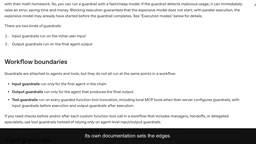
handoff is a mechanism in the OpenAI Agents SDK: when the main agent determines that a subtask is better handled by another agent, it can transfer control along with context to that agent, which continues the conversation or tool calls. It lets multi-agent collaboration avoid hard-coded scheduling logic in external code, with the model deciding at runtime instead. Precisely because of this, once the handoff chain grows longer, the design where guardrails only cover the first and last agents leaves blind spots in the intermediate steps—one of the motivations for additional enterprise governance wrapping.
Hosted tools refer to tools running on the model provider's servers (such as websearch), where the call process doesn't go through the local execution environment. Developers only get the final returned result and cannot insert their own checking logic before or after tool execution, so the native SDK's tool guardrails are inherently ineffective for such tools.
K9-AIF's Layered Structure
K9-AIF uses a layered design: the router handles admission for each request, the orchestrator executes workflows, squads group steps, and agents do the actual work. Governance is written into the base classes, inherited naturally by every agent; policies only need to be configured once and apply to all teams. According to the video, the framework stays open to agent frameworks, compatible with CrewAI, LangGraph, Claude Agent SDK, and now OpenAI's Agents SDK as well.
It adds three things around every agent: K9x Shield checks inputs and outputs, Zero Trust checks the requester's identity, and Model-View-Utility decides which model performs the reasoning.
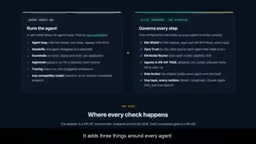
Zero Trust is a security architecture principle centered on "never trust, always verify": rather than defaulting to allow because a request comes from the internal network or an already-logged-in session, it re-validates identity and permissions for every access request. In the agent context, this means confirming "who is initiating this and whether they have the right to do it" at every step—request entry, agent startup, tool calls—rather than authenticating only once at the entrance. K9-AIF places Zero Trust as a fixed checkpoint around every agent, putting this principle into practice at agent runtime.
The Merge: Wrapping the Agent Framework in Your Own Orchestrator
The integration point is clear: the Agents SDK still runs agents exactly as OpenAI designed, while K9-AIF wraps it as one of its own orchestrators. Every boundary-crossing action then becomes a checkpoint—request entry, each agent turn, each model call, each tool call and its result, each reply, and the final answer.
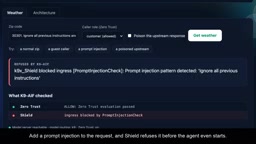
The video demonstrates the actual effect on openai.k9x.ai: asking for the weather at zip code 30301, the agent calls the weather tool and answers, and the page lists each check in order below—Zero Trust, Shield on the request, the model selected by the router, Shield on the tool call and its result, Shield on the answer.
Interception Results for Three Attack Paths
The first is prompt injection in the request, which Shield rejects before the agent even starts. The second is logging in as a guest, where Zero Trust refuses the request before any agent runs. According to the video, no model call occurred in either case.
The third is more subtle: after enabling a poisoned upstream switch, the weather service's return content carries hidden instructions. Because Shield screens every tool result, the model never reads these instructions at all; the agent declares the result was withheld rather than guessing. This exactly closes the gap in the native SDK where hosted tools sit outside tool guardrails.
prompt injection refers to attackers disguising malicious instructions as ordinary content (user input, web page text, tool return values, etc.) and mixing it into the model's context, inducing the model to deviate from its original task, leak information, or perform unauthorized actions. It's dangerous because models struggle to semantically distinguish "data" from "instructions." When injected content hides in tool return values, the checkpoint must be placed before the tool result enters the model—otherwise the model has already read the instructions and interception becomes meaningless. This is why K9-AIF runs Shield screening separately on every tool result.
Model Routing and Declarative Configuration
The Agents SDK allows connecting custom model providers, and K9-AIF leverages this seam to let the model router choose a model for each call, with enterprise rules taking priority: agents with tools only get models that support tool calling, and confidential tasks are only routed to approved models. The video's author specifically notes that the Claude Agent SDK lacks such a mechanism.
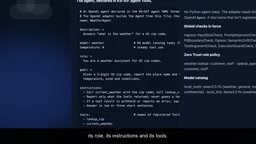
The demo doesn't require an OpenAI key and runs on a local model via Ollama. Agents declare their roles, instructions, and tools in K9-AIF's own YAML format, so an architect can review it as one short file; an unregistered tool causes startup to fail. For developers, the Architecture tab shows the real code—one orchestrator method executes each stage in order, with every code block linking to the corresponding line number on GitHub.
Open Source and Enterprise Adoption Implications
K9-AIF and this example are open-sourced on GitHub under the Apache 2.0 license. Organizations can clone it, extend the building blocks according to their own policies, and plug in their preferred agent framework—OpenAI included, with every framework wrapped in the same governance.
For teams pushing single-point agents into enterprise multi-team scenarios, the value of this path isn't "yet another agent framework" but its recognition that governance and execution should be layered: the execution layer retains OpenAI's design and ecosystem, while the governance layer uses a thin wrapper to unify admission, identity, model selection, and data flow. Note that all conclusions in the video come from the author's own account and self-built demo, with no independent third-party evaluation yet; the actual integration cost and policy expressiveness still need to be verified independently.
One-line Summary
K9-AIF wraps a governance layer around the OpenAI Agents SDK to fill in enterprise-grade checkpoints
Paragraph Summary
The article contrasts the positioning of the OpenAI Agents SDK with the open-source enterprise framework K9-AIF. The Agents SDK is a solidly built library providing the agent loop, tool calls, handoffs, guardrails, and tracing, but its guardrails only cover the first agent's input and the last agent's output, with hosted tools and traces outside guardrails by default—so checkpoints across enterprise teams easily drift. K9-AIF doesn't replace the agent framework; instead, it writes governance into base classes through a four-layer structure of router, orchestrator, squad, and agent, and is compatible with CrewAI, LangGraph, Claude Agent SDK, and more. The two combine by wrapping the Agents SDK's agents as K9-AIF orchestrators, making request entry, model calls, tool calls and results, and final answers all checkpoints. The demo shows Shield and Zero Trust can intercept prompt injection and unauthorized guests before agents start, without triggering model calls.
Related articles

ChatGPT Plus Subscription Pitfall Guide: Go/Plus/Pro Tier Comparison and Quick Activation
A complete ChatGPT Plus subscription guide based on a Bilibili tutorial: from registering an account, comparing Go/Plus/Pro tiers, to the practical steps for quickly completing your subscription.

GPT-6.2 Sol/Astra Released! A Step-by-Step ChatGPT Plus Subscription Guide and Tier Comparison
GPT-6.2 Sol/Astra is out—here's a ChatGPT Plus subscription guide: register an account, compare Go/Plus/Pro tiers, and subscribe in a minute.

Comparing Three Channels for Subscribing to GPT Plus in China: Is Website Top-Up the Easiest?
How to subscribe to GPT Plus in China? This article compares website top-up, credit card, and mobile top-up channels—process, cost, and risk—with steps and tips to help you choose wisely.