OpenAI Agents SDK Explained: Handoffs, Guardrails, and Framework Trade-offs
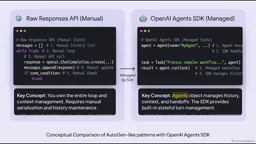
OpenAI Agents SDK 0.22.1 explained: architecture mapped to AutoGen, plus the boundary of when to use it and when not to.
The article examines OpenAI Agents SDK 0.22.1, a production-ready release, arguing not that it's "yet another Agent framework" but about architecture choices and applicable boundaries. It first gives the official decision rule: short-lived processes that only return model responses should use the raw API directly, SDK and API can coexist within one app, and framework choice should target specific tasks rather than the whole stack. It then maps the architecture to AutoGen: Manager mode corresponds to Selector Group Chat, Handoffs mode to Swarm. Three engineering mechanisms follow: input Guardrails running in parallel with execution to avoid upfront latency, tool use behavior plus automatic tool choice reset to prevent infinite loops, and Hooks for runtime visibility. Finally it covers Sessions multi-backend persistence, tracing data feeding evaluation and fine-tuning, and the tool ecosystem enabled by native MCP support. It closes with an open question: will the boundary between simple API and managed Agents disappear?
OpenAI's Agents SDK has reached version 0.22.1, which the official team positions as production-ready. What's most worth discussing about it isn't "yet another Agent framework," but rather how its architecture maps over AutoGen's multi-agent ideas, and when it recommends you skip the framework altogether.
API or SDK: First Ask Whether You Need a Framework
Agents SDK's official docs contain a refreshingly blunt decision rule: more framework isn't always better. If a process is short-lived and its main job is just returning model responses to the user, then using the raw API is enough.
The practical takeaway is that you don't need to make a single global choice across your entire application. Within the same app, complex tasks can go through the SDK's managed workflows while simple low-level paths call the Responses API directly—the two can absolutely coexist.
Choosing a framework is fundamentally about picking the right level of abstraction for the specific task at hand, not slapping a label on your entire tech stack.
The Responses API is OpenAI's next-generation conversation interface launched in early 2025, replacing the earlier Chat Completions API. It handles text, images, and other inputs uniformly in a single call, and natively supports built-in tools (such as web search, file search, and the code interpreter) as well as stateful conversation management. Unlike the Agents SDK, the Responses API doesn't offer multi-agent orchestration, handoffs, or persistent session abstractions—it's closer to a low-level "one request, one response" primitive. So when the official docs suggest using the raw API directly for "short-lived processes that only need to return model responses," this is the scenario they mean: you just need the model to respond to input, without a framework managing control flow between Agents for you. Thinking of the Responses API as the SDK's foundation is accurate—the SDK's managed workflows also call the model interface under the hood, just wrapped with orchestration, validation, and state layers.
Handoffs Instead of Manager: Translating Architecture Between Two Frameworks
If you're familiar with AutoGen, understanding the OpenAI Agents SDK comes quickly, because the architectural shapes map almost one-to-one—only the terminology differs.
Manager Mode: Centralized Orchestration
In Manager mode, a central orchestrator holds control of the entire conversation. It places specialist Agents like a booking Agent and a refund Agent into its own tool list, calling them as "agent-as-tool," then decides the next step after getting results.
Handoffs Mode: Full Transfer
Handoffs mode instead uses a handoffs list. Once a handoff occurs, the Agent passes the full conversation history to the specialist Agent, which takes complete control—control does not automatically return to the original triage Agent.
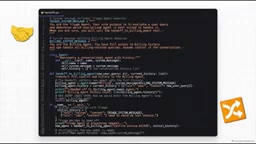
The correspondence is crystal clear: AutoGen's Selector Group Chat is equivalent to the OpenAI SDK's Manager mode, while AutoGen's Swarm maps directly to Handoffs mode. Once you understand the architectural shapes, moving between frameworks is straightforward.
AutoGen is an open-source multi-agent conversation framework from Microsoft Research, whose core abstractions are "conversable Agents" and "group chat orchestration." Selector Group Chat is one such group chat mode: a selector (which can be an LLM or a rule) decides the next speaking Agent each round, with control always remaining at the group chat management layer and specialist Agents only responsible for producing their own utterances. Swarm is another mode: once an Agent is selected, it takes over the conversation, and subsequent rounds are up to it to decide whether to hand off again—control doesn't automatically return to the original dispatcher. The difference between these modes is fundamentally "centralized orchestration" versus "control transfer," which is exactly the architectural divide between Manager and Handoffs in the OpenAI Agents SDK. With this mapping understood, migrating from AutoGen to the Agents SDK is mainly about renaming and adjusting how tools are registered, rather than redesigning control flow.
Guardrails: Speed Bought Through Parallel Validation
Input and output validation usually means extra latency, but this SDK handles it with parallel tracks. Input Guardrails run concurrently with Agent execution, so they don't block at the start of the flow. If validation fails—say, the input is completely unrelated to the task or violates rules—it fails fast and immediately aborts the Agent.
The point of this design: safety checks are no longer a gate on a serial chain, but a parallel side channel alongside execution.
Tool Call Loops: How to Avoid Infinite Loops
Equipping LLMs with tools is powerful, but anyone who has actually built Agents knows there's a huge risk here—infinite loops. The SDK provides several concrete mechanisms to prevent them.
The tool use behavior Parameter
This parameter gives you fine-grained control over how tool outputs are handled. The default is run LLM again, letting the model process the tool result to generate a final response; you can also set it to stop on first tool to pause execution immediately, or stop at tools to stop for specific tool names, or even write a fully custom logic function. That way you can pass results or end the run without triggering another expensive model call.
Automatic Tool Choice Reset
If you force the model to use a particular tool, it may keep generating the same forced tool call after the result is returned to it. The SDK automatically resets that parameter back to auto after tool execution, silently breaking the loop.
Observability Through Hooks
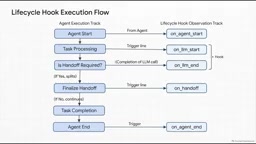
Through global run hooks or agent hooks on individual Agent instances, you can monitor every step: Agent startup, each model call, local tool calls, and the moment a handoff transfers control from one Agent to another. Runtime visibility is remarkably thorough.
Sessions and Extensibility: Persistent Memory and Real Tools
Real applications can't survive on default in-memory state alone. The SDK ships with a set of production-ready session backends: relational structures with SQLAlchemy and SQLite, Redis for speed, MongoDB's document model, and fully encrypted session storage. You have real choices about where conversation state lives.
Built-in tracing captures every Agent action, and its purpose goes beyond debugging. This trace data natively supports OpenAI's evaluation tools and plugs directly into fine-tuning and distillation pipelines—the workflow data you record today can train a more efficient system.
The final piece is giving Agents hands and eyes. There's an MCP servers field in the standard Agent config, and with native Model Context Protocol support you can plug external systems directly into the framework. The Playwright and GitHub tools introduced earlier can be connected alongside ordinary function tools to the same SDK Agent, effectively opening up an ecosystem of ready-made capabilities.
Model Context Protocol (MCP) is an open protocol for letting AI applications connect to external tools and data sources in a standardized way. It decouples "tool providers" from "model callers": external systems only need to implement an MCP server exposing tools, resources, or prompt templates, and any MCP-compatible client (including the Agents SDK) can discover and call these capabilities out of the box. In the Agents SDK's standard Agent config, the MCP servers field is the entry point for this protocol. Its real value is ecosystem reuse: tools with existing MCP servers like Playwright and GitHub don't need adapter layers rewritten for each framework—they're registered alongside ordinary function tools into the same Agent. This also explains what the article calls a "ready-made capability ecosystem"—what you're connecting isn't some framework's private plugin, but a protocol layer shared across frameworks.
An Open Question
From the early debate between the Responses API and lightweight Agent SDKs, to today's increasingly native frameworks with ever-deeper connections to protocols like MCP, one question worth watching is: will the boundary between simple API calls and fully managed Agents eventually disappear entirely?
For developers, the more pragmatic approach right now is to keep both options open: complex orchestration goes to the SDK, simple paths stay with the raw API—rather than making an irreversible framework bet on your entire application upfront.
Related articles
 Tech Frontiers
MuJoCo: An Analysis of DeepMind's Open-Source General-Purpose Physics Simulator
An in-depth analysis of Google DeepMind's open-source physics simulator MuJoCo: high-performance C++ kernel, MJCF modeling format, contact solving principles, MJX GPU acceleration, and robot reinforcement learning use cases.
 Tech Frontiers
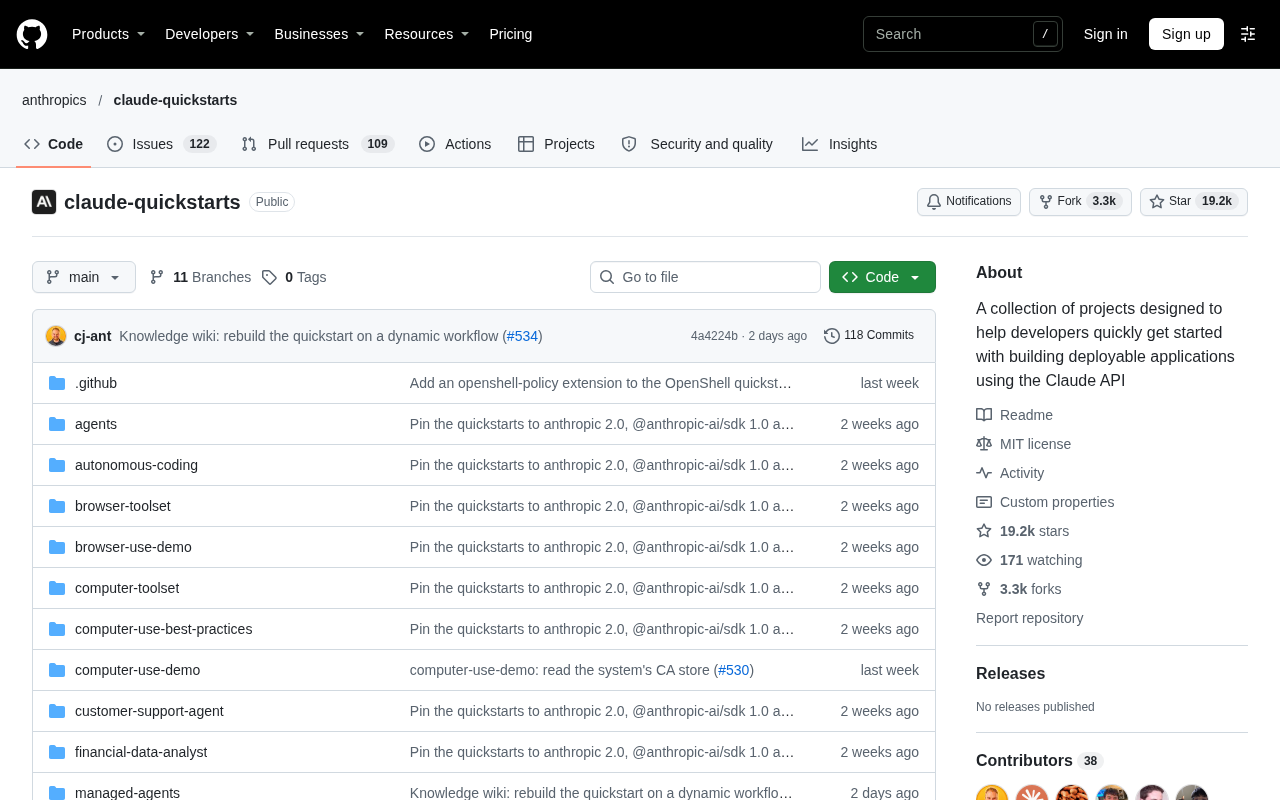
Claude API Quick Start: The Official Quickstarts Project Collection
Anthropic's official claude-quickstarts project collection helps developers quickly build deployable apps with the Claude API. Nearly 20k stars, Python-based, great for beginners and prototyping.
 Tech Frontiers
AI Agents Connecting Directly to APIs: Which Calls Can Be Safely Allowed?
AI agents can call any API, but the real challenge is deciding which calls can be safely allowed. This article analyzes allowance decisions from three dimensions—intent matching, least privilege, and controllable impact—and argues that the control layer should sit outside the agent, combined with audit traceability to build a trustworthy API call governance mechanism.