OpenAI and ServiceNow Expand Partnership: AI Agents Come to Enterprise Workflows
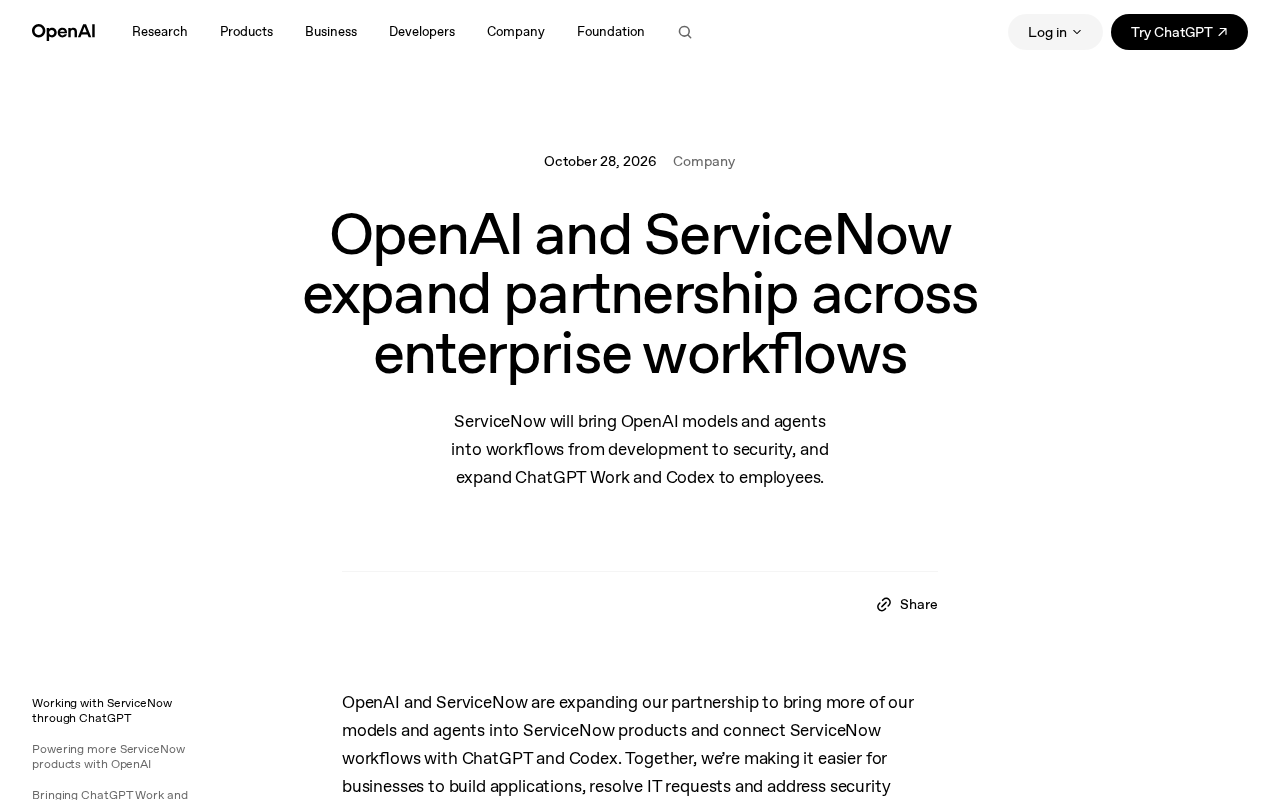
OpenAI and ServiceNow expand their partnership with bidirectional embedding of models and workflows, pushing agents into core enterprise processes.
OpenAI and ServiceNow have announced an expanded partnership centered on bidirectional embedding rather than one-way API calls: OpenAI's models and agents enter the ServiceNow platform and its workflows, while ServiceNow's workflow capabilities are brought into ChatGPT and Codex. This turns AI from an assistant outside the workflow into a participant inside it, able to use ServiceNow's process rules, ticket data, and approval chains. The partnership targets judgment and coordination stages that traditional RPA struggles with, and Codex's inclusion hints at dev-ops automation. Specific integration details, timelines, and covered modules remain undisclosed.
OpenAI and ServiceNow have announced an expansion of their partnership, and this time the focus is no longer just on model integration—it's bidirectional. OpenAI's models and agents will be embedded into the ServiceNow platform and its workflows, while ServiceNow's workflow capabilities will be brought forward into ChatGPT and Codex.
The Core of the Partnership: Bidirectional Embedding, Not One-Way Calls
Most vendor partnerships in the past have been one-directional—plug some large model API into an existing product, add a chat entry point, and call it done. This expanded partnership between OpenAI and ServiceNow shows a distinctly bidirectional character.
On one side, OpenAI's models and agent capabilities enter ServiceNow to directly serve internal enterprise process operations; on the other, ServiceNow's workflows are brought into ChatGPT and Codex, allowing developers and knowledge workers to trigger enterprise-grade processes right from the AI interface. This bidirectional design means AI is no longer just an "assistant" outside the workflow—it becomes a participant inside the workflow.
For enterprise users, the practical significance of this shift is that AI agents can call upon the process rules, ticket data, and approval chains accumulated in ServiceNow, rather than generating answers in a vacuum of information.
Why Enterprise Workflows Need Agents
ServiceNow has long held a central position in enterprise IT service management and operational process orchestration, and its platform carries a large number of standardized cross-departmental processes. These processes are characterized by clear rules, numerous nodes, and heavy context dependence—exactly the scenarios that traditional RPA struggles to handle flexibly and where large model agents have an opportunity to step in.
Bringing OpenAI's agents into this kind of platform points to the judgment and coordination stages within processes: understanding ticket intent, selecting the appropriate handling path, and passing state between multiple systems. OpenAI frames the partnership as bringing models and agents into ServiceNow and its workflows, while ServiceNow frames it as bringing workflows into ChatGPT and Codex. Together, the two statements sketch out a combined form of "AI interface + enterprise process backend."
The Inclusion of Codex Is Worth Noting
Worth particular attention is that Codex appears within the scope of the partnership. Codex is oriented toward code and development tasks, and connecting it with ServiceNow workflows suggests the partnership covers not only business process approvals but also automation linkages on the development and operations side. However, the source material does not disclose the specific technical integration approach, launch timeline, or which product modules are covered—these details remain to be announced by both parties.
RPA (Robotic Process Automation) refers to automation technology that uses scripts or software robots to simulate manual interface operations and move data between multiple systems. Its strength lies in handling repetitive tasks with fixed rules and stable interfaces, such as auto-filling forms or batch-exporting reports. But RPA's limitations are also obvious: it relies on preset paths and lacks the ability to understand context. Once it encounters interface redesigns, unstructured input, or branches requiring judgment, it fails. The difference with large model agents is that they possess semantic understanding and reasoning capabilities—they can read the natural language descriptions of tickets, infer user intent, choose among multiple possible paths, and pass results to downstream systems. The two are not a simple replacement relationship—RPA excels at deterministic execution, while agents excel at judgment and coordination in uncertain environments. What actually causes bottlenecks in enterprise processes is often the latter, which is why model vendors position agents as the "judgment layer" of processes.
Codex was originally a series of code generation models launched by OpenAI, later evolving into an agent product form oriented toward software development tasks, covering code writing, review, debugging, and repository-level operations. Connecting Codex with ServiceNow workflows opens up technical possibilities: development or operations events (such as change requests triggered by tickets or fault remediation tasks) could be read directly by Codex to generate code changes or remediation suggestions, then written back into ServiceNow's change management process for approval and record-keeping. This means AI is not just answering development questions but participating in the full chain from problem discovery to change implementation. However, this kind of cross-system integration typically involves engineering details such as identity authentication, code repository permissions, and audit trails, making implementation significantly more difficult than simple conversational integration.
Practical Impact on Enterprises
From the perspective of enterprise procurement and architecture decisions, this kind of partnership has two direct consequences.
First, the distribution channel for AI capabilities is shifting from "standalone AI products" to "built into existing enterprise software." Enterprises no longer need to build a separate AI system—they gain agent capabilities within their existing ServiceNow use cases. Second, the entry points for workflows become fragmented—employees can use AI within ServiceNow, or initiate processes from ChatGPT or Codex—which raises new requirements for permission management and data boundaries.
The source material does not provide specific customer cases, availability scope, or pricing information, so for now it is more appropriate to understand this partnership as a directional signal: the binding between enterprise software and frontier model vendors is deepening, and the pace of agents entering production processes is accelerating.
AI embedded in enterprise software and standalone AI products are two different modes of capability distribution. The former embeds model capabilities directly into systems that enterprises have already purchased (such as ServiceNow, Salesforce, SAP), so employees can invoke them while using the original interface; the latter requires enterprises to separately procure, separately integrate, and separately govern. The advantage of the embedded mode is that it lowers the adoption threshold and data movement costs—models can directly access existing process data and permission systems within the system. The disadvantage is that capabilities are limited by the vendor's integration depth, reducing the choices available to enterprises. When workflow entry points are scattered across multiple AI interfaces, enterprises also face governance issues such as identity federation, data residency, and cross-system alignment of audit logs. This is in fact new architectural cost introduced by AI entering core processes—not a detail that can be ignored.
A Brief Observation
The expanded partnership between OpenAI and ServiceNow reflects a path choice by model vendors to penetrate deeply into the enterprise—not competing head-on with existing enterprise software, but embedding within it. For ServiceNow, this means filling in AI capabilities within the platform; for OpenAI, it is a channel to bring models into core enterprise processes. If the bidirectional embedding design can be implemented, the shape of enterprise workflows may gradually shift from "humans operating systems" to "humans giving instructions, agents running the process." The success of this path depends on integration depth and governance capability—and neither has yet been elaborated in the currently disclosed information.
One-line Summary
OpenAI and ServiceNow expand their partnership, embedding models and workflows bidirectionally to push agents into core enterprise processes.
Paragraph Summary
OpenAI and ServiceNow have announced an expanded partnership whose core feature is bidirectional embedding rather than one-way API calls: OpenAI's models and agents enter the ServiceNow platform and its workflows, while ServiceNow's workflow capabilities are brought forward into ChatGPT and Codex. This design turns AI from an assistant outside the workflow into a participant inside the process, able to call upon the process rules, ticket data, and approval chains accumulated in ServiceNow. The partnership targets the judgment and coordination stages of enterprise processes—precisely the scenarios that traditional RPA struggles to handle flexibly. Codex's inclusion suggests that automation on the development and operations side is also covered. For enterprises, AI capability distribution is shifting from standalone products to embedded enterprise software, and fragmented entry points bring new challenges for permission management and data boundaries. Specific integration approaches, launch timelines, and covered modules have not yet been disclosed.
Related articles
Ollama Local Deployment Guide: Run Open-Source LLMs with Zero Experience
Ollama local deployment tutorial: what Ollama is, why choose it, how to download, install, and run open-source LLMs, and use its API for custom development. Beginner-friendly.
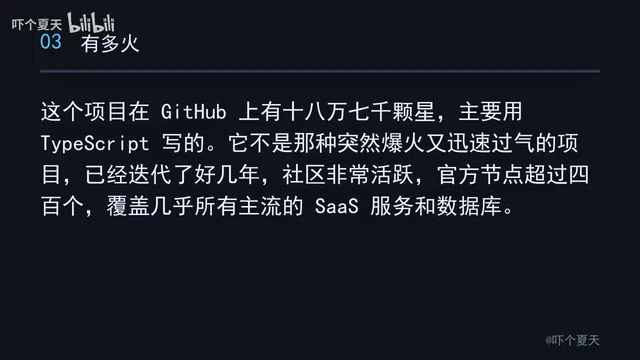
n8n: The 187K-Star Open-Source Automation Powerhouse That Turns Repetitive Work into Workflows
n8n is a 187K-star open-source visual workflow automation engine with 400+ nodes, Webhook/schedule/polling triggers, self-hosting for data security, and AI Agent support. Here's a guide to its core concepts, use cases, and pitfalls.
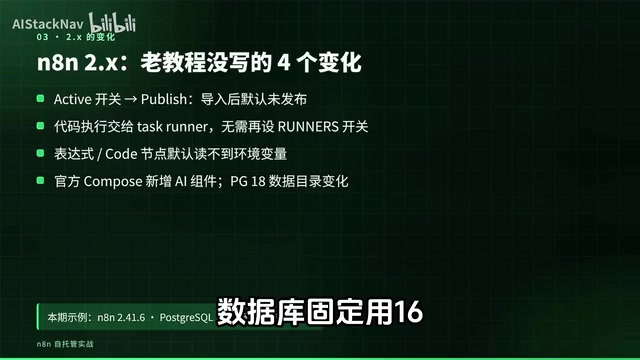
Self-Hosting n8n in Practice: Docker + PostgreSQL + Caddy Deployment Guide
A step-by-step guide to deploying a self-hosted n8n instance with Docker Compose, PostgreSQL, and Caddy automatic HTTPS, including env var pitfalls, Feishu alerting, and backup/upgrade/rollback tips.