OpenAI Claims Breakthrough on Millennium Problem: The Truth and Controversy Behind Navier-Stokes Progress
OpenAI's Navier-Stokes claim: genuine breakthrough or premature announcement? Examining AI's evolving role in pure mathematics.
OpenAI announced a breakthrough on the Navier-Stokes equations, one of seven million-dollar Millennium Prize Problems. While exciting, the mathematics community urges caution: partial progress differs fundamentally from complete proof. The claim highlights AI's rapid evolution from computational tool to mathematical research partner, exemplified by systems like AlphaProof and formal proof tools like Lean. Regardless of outcome, this event marks a pivotal moment in understanding AI's role in humanity's most abstract intellectual pursuits.
A Claim That Shook the Mathematics World
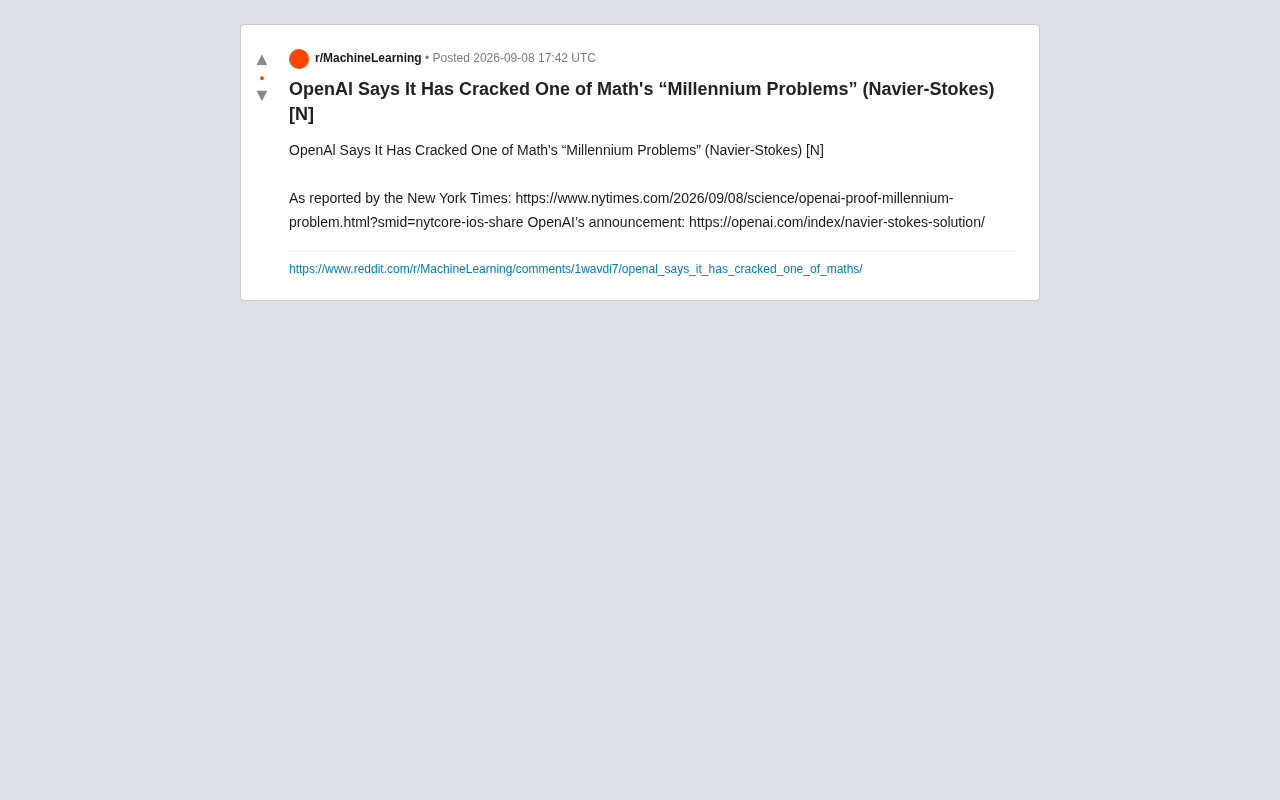
According to a report by The New York Times and confirmed on OpenAI's official blog, OpenAI has announced that its AI system achieved a breakthrough on the famous Navier-Stokes Equations problem. This news quickly sparked heated discussion in tech communities like Reddit, because the existence and smoothness problem of the Navier-Stokes equations is one of the seven "Millennium Prize Problems" established by the Clay Mathematics Institute in 2000, each carrying a $1 million reward.
Background on the Clay Mathematics Institute and Millennium Problems: The Clay Mathematics Institute was founded in 1998 by American businessman Landon Clay and is headquartered in Cambridge, Massachusetts. In 2000, the institute announced seven mathematical problems with $1 million prizes each, aiming to advance 21st-century mathematics. These seven problems include: P vs NP, the Hodge Conjecture, the Poincaré Conjecture, the Riemann Hypothesis, Yang-Mills Existence and Mass Gap, Navier-Stokes Existence and Smoothness, and the Birch and Swinnerton-Dyer Conjecture. To date, only the Poincaré Conjecture has been solved, proven by Russian mathematician Grigori Perelman in 2003 (though he declined the prize). These problems represent the deepest and most difficult unsolved mysteries in pure mathematics, and their resolution would have revolutionary impact on mathematics and physics.
If this claim proves true, it would mark the first time artificial intelligence has made a substantive, original contribution at the frontier of pure mathematics — not merely assisting with computation or verification. But as many senior researchers in the community have reminded us, major mathematical claims require rigorous peer review before final recognition, so we need to examine the specific implications of this news with clear heads.
What Are the Navier-Stokes Equations? Why Are They a Millennium Problem?
Fundamental Equations Describing Fluid Motion
The Navier-Stokes equations are a set of partial differential equations describing the motion of viscous fluids (like water and air), originating in the 19th century. They are the cornerstone of fluid mechanics, widely applied in countless engineering fields such as weather forecasting, aircraft design, and blood flow simulation.
Historical Background of the Navier-Stokes Equations: The Navier-Stokes equations were first proposed by French engineer Claude-Louis Navier in 1822, later refined by British mathematician George Stokes in 1845. These equations essentially apply Newton's second law to continuous media, combining principles of mass and momentum conservation. The equations include interacting pressure terms, viscous terms, and convective terms, with the nonlinear convection term (v·∇)v being the root cause of extreme mathematical difficulty. Interestingly, the two-dimensional version of the Navier-Stokes equations has been proven to have global smooth solutions, but the three-dimensional case is far more complex due to vorticity stretching mechanisms — this is precisely the core focus of the Millennium Problem.
The Status of Partial Differential Equations in Modern Mathematics: Partial differential equations (PDEs) are equations containing unknown multivariate functions and their partial derivatives, serving as the core mathematical tool for describing continuous change phenomena in nature. Unlike ordinary differential equations involving only one independent variable, partial differential equations handle variation patterns in multidimensional space. Modern PDE theory began in the 18th century, developed through the work of mathematical giants like Cauchy, Riemann, and Hilbert. The Navier-Stokes equations belong to nonlinear parabolic PDE systems with extremely complex mathematical structure. Existence, uniqueness, regularity (smoothness), and stability of solutions constitute the four fundamental problems in PDE theory. The Navier-Stokes Millennium Problem essentially asks: Are these equations physically 'well-posed' — that is, do small changes in initial conditions always lead to small changes in solutions, rather than sudden blow-up?
However, while engineers use numerical methods to solve these equations daily, mathematicians have never been able to answer a fundamental question: In three-dimensional space, given smooth initial conditions, do the Navier-Stokes equations always have a global smooth solution (finite and non-divergent everywhere)?
Turbulence and Singularities: The Core Difficulty
This problem is listed as a Millennium Prize Problem because the core difficulty lies in "turbulence." The nonlinear terms in the equations may cause solutions to "blow up" in finite time — meaning certain physical quantities (like velocity or vorticity) tend toward infinity. Mathematicians have been unable to prove whether such singularities truly occur in three-dimensional incompressible fluids. Proving that solutions remain smooth forever, or finding a counterexample with blow-up, would be sufficient to win the Clay Mathematics Institute's million-dollar prize.
The Physical Nature of Turbulence and Mathematical Challenges: Turbulence is one of the most mysterious phenomena in fluid mechanics, characterized by irregular, chaotic, and multi-scale fluid motion. When a fluid's Reynolds number (representing the ratio of inertial to viscous forces) exceeds a critical value, initially smooth laminar flow suddenly transitions to turbulence. Turbulence involves energy cascade processes from large-scale vortices to small-scale eddies, achieved in three-dimensional space through the 'vorticity stretching' mechanism: vortex tubes are elongated and thinned, causing vorticity to intensify sharply. Physicist Richard Feynman called turbulence 'the most important unsolved problem in classical physics.' From a mathematical perspective, turbulence corresponds to extremely complex behavior in solutions to the Navier-Stokes equations. The key question is: Can the nonlinear terms concentrate energy to infinitesimally small scales in finite time, causing velocity gradient blow-up? If the answer is yes, it would mean the equations cannot fully describe real fluids; if no, we need to find profound mathematical mechanisms preventing blow-up.
OpenAI's Claim Requires Careful Interpretation
Essential Difference Between Partial Progress and Complete Proof
Faced with OpenAI's high-profile announcement, the mathematics community and tech circles initially responded with cautious skepticism. Throughout mathematical history, there have been multiple announcements that the Navier-Stokes problem was "solved," but the vast majority were eventually proven to contain gaps or apply only to special cases.
A crucial distinction worth noting: Did the AI system completely prove three-dimensional global smoothness (truly solving the Millennium Problem), or did it make progress on a specific simplified model, particular conditions, or related auxiliary propositions? The latter, while academically valuable, differs fundamentally from the claim of "conquering a Millennium Problem." With limited original information, we should not equate "making progress" with "final resolution."
Peer Review Is the Sole Arbiter of Mathematical Proof
The mathematics community has a rigorous verification mechanism. Any claimed solution to a major conjecture must be published as a complete paper and undergo line-by-line scrutiny by global experts. Historically, even Shinichi Mochizuki's proof of the ABC conjecture has remained in limbo due to verification difficulties.
The Verification Crisis in Mathematical Proof: Modern mathematical proofs face dual challenges of length and complexity. Some important proofs span hundreds or even thousands of pages, relying on deep results from multiple subfields, exceeding any single mathematician's capacity for complete understanding. For example, the complete proof of the Classification of Finite Simple Groups is scattered across more than 500 papers totaling over 15,000 pages, taking roughly 30 years to substantially complete. Shinichi Mochizuki's claimed proof of the ABC conjecture exceeds 500 pages, introducing an entirely new mathematical language ('Inter-universal Teichmüller Theory'), and has yet to gain broad acceptance in the mathematics community. This 'verification crisis' makes formalized proof increasingly important: if a proof can be fully formalized and computer-verified, we gain unprecedented certainty. But formalization itself faces challenges — converting informal mathematical intuition into rigorous formal logic is extremely time-consuming, and currently only a small fraction of mathematical knowledge has been formalized. AI's potential lies in possibly accelerating this formalization process dramatically while helping discover hidden gaps in human proofs.
Therefore, regarding OpenAI's claim about the Navier-Stokes equations, the most rational stance is: wait for full publication of the proof and independent mathematicians' verification conclusions. Until then, any definitive statement that "AI solved a Millennium Problem" is premature.
AI's Rapid Rise in Mathematical Proof
From Computational Tool to Mathematical Research Collaborator
Setting aside the truth or falsehood of the specific claim, this event itself reflects a profound evolution in AI's role in mathematics. Over the past few years, we've witnessed DeepMind's AlphaProof achieving silver medal level at the International Mathematical Olympiad, and various large models being applied to formal proof tools like Lean.
DeepMind's AlphaProof Breakthrough: AlphaProof is an AI mathematics system launched by DeepMind in 2024, combining AlphaZero's reinforcement learning methods with formal proof techniques. The system achieved silver medal level on 2024 International Mathematical Olympiad (IMO) problems (solving 4 out of 6 questions), marking the first time AI approached top human competitors in such a high-difficulty mathematics competition. AlphaProof's core innovation lies in modeling mathematical proof as a policy search problem: the system learns to select promising reasoning paths in the vast proof space, similar to AlphaGo's decision-making in Go. Unlike traditional symbolic AI, AlphaProof uses neural networks to evaluate the value of intermediate proof states and generates training data through self-play. This approach's breakthrough is that it doesn't require large amounts of manually annotated proof data, but can autonomously explore and learn mathematical reasoning patterns. This marks a major leap for AI from solving computational problems to tackling abstract reasoning problems requiring creative insight.
Formalized Proof and Lean: Formalized proof is mathematical proof written in rigorous formal logic language that can be completely verified by computers. Lean is an interactive theorem prover developed by Leonardo de Moura at Microsoft Research, based on dependent type theory. Unlike traditional mathematical papers, proofs in Lean must be constructed step-by-step, with each step verified by a type checker. In recent years, Lean has developed rapidly due to its relatively friendly syntax and active mathematics community, having formalized substantial undergraduate and graduate-level mathematics. In 2023, Fields Medalist Terence Tao began using Lean for research, marking formalized mathematics' move from the margins to the mainstream. The combination of AI and Lean is particularly promising: AI can suggest proof strategies while Lean ensures absolute correctness at each step, forming an ideal combination of creativity and rigor. The main current challenge is translating human mathematicians' intuitive insights into formalizable logical steps.
AI is evolving from mere computational tools to "research partners" capable of symbolic reasoning, exploring proof paths, and even proposing novel ideas. Even if OpenAI's achievement ultimately proves partial, it represents a serious assault by AI reasoning capabilities on core problems in pure mathematics.
Opportunities and Risks of AI-Assisted Mathematical Research
AI participation in mathematical research brings new opportunities alongside new challenges. On one hand, AI can explore vast proof spaces difficult for humans to cover; on the other hand, AI-generated proofs are often lengthy and difficult for humans to understand, and verifying their correctness is itself a challenge.
Additionally, tech companies' "packaging" of research results for marketing and PR purposes may lead the public to misunderstand scientific progress. Distinguishing genuine mathematical breakthroughs from marketing rhetoric will become an important issue in scientific communication in the AI era.
Conclusion: Maintain Hope, but Stay Clear-Headed
OpenAI's claim regarding the Navier-Stokes problem is undoubtedly exciting and may herald a new era of AI-assisted mathematical research. But before the Clay Mathematics Institute formally confirms it and independent experts complete their review, we should remain cautious about claims of "conquering a Millennium Problem."
Regardless of the final conclusion, this event deserves continued tracking by everyone interested in the intersection of AI and science. It concerns not only the fate of a Millennium Prize Problem in mathematics, but also how we understand the role artificial intelligence can play in humanity's most abstract intellectual activities.
Related articles

CGI: The First Open-Source GPU Compute Pricing Index, Making Compute Pricing Transparent
Computable GPU Index (CGI) is the first open-source GPU compute pricing index, denominated in USD per GPU-hour, calculated from a fixed provider panel with mathematical rigor and full verifiability. This article analyzes CGI's core features, the importance of compute pricing indices, and the potential for compute financialization.

Why Nintendo Isn't Afraid of GTA VI: The Confidence Behind Differentiation and Its Industry Lessons
Facing GTA VI's gravitational pull, Nintendo stays unfazed with exclusive IPs, an independent hardware ecosystem, and a differentiation strategy. A deep dive into the logic and industry lessons.

BetterClaw: Deploy AI Agents for Free in 60 Seconds — A No-Code Automation Assistant
BetterClaw is a no-code AI agent platform with 60-second deployment and BYOK model for free usage. Connect Gmail, Slack, and Telegram to automate inbox sorting, briefings, and monitoring tasks.