OpenAI Codex Deep Dive: The Leap from ChatGPT to an AI Coding Agent

OpenAI Codex is an AI coding agent that goes beyond chat to autonomously execute development tasks.
OpenAI Codex represents a paradigm shift from conversational AI to autonomous coding agents. Unlike ChatGPT which provides advice, Codex can independently read codebases, write code, fix bugs, and run tests in sandboxed environments. This article explores the fundamental differences, where Codex fits in the AI toolchain, and why developers must evolve from writing code to directing AI.
What Is Codex? It's Not Just Chat — It Gets Work Done
Codex is an AI coding agent released by OpenAI. Pay close attention to the keyword here — "agent." This means it doesn't simply answer your questions; it can autonomously complete programming-related tasks for you.
It's worth explaining the concept of an "Agent" here, as it's key to understanding Codex. In the AI field, an agent is a system with four core capabilities: perceiving its environment, making autonomous decisions, executing actions, and maintaining a feedback loop. Unlike traditional conversational AI, an agent doesn't passively wait for your questions. Instead, it can proactively read file systems, invoke compilers, execute terminal commands, analyze results, and autonomously adjust its next steps based on those results. This concept originates from research in reinforcement learning and multi-agent systems. Since 2024, as the reasoning capabilities of large language models have rapidly improved, Agent architectures have begun large-scale deployment in software engineering — and Codex is a flagship product of this wave.
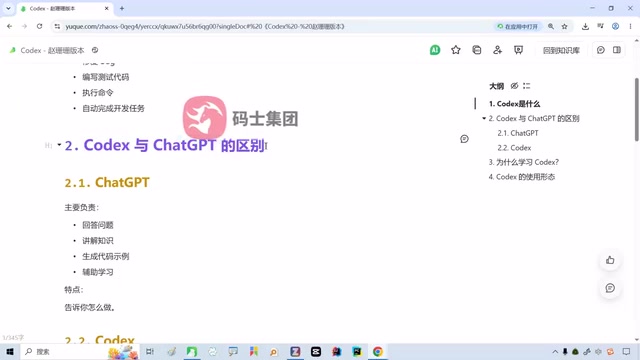
Specifically, what Codex can do goes far beyond code generation:
- Read and understand code: Automatically analyze project structure and code logic
- Fix bugs: Locate issues and autonomously repair them
- Run tests: Execute test cases to verify code correctness
- Execute commands and scripts: Carry out various operational tasks in the development environment
If all you want is for AI to generate a code snippet that you then copy-paste into your IDE, tools like Doubao, DeepSeekAd, or ChatGPT itself are perfectly sufficient. But Codex is positioned entirely differently — it's an end-to-end programming executor.
"End-to-end" means Codex can handle everything from receiving requirements to delivering runnable code, autonomously completing every step in between. Its technical implementation relies on a sandboxed cloud execution environment — each task spins up an isolated container where Codex has access to a complete development toolchain, including a code editor, package manager, testing framework, and version control system. It operates using the ReAct (Reasoning + Acting) pattern: first reasoning through the task requirements, then executing specific actions, observing the results, and continuing to reason about the next step — forming a complete closed loop. This architecture enables Codex to handle complex, multi-step development tasks rather than just one-off code generation.
Codex vs. ChatGPT: The Fundamental Difference Between Talking and Doing
Many people are confused the first time they encounter Codex: "Isn't this just ChatGPT?" After all, Codex does rely on ChatGPT's underlying large model capabilities. But the difference between them is fundamental.
ChatGPT: Like a Teacher
You can ask ChatGPT: "How do I implement a login feature in SpringBoot?" It will explain the principles in detail and generate sample code. But then what? You need to Ctrl+C, Ctrl+V the code into your development tool yourself, debug it yourself, test it yourself, and troubleshoot it yourself. ChatGPT is responsible for "talking."

Codex: Like a Programmer Colleague
With the same requirement, you tell Codex: "Build the login feature for me." It will read your project code on its own, understand the project structure, then autonomously write code, modify files, run tests, and debug issues. Once everything works, it tells you: "Done." Codex is responsible for "doing."
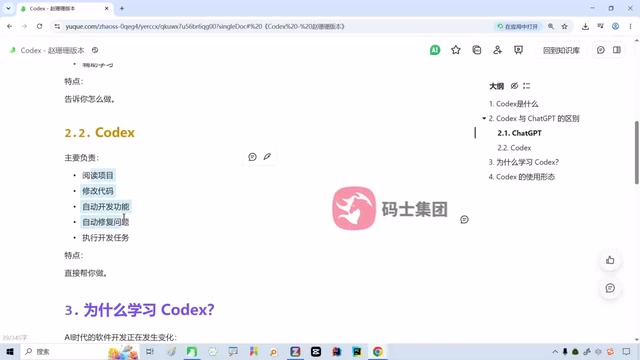
To summarize the difference in one sentence:
ChatGPT is your programming consultant; Codex is your programming assistant. One tells you how to do it; the other just does it for you.
This difference may seem simple, but it actually represents a major leap in AI-assisted programming — from "information provision" to "task execution." In the ChatGPT era, AI lowered the knowledge barrier to programming. In the Codex era, AI is beginning to directly reduce the execution cost of programming.
Why Developers Must Learn Codex
A Fundamental Shift in Development Paradigms
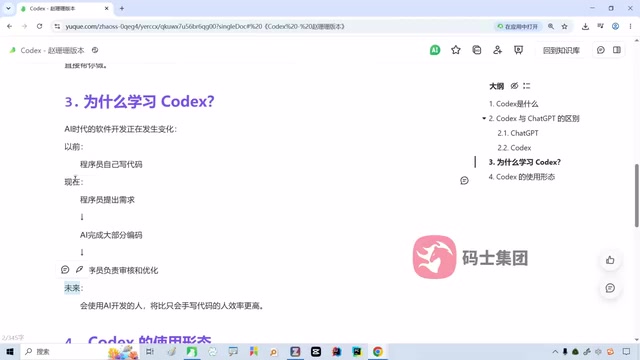
We are witnessing a paradigm shift in how programming is done:
- The past: Programmers wrote all code by hand, typing every line themselves
- The present: Programmers define requirements, AI agents complete most of the code, and programmers review and optimize
- The future: The most valuable person won't be the fastest coder, but the one who's best at communicating requirements to AI
In fact, paradigm shifts in programming have occurred multiple times throughout history. From machine language to assembly, from assembly to high-level languages (C, Java, Python), from hand-written code to frameworks and low-code platforms — each transition pushed the programmer's focus from low-level implementation toward higher levels of abstraction. The emergence of AI coding agents is the latest continuation of this trend — the core value of programmers is shifting from "code implementer" to "system architect" and "AI collaborator." Notably, every historical paradigm shift has never eliminated programmers. Instead, the resulting efficiency gains created more software demand and more development positions. The current AI programming revolution will most likely follow the same pattern.
AI Won't Replace Programmers, But It Will Redefine Them
A common misconception needs to be cleared up here: learning tools like Codex or Claude Code doesn't mean programmers will be replaced. The reason is simple — AI-generated code needs humans to review and optimize it. If you know nothing about programming, you simply can't judge whether AI-written code is reasonable, secure, or meets business requirements.
But the reality is harsh: programmers who use AI coding tools will be far more productive than those who write everything by hand. This isn't a prediction about the future — it's happening right now. When your colleague uses Codex to complete a feature module in an hour while you're still manually writing code and debugging, that efficiency gap becomes a competitiveness gap.
From "Writing Code" to "Directing AI to Write Code"
The truly valuable skills of the future will no longer be "how many lines of code you can type per day," but rather:
- Requirement decomposition: Breaking complex requirements into clear, AI-executable instructions
- Architecture design: Setting the right technical direction and constraints for AI
- Code review: Quickly identifying issues in AI-generated code
- Prompt engineering: Using the most precise descriptions to get the highest-quality output from AI
Among these, prompt engineering in programming contexts differs significantly from general conversational scenarios and deserves special attention. When giving instructions to coding agents like Codex, developers need to provide precise technical context: the tech stack version being used, project architecture constraints, coding standards, performance expectations, and more. A high-quality programming prompt typically includes three layers: goal description (what to do), constraints (how to do it), and acceptance criteria (how to know it's done right). This is highly related to traditional requirements documentation skills, which is why experienced senior developers often get better results from AI coding tools — they know which information the AI absolutely needs and which edge cases cannot be overlooked.
This is also the fundamental reason why not just Codex, but also Claude Code, Cursor, and other AI coding tools are worth deep investment from developers.
Where Codex Fits in the AI Coding Toolchain
The AI coding tools currently on the market can be roughly categorized into several tiers:
| Tier | Representative Tools | Core Capability |
|---|---|---|
| Conversational assistance | ChatGPT, DeepSeek | Answering questions, generating code snippets |
| IDE-embedded assistants | GitHub Copilot, Cursor | Code completion, context awareness |
| Coding agents | Codex, Claude Code | Autonomous task execution |
Codex sits at the highest tier — coding agent. It doesn't just offer suggestions while you write code; it directly takes over part of the development work. This means it's suited for different scenarios: when you need to quickly implement a well-defined feature, fix a known bug, or refactor existing code, Codex delivers maximum value.
Understanding the technical differences between these three tiers helps developers choose the right tool. Conversational assistance tools are essentially general-purpose large models applied directly to programming, limited by their lack of persistent awareness of project context — you need to manually provide relevant code and background information with every question. IDE-embedded assistants (like GitHub Copilot) integrate into the development environment through technologies like the Language Server Protocol, sensing the current file, cursor position, and project dependencies to achieve context-aware code completion, dramatically reducing repetitive input. Coding agents go even further — they not only sense context but can actively operate the development environment: creating files, modifying configurations, installing dependencies, running tests, and committing code. These three tiers are not replacements for each other but complementary — developers choose different tiers for different scenarios: ChatGPT for quick lookups, Copilot for daily coding, and Codex for complex tasks.
Conclusion
Codex represents a new phase in AI-assisted programming: evolving from "AI tells you how to write" to "AI writes it for you." For developers, this is both an upgrade in productivity tools and a transformation in how we work. Mastering AI coding agents like this early on not only boosts your current productivity but also prepares you for the development paradigm of the future.
Remember this key point: Codex's value isn't in replacing your programming ability — it's in amplifying it. The stronger your technical foundation, the more precisely you can communicate requirements to Codex, the more efficiently you can review its output, and ultimately achieve a 1+1>2 effect.
Related articles

Gaussian Process Bandit Optimization: Exploration Strategies and Inference Regret Guarantees
Cumulative regret guarantees in Bayesian optimization fail to reflect final recommendation quality. This article examines a new study that provides inference regret guarantees for Gaussian process bandit optimization through exploration query strategies and fill distance analysis, validated on hyperparameter optimization and control tasks.

The Most Detailed Codex Guide on Bilibili: From Installation to Real-World Practice
The most detailed Codex guide on Bilibili: from app store installation to daily work mode configuration, with a real coffee shop project demonstrating file organization, data extraction, dashboard creation, and other practical tasks. Learn to use Plan Mode and desktop pets to leverage Codex efficiently.

Appearance Compensation in Volume Rendering: Why RGB Accuracy Cannot Guarantee Density Correctness
Volume rendering research reveals that volumetric data perfectly reproducing external RGB views may still contain density errors: appearance compensation can double central density and keep external rays unchanged even when L2 error exceeds 14.52%. Density recovery depends on appearance capacity, spatial resolution, and measurement design.