OpenAI Codex in Practice: From Installation to Skills and MCP Calls

A Bilibili creator shares a hands-on Codex intro: positioning, comparison with Claude Code, installation and configuration, and job-market impact.
Based on a Bilibili creator's livestream course, this article introduces the entry path for OpenAI's coding agent Codex. Codex handles coding, testing, and operations via natural language, and its user base is expanding beyond programmers. Some companies ask about relevant experience in interviews, and some teams require 90%+ AI code generation rates. The creator finds Codex's output better than Claude Code's and notes Claude Code's account-ban issue. External model configuration is unstable, so pairing with GPT is recommended. The article also critiques assessing performance by lines of code and urges integrating agent tools into workflows rather than chasing a single metric.
In an era where AI coding assistants are iterating rapidly, OpenAI's Codex is shifting from a "toy option" to infrastructure for many teams. A Bilibili creator shared hands-on observations about Codex in a live-streamed course, covering its positioning, side-by-side comparisons, and installation and configuration pitfalls—offering an entry path for developers who have never touched tools like this.
What Codex Is: An Agent That Writes Code
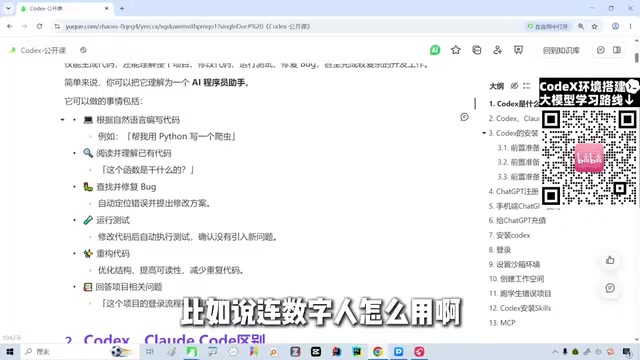
Codex is an AI coding assistant launched by OpenAI—think of it simply as an agent tool that takes instructions and gets things done. You send it natural-language commands, and it can complete a range of development tasks—write a piece of logic in Java, build a page in HTML—even if you're not familiar with that language.
This characteristic is expanding the user base from programmers to non-programmers. The creator mentioned that Douyin already has many livestreams discussing how digital humans work with Codex, and many people in non-technical roles use it as a daily productivity tool. The barrier to entry is dropping, and being able to describe requirements in natural language is becoming a new baseline skill.
For developers, this trend shows up even more directly in the job market. The creator observed that some companies directly ask candidates in interviews whether they've used Codex or Claude Code—never having used them could mean being eliminated outright. Some students reported that their companies require AI code generation rates to reach 90% or higher, and falling below that ratio may affect performance reviews. However, the creator also pointed out that judging by lines of generated code isn't fair—front-end code volume is naturally higher than back-end, so using line counts as a uniform metric has obvious bias.
An agent is a core concept in today's AI landscape, referring to an AI system that can perceive its environment, plan autonomously, and execute multi-step operations to achieve goals. Unlike traditional chatbots, agents can not only answer questions but also call tools, read and write files, execute commands, and adjust subsequent actions based on execution results. In coding scenarios, this means AI can act like a junior developer: after receiving a task, it breaks down the steps, writes code, runs tests, and fixes errors without step-by-step human guidance. OpenAI's Codex is built on this paradigm, packaging the code-generation capabilities of large language models into an interactive agent that turns natural-language instructions directly into runnable software output. Understanding the boundaries of an agent's autonomy is key to evaluating the real value of such tools.
Codex vs. Claude Code: Subjective Comparison and Recommendations
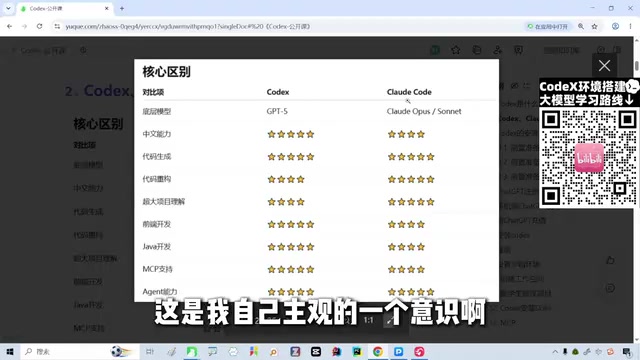
The creator did a side-by-side comparison of Codex and Claude Code. His intuitive impression is that when the same task is given to both, Codex produces somewhat better quality results—which is the main reason he uses Codex more in daily work. He emphasized that this is subjective experience, and tools iterate quickly, so their current performance may have changed.
On the Claude Code side, account bans were mentioned as a serious issue, and many users have switched to pairing it with models like DeepSeekAd. Some people have also tried connecting Codex to other models, but the creator's own experience is that the configuration process is unstable—there are many online tutorials, some people get it working and some don't, and it works one moment and not the next.
His advice is straightforward: if your goal is to use Codex, pair it with GPT and don't bother with external models. The creator speculates that after Codex merged with GPT, support for external models may have narrowed, which could be one potential reason for configuration failures—but he explicitly states this is only a guess and has not been verified.
Bring Your Own Model means users don't directly use the default model officially bundled with an AI coding assistant; instead, they configure an endpoint address and API key to connect the tool to large language models from other vendors (such as DeepSeek, Tongyi Qianwen, etc.). The main motivation is usually to reduce costs or leverage the advantages of specific models on certain tasks. However, configuring external models involves API protocol compatibility, relay service stability, authentication methods, and multiple other factors—any mismatch can lead to connection failures or intermittent availability. In addition, for business strategy or security reasons, tool vendors may gradually narrow support for external models, making the long-term viability of unofficial configurations uncertain. For most users, the officially recommended default pairing remains the best choice in terms of stability and maintenance cost.
Installation and Configuration: A Realistic Path from Zero
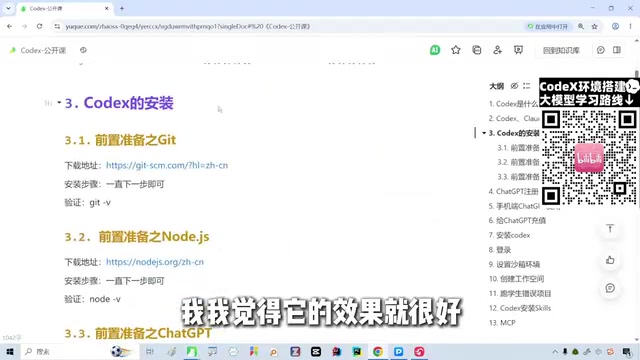
This course is aimed at students who have never used Codex, so it starts with installation. The creator's core point is: don't jump straight into complex combinations—first get things working the official, recommended way.
For users who want to connect other models, he mentioned that there are online tutorials for configuring via relay stations or CC4H and similar solutions, which you can try on your own—but he himself did not succeed in configuring it, so he doesn't teach that experience. This kind of honesty is rare in technical tutorials—acknowledging limits is more valuable than giving plausible-sounding steps.
Relay stations and CC4H are two common unofficial access solutions in the community. A relay station usually refers to a third-party API proxy service through which users forward requests to the target model, bypassing regional restrictions or billing systems of official interfaces; CC4H is a specific configuration tool or script used to simplify connecting tools like Claude Code to third-party models. Most of these solutions are maintained by community enthusiasts and lack official support, so stability, security, and compliance all carry risks. Using a relay station means API keys and code content are forwarded through third-party servers, creating data leakage risks; version compatibility issues with configuration scripts also often cause the "works one moment, not the next" phenomenon. For production environments or scenarios involving sensitive code, it's advisable to prioritize officially supported access methods.
Why You Should Get Started Now
The creator repeatedly emphasized one judgment during the livestream: if you haven't yet touched tools like Codex or Claude Code—whether you're a senior programmer with eight or nine years of experience or a newcomer just entering the field—you may be out of step with the current pace of technology.
His reasoning isn't complicated: these tools have already replaced a substantial portion of productivity in actual work, covering testing, operations, and coding. For those proficient in using them, the efficiency gains are an order of magnitude. In interview scenarios, this has even become a screening threshold; in on-the-job scenarios, it is being incorporated into performance systems.
Of course, what tools replace is not judgment. The creator's criticism of code generation rate assessments shows that poorly designed metrics distort behavior. What's truly worth investing in is incorporating these agent tools into your workflow, understanding what they're good at and where their boundaries are—rather than being led by a single number.
FAQ
Codex or Claude Code—which should I choose? Based on personal experience, the creator recommends Codex more, but emphasizes that tools iterate quickly and suggests trying both and choosing based on task type.
Can Codex connect to DeepSeek? Some succeed and some fail; configuration stability is poor. The creator suggests using Codex directly with GPT to avoid unnecessary hassle.
Will not having used these tools affect job hunting? According to the creator's observations, some companies already ask directly about relevant experience in interviews, and not having touched them may put you at a disadvantage.
One-line Summary
A Bilibili creator shares a hands-on Codex introduction: positioning, comparison with Claude Code, installation and configuration, and job-market impact.
Paragraph Summary
Based on a Bilibili creator's livestream course, this article systematically introduces the entry path for OpenAI's coding agent Codex. Codex can complete coding, testing, operations, and other tasks via natural language, and its user base is expanding from programmers to non-technical people. Some companies already ask directly about relevant experience in interviews, and some teams even require an AI code generation rate of 90% or higher. The creator subjectively believes Codex produces better quality than Claude Code on the same task, and that Claude Code's account-ban issue is relatively serious. Configuring Codex to connect to third-party models like DeepSeek is unstable, so he recommends using it directly with GPT. The article also criticizes the fairness of assessing performance by lines of code and emphasizes incorporating agent tools into workflows rather than being led by a single metric.
Related articles

RePlan-VLA: Progress-Aware Replanning Breakthrough for Long-Horizon Robotic Manipulation
The RePlan-VLA framework converts VLA models' short-horizon capabilities into reliable long-horizon execution through progress-aware adaptive replanning, improving success rates by 21.9% and 10.4% on RoboCasa365 and CALVIN, and validating real-world deployment on a Franka Research 3 robot.

Geometric Bridge Flow Matching: A New Breakthrough in Blind Rigid Motion Correction
Geometric bridge flow matching enables blind rigid motion correction in head CBCT, achieving 37.1 dB PSNR and 0.27 mm RPE on simulated data in ~9.1 minutes, outperforming existing methods.

Google Releases Gemini 4 Hydrogen: 2.5x Faster Without Sacrificing Intelligence
Google releases the lightweight Gemini 4 Hydrogen: 2.5x faster task completion, AA Intelligence Index of 54 beating its flagship sibling, 7.3s single-step on Agent Arena faster than Claude and GPT rivals, four thinking levels with pay-as-you-need pricing, now available across AI Studio and more.