OpenAI Cuts Codex $200 Plan Credits in Half: Is It Still Worth Subscribing?

OpenAI's Codex $200 plan credits dropped 10x, but cheaper models may mean you complete more tasks than ever.
OpenAI overhauled Codex $200 subscription credits, slashing monthly allowances from a peak of ~$12,000 to roughly $2,000, triggering developer backlash. The root cause is Anthropic cutting Fable's price in half, forcing OpenAI to respond with GPT-6.1 Soul at dramatically compressed margins. Despite the nominal credit cut, Soul's per-task cost is roughly one-thirteenth of Opus, meaning actual task throughput may actually increase. The author criticizes the $500 plan and Ultra Fast feature, blaming Cerebras chip scarcity for out-of-control costs, and argues the simultaneous rollout of several controversial moves squandered the goodwill Soul deserved.
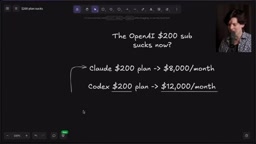
A few weeks ago, a $200 OpenAI Codex subscription delivered up to $12,000 worth of inference credits per month, and Claude's $200 plan offered similarly generous quotas. Now that number has plummeted to roughly $2,000 per month — nearly a 10x reduction. This change in how credits are calculated, announced by OpenAI ahead of Dev Day, has sparked fierce controversy in the developer community. Drawing on a breakdown of real usage data from a YouTube creator, this article examines the economic logic behind the shift and whether the $200 Codex plan is still worth it.
From "Near-Unlimited" to Credits Slashed in Half
The $200 subscription tier was originally designed to feel "unlimited." In the early days, users sent 10 to 15 prompts per day, got responses within minutes, and only touched a handful of files. As model capabilities and costs both climbed, OpenAI and Anthropic found themselves unwilling to bear the public pressure of users comparing notes on how much they could squeeze out of $200 — and fell into a subsidy arms race that pushed quotas to absurdly generous levels.
In the author's own testing, one week after the adjustment yielded roughly $573 in usage, translating to about $2,000 per month. Compared to the previous peak of $12,000 per month (or even $24,000 at the extreme, given three-day resets), this is a substantial real-world cut. The key issue: the "dollar value" stamped on subscription credits and the API price are both "fictional" numbers — neither reflects what it actually costs these companies to run the models.
The Gap Between Two "Fake" Numbers
The author points out that the enormous gap between subscription credits and API prices is confusing, but the logic behind it is clear. API prices are what these labs charge enterprise customers — a "how much will the market bear" figure, with historically staggering gross margins estimated at around 95%. The actual hardware and energy cost of burning through $100 worth of tokens is closer to $2–$5, not the $100 list price.
In a fully competitive market, Anthropic and OpenAI would be forced to drive API prices down, rapidly narrowing the chasm between "subscription subsidy" and "actual cost." The author argues we are at the very beginning of that compression.
High gross margins in API pricing aren't unique to AI, but they're especially extreme in the large model space. The so-called "95% gross margin" refers to the gap between revenue and direct variable costs (primarily the compute and electricity consumed by GPU inference) as a share of revenue — it does not include R&D, salaries, data center depreciation, or other fixed costs. So even with 95% API gross margins, these labs are still losing money overall: the enormous cost of training, talent, and infrastructure drives net profit deep into the red. What counts as "cost" depends on how you measure it: if you only count the marginal compute consumed per inference, then yes, $100 in API fees burns just $2–$5 in hardware and power; but once training, R&D, and operations are amortized in, the per-unit cost rises sharply. The essence of subscription subsidies is that labs use high-margin API revenue to cross-subsidize low-cost or fixed-quota subscribers, while buying market share and locking in developer ecosystems. When API prices are forced down by competition, the room for that cross-subsidy naturally shrinks.
Fable's Price Cut and the Chain Reaction It Triggered
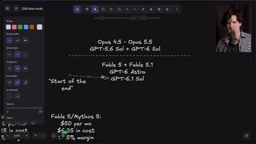
The spark for all of this was Anthropic's pricing strategy for the Fable/Mythos model. According to the author's analysis, the Mythos preview was originally expected to be priced at $25 per million input tokens and $125 per million output tokens — applying the usual ~95% gross margin, the true cost of output tokens would be around $6.25. But when Fable 5/Mythos 5 officially launched, the price was cut in half to $10 per million input and $50 per million output — and the model didn't get smaller or dumber; it got larger and more capable.
This means Anthropic's gross margin dropped from roughly 95% to about 87.5%, and per-unit profit fell from $118.75 to $43.75 — a far more dramatic collapse than the margin percentages suggest. Anthropic chose this pricing deliberately to make life harder for OpenAI — and it worked. This is the starting point of OpenAI's panic.
The author further speculates that OpenAI's pricing logic is driven more by competitors than by its own margins: Astra's price was set to exactly match Fable's. GPT-6.1 Soul's pricing is even more aggressive — $2 per million input tokens and $10 per million output, with substantially lower cache-read costs. All told, this model's effective cost may be about 5x cheaper than originally planned, with gross margins potentially sitting around 50%. In other words, OpenAI is no longer "printing money" on this model.
Understanding this pricing war requires the "Pareto frontier" evaluation framework. In AI model benchmarking, the Pareto frontier refers to the set of models on a performance-vs-price plot where no other model simultaneously beats them on both dimensions — meaning you can't get a smarter model for the same money, or a cheaper model at the same intelligence level. Models on the frontier represent the current efficiency boundary of the market; models that fall inside the frontier have been outcompeted on value. When Anthropic cut Fable's price, it pushed its own models to a better position on the frontier, forcing OpenAI to follow — otherwise Astra would fall inside the frontier and lose its appeal to enterprise customers. This competition isn't a marketing strategy; it's a structural market response, and the ultimate beneficiaries are developers and enterprise users.
Differences in Subscription Restrictions Between Claude and Codex
The two companies take very different approaches to subscription usage limits. Claude's $200 subscription can only be used within Claude Code — it's not really "$8,000 of Claude credits"; it's a subscription for running a large volume of inference inside Claude Code. You can't pipe it into tools like Pi, OpenClawAd, or Hermes, and even attempting to disguise it as a tool in a system prompt will result in rejected requests. Additionally, Fable usage is capped at only half of the subscription's total quota.
OpenAI is far more permissive: you can use the Codex subscription almost anywhere (as long as you're not using it to serve user traffic to third parties), such as automatically reviewing every PR in CI. And OpenAI hasn't set separate credit caps for Astra or Soul — instead, it chose an across-the-board credit reduction to narrow the subsidy gap. GPT-6.1 Soul can consume your entire weekly quota, unlike Fable which is limited to half.
The Right Metric: Cost Per Task
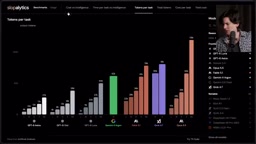
The author's core argument is this: the "dollar value" of the subscription may have been halved, but the right measure of actual value is the number of tasks you can complete. In his own Terminal Bench tests, GPT-6.1 Soul's max/high runs nearly match Opus 5.5, but Opus costs $0.11–$0.13 per task, while 6.1 Soul comes in at just $0.0096 — roughly one-thirteenth of the price.
Looking at the Pareto frontier on Artificial Analysis's intelligence index, Luna and Soul sit squarely on the frontier line, overlapping with it almost perfectly, making them by far the best value models available. So even though the nominal subscription quota has been halved, because the underlying model is so much cheaper, the actual number of tasks you can complete may well be several times higher than before. The author is candid: "If forced to pay API rates, I'd choose Soul without hesitation."
The $500 Plan and Ultra Fast: A Self-Inflicted Wound
The author's real frustration with OpenAI centers on the $500 plan and the Ultra Fast feature. Rebranding the 20x plan as a 10x plan while telling users "pay 2.5x more for the 25x plan if you want" is a perceptual disaster. What makes it worse is that these subscription tiers aren't even OpenAI's main profit center — the company makes its money from $8 and $20 consumer plans and from selling API access to labs. The $200 subscription is purely a marketing exercise. So if the $500 plan fails to function as marketing, it's a failure, full stop.
Ultra Fast is the bigger mistake. Astra already isn't cheap ($1 cached / $10 standard per million input tokens, $50 per million output). Enable Ultra Fast and input leaps to $60 and output soars to $300 per million tokens. The author had Astra review two PRs in Ultra Fast mode and spent roughly $600 — approaching the cost of hiring a human engineer for the task. The $500 plan's weekly quota can be burned through in approximately 2.1 hours on Ultra Fast.
According to the author, Ultra Fast was originally planned to run on Cerebras' dedicated chips, but after Jane Street bought out Cerebras' capacity, OpenAI was forced to over-provision Nvidia GPUs to brute-force the speed — resulting in terrible costs and margins. Launching low-margin 6.1 Soul, slashed credits, the new $500 plan, and the money-burning Ultra Fast all at the same time meant that the goodwill 6.1 Soul should have earned was rapidly consumed.
Cerebras is an AI chip startup focused on Wafer Scale Engine technology, turning an entire silicon wafer into a single processor with extremely high on-chip bandwidth — ideally suited for inference scenarios with extreme low-latency requirements. Compared to Nvidia GPU clusters, Cerebras chips have orders-of-magnitude advantages in single-token generation speed, but lower total throughput and flexibility, and extremely limited production capacity. Jane Street, as a high-frequency quantitative trading firm, has a natural and massive demand for low-latency compute, so buying out Cerebras' capacity is no surprise. OpenAI's forced pivot to Nvidia GPUs to achieve "Ultra Fast" comes at a cost: it requires large numbers of GPUs simultaneously serving a single request (so-called "over-provisioning"), which significantly reduces hardware utilization, drives up per-token costs, and squeezes an already thin margin. This supply chain setback is the direct technical reason Ultra Fast is priced so outrageously.
Verdict: Is the $200 Codex Plan Still Worth It?
Back to the original question: if you've been treating the $200 subscription as an "Astra plan" — the way the author used to treat Claude as a "Fable plan" — then yes, it got worse. If you're subscribing purely to use Astra or Opus, the Claude plan is a better fit.
The author's actual workflow is a combination: using Claude to orchestrate Soul sub-agents to review its own work, because OpenAI models are more thorough in analysis and can dig deeper. For that kind of task, the Codex subscription delivers solid value. But he's clear: if you're continuously shipping serious engineering code, the Claude plan is nearly essential.
Looking further out, as OpenAI and Anthropic intensify their competition in the enterprise market and API prices keep falling, subscription subsidy levels will continue to decline, and social media will keep filling up with "worse value" charts. But the author's assessment is this: a year from now, using the same plan with new models, you'll be getting more work done than you are today — or something has gone seriously wrong. GPT-6.1 Soul remains one of the best value models in history, and it shouldn't be underestimated just because the subsidy rate has dipped slightly.
Related articles

Gaussian Process Bandit Optimization: Exploration Strategies and Inference Regret Guarantees
Cumulative regret guarantees in Bayesian optimization fail to reflect final recommendation quality. This article examines a new study that provides inference regret guarantees for Gaussian process bandit optimization through exploration query strategies and fill distance analysis, validated on hyperparameter optimization and control tasks.

The Most Detailed Codex Guide on Bilibili: From Installation to Real-World Practice
The most detailed Codex guide on Bilibili: from app store installation to daily work mode configuration, with a real coffee shop project demonstrating file organization, data extraction, dashboard creation, and other practical tasks. Learn to use Plan Mode and desktop pets to leverage Codex efficiently.

Appearance Compensation in Volume Rendering: Why RGB Accuracy Cannot Guarantee Density Correctness
Volume rendering research reveals that volumetric data perfectly reproducing external RGB views may still contain density errors: appearance compensation can double central density and keep external rays unchanged even when L2 error exceeds 14.52%. Density recovery depends on appearance capacity, spatial resolution, and measurement design.