OpenAI Cuts GPT-6.2 Usage: Astra and Sol Limits Accelerated by 40%
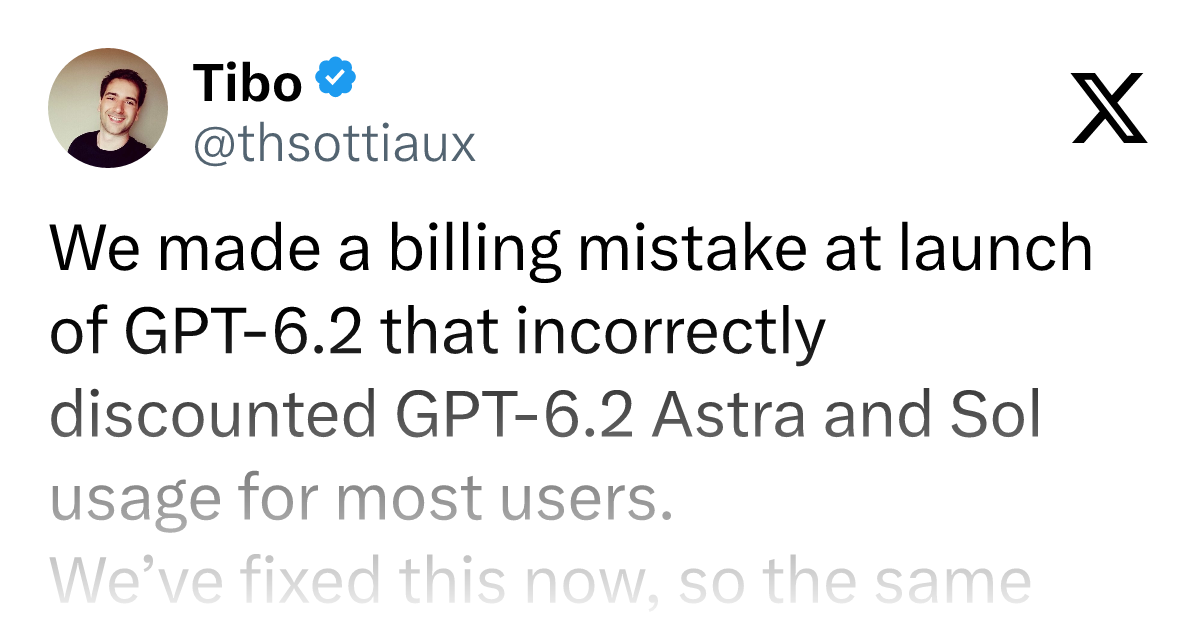
OpenAI adjusted GPT-6.2 usage limits, and accelerated rate limiting for Astra and Sol has drawn developer community attention.
According to Hacker News discussions, OpenAI adjusted GPT-6.2 usage policy, causing users to hit limits faster with Astra (40% faster) and Sol (25% faster). This directly affects API-dependent developers, potentially forcing them to optimize request frequency, add fallbacks, or switch models. Community discussion centers on transparency and production stability, but most views are speculative without official OpenAI details. The article advises monitoring API usage, setting alerts, preparing fallbacks, and watching official announcements to build more resilient architectures.
Event Overview
According to discussions in the Hacker News community, OpenAI has adjusted the usage policy for GPT-6.2, causing users to hit usage limits more quickly when using its models Astra and Sol. Specifically, Astra now reaches its limit 40% faster than before, while Sol is 25% faster. This change has drawn widespread attention in the developer community, as usage limits directly affect API call frequency, application stability, and cost planning.
Rate limits are mechanisms used by cloud services and API providers to control the number of requests or resource consumption per unit of time, commonly expressed as requests per minute (RPM), tokens per minute (TPM), and concurrent request caps. For large language model APIs, rate limits directly determine whether an application can stably handle high-concurrency requests, and they also affect developers' cost models and architecture design. When limits are tightened, the same business traffic triggers rate-limiting errors (such as HTTP 429) sooner, and developers typically need to respond with request queues, exponential backoff retries, or load balancing.
Specific Impact of the Rate Limit Adjustment
For developers relying on the OpenAI API, tighter rate limits mean the same tasks may trigger throttling sooner. As a model aimed at certain high-performance scenarios, Astra's 40% acceleration in hitting limits may force users to optimize request frequency or switch to other models. Although Sol's 25% acceleration is smaller in magnitude, it can still significantly affect user experience when compounded across multi-turn conversations or batch processing scenarios.
In community discussions, some developers noted that this adjustment may be related to resource allocation strategy, but OpenAI has not yet released a detailed explanation.
Community Reaction and Discussion Focus
In the Hacker News discussion, users mainly focused on two points: the transparency of the adjustment and its impact on production environments. Some comments argued that rapid changes to usage limits bring uncertainty to businesses that depend on the API, especially when there is no advance notice. Other users speculated that this may be OpenAI balancing the load across different models or preparing for future updates.
Despite the high level of discussion, most views are still based on personal experience and speculation, lacking official data support.
The transparency problem of API rate limiting has long been a concern in the developer community. Major AI providers typically reserve the right to adjust usage limits through their terms of service, but the frequency of adjustments and advance notification mechanisms vary widely. Rate limit changes without advance notice can lead to cascading failures in production environments, especially for enterprises that rely on fixed call quotas for capacity planning. As a result, community discussions often include calls for changelogs, status pages, and quota alerting interfaces to reduce operational uncertainty.
Recommendations for Developers
In response to changes in usage limits, developers can consider the following strategies: monitor API usage and set alert thresholds; introduce fallback solutions on critical paths, such as switching to models with more lenient limits; maintain communication with OpenAI and follow official announcements. In addition, evaluating other AI providers as backups is also a common practice to reduce risk.
Fallback is a key pattern for building resilient AI applications, referring to automatically switching to a backup model, caching results, or simplifying processing logic when the primary model is unavailable or triggers rate limiting. Implementing fallback usually requires abstracting the model invocation layer, defining priority queues, and setting circuit-breaker thresholds based on error rates or latency. For multi-model architectures, developers also need to consider differences among models in output format, context length, and pricing to ensure that business logic still runs correctly after fallback.
Conclusion
OpenAI's adjustment to GPT-6.2 usage limits, especially the accelerated rate limiting for Astra and Sol, reflects the ongoing tension between resources and demand in AI services. Developers need to closely monitor such changes and build more resilient technical architectures. Since the current information mainly comes from community discussions, it is advisable to defer to OpenAI's official follow-up statements.
One-line Summary
OpenAI adjusted GPT-6.2 usage limits, and accelerated rate limiting for Astra and Sol has drawn attention from the developer community.
Paragraph Summary
According to discussions in the Hacker News community, OpenAI has adjusted the usage policy for GPT-6.2, causing users to hit usage limits more quickly when using the Astra and Sol models, with Astra reaching its limit 40% faster and Sol 25% faster. This change directly affects developers who rely on the API and may force them to optimize request frequency, introduce fallback solutions, or switch to other models. Community discussion mainly focuses on the transparency of the adjustment and its impact on production environment stability, but most views are based on personal experience and speculation, lacking detailed official explanation from OpenAI. The article recommends that developers monitor API usage, set alert thresholds, prepare fallback solutions, and follow official announcements in order to build more resilient technical architectures.
Related articles

Bin's Live Stream Highlights: Hilarious Interactions from "You Came at the Right Time" to "I'll Support You From Now On"
Bin's hilarious live stream highlights: from "You came at the right time" to "I'll support you from now on," featuring Championship skins, wigs, and other game memes that showcase Bilibili's unique streaming culture.

Hunter Rescues Educated Youth: The Mountain-Chasing System Launches a New Warm-Hearted Viral Drama Formula
Bilibili's early-access period short drama *Everyone Thinks I'm a Poor Hunter* opens with a snowy-night rescue of an educated youth. Hunter Chen Shan activates the mountain-chasing system, using realistic hypothermia first-aid details and mutual-probing character dynamics to deliver a warm-hearted period drama without the sleaze.

Riemann Hypothesis Proven by AI? The Truth Has Nothing to Do With Your Reality
34-year-old mathematician Levent Alpöge claims to have proven the Riemann Hypothesis and Generalized Riemann Hypothesis with Claude, releasing 17 million lines of formal verification code. This article sorts out the facts, debunks myths about RSA collapse and new material revolutions, and analyzes the true significance of mathematics-AI collaboration.