OpenAI Cuts Off Cursor's Direct Access: An Ecosystem Power Struggle Over Distribution Rights

OpenAI cuts Cursor's native access after SpaceX acquisition, sparking an AI ecosystem distribution rights battle.
OpenAI has confirmed it will terminate Cursor's native model integration starting November 12, triggered by SpaceX's acquisition of the AI coding tool. This isn't a usage ban — developers can still access GPT via API keys — but a strategic reclaiming of distribution rights. The move highlights how AI coding tools are evolving from mere model channels into powerful developer gateways, and signals that 'cooperating while staying on guard' will define the relationship between model providers and application-layer tools going forward.
An Announcement That's Easy to Misread
OpenAI has confirmed that starting November 12 of this year, Cursor will lose official direct access to OpenAI's models. The news quickly rippled through the developer community, but it's easily misread as "Cursor users can no longer use GPT."
That's not what's actually happening. What's really changing is that Cursor can no longer bundle OpenAI models directly into its official subscription plans for distribution. For everyday users, the door isn't completely shut — developers can still enter their own OpenAI API keys or continue calling the relevant models through extension plugins.
It's worth explaining the fundamental difference between native integration and API key access. Native Integration means Cursor embeds OpenAI's model capabilities directly into its product — users subscribe to a Cursor plan and seamlessly use GPT-series models without any additional configuration. The API key approach, on the other hand, requires users to register a developer account on OpenAI's platform, set up a payment method, obtain a key, and enter it into Cursor's settings. In effect, the user establishes a direct billing relationship with OpenAI, with Cursor serving merely as the calling interface. The core distinction is this: under native integration, Cursor is OpenAI's commercial distribution partner, controlling the payment gateway and usage data; under the API key model, OpenAI deals directly with the end user, retaining the complete commercial relationship chain.
In other words, this is a reclaiming of distribution rights, not a blocking of usage rights. Understanding this distinction is the prerequisite for making sense of the whole situation.
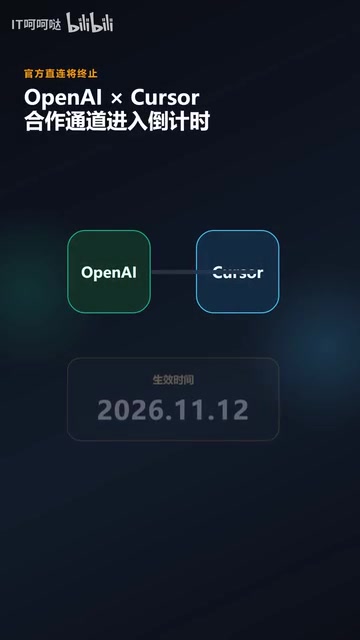
SpaceX's Acquisition of Cursor: The Trigger for the Power Play
To understand why OpenAI suddenly decided to "decouple," you have to look at the shift in the commercial relationship.
The key context: Cursor was acquired by SpaceX. This previously independent and neutral AI coding tool has now entered Elon Musk's business empire. And Musk's xAI is a direct competitor to OpenAI in the large model arena.
Cursor, developed by Anysphere, is built on the VS Code open-source architecture and is one of the most popular AI-native code editors available today. SpaceX's acquisition of Cursor marks a further deepening of Musk's strategic positioning across the AI toolchain. Musk's xAI, founded in 2023, launched the Grok series of large models, competing head-to-head with OpenAI's GPT series and Google's Gemini series. xAI's ambition goes beyond building general-purpose large models — it aims to construct a complete AI ecosystem spanning model training, inference deployment, and end-user applications. Within this strategy, acquiring Cursor means xAI has gained a natural developer gateway — millions of active developers worldwide write code and debug programs in Cursor every day, and these high-frequency interaction scenarios are an ideal channel for promoting Grok models.
As a result, the nature of OpenAI's relationship with Cursor has undergone a fundamental transformation — from an ordinary commercial partnership to a much more direct ecosystem-level competition. When a downstream distribution channel falls into a competitor's hands, a model provider naturally becomes unwilling to let a potential rival continue bundling and distributing its flagship capabilities — along with the invaluable developer gateway.
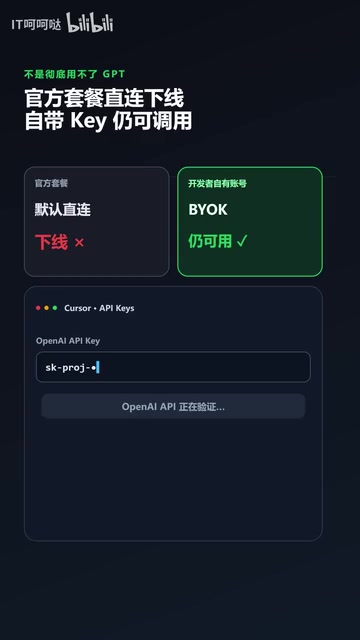
Why Distribution Rights Matter
For model providers, "official native bundling" means two things: handing over your most powerful model capabilities, and ceding the billing and usage relationship with developers to a third-party client. The former is a technology asset; the latter is a commercial lifeline. When a partner's stance shifts to that of a competitor, both of these become strategic resources that can no longer be casually lent out.
The Industry Status of AI Coding Tools Is Undergoing a Fundamental Shift
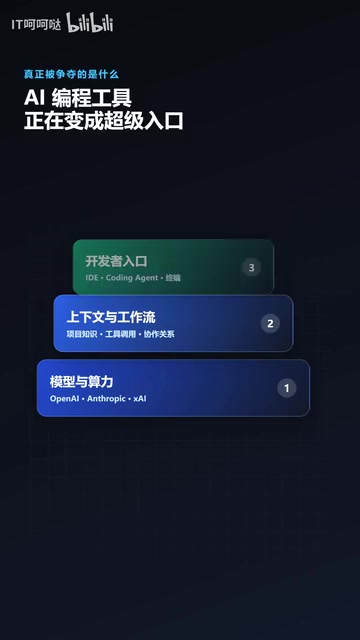
The real takeaway from this event isn't the surface-level story of "a model lost one distribution channel." It's that the industry status of AI coding tools is undergoing a fundamental shift.
In the past, tools like Cursor were more like downstream channels for model companies — responsible for packaging large model capabilities into user-friendly products and delivering them to developers. But now, they're no longer content to be mere "middlemen."
What's truly being contested are three things:
- Developer workflows: Whoever controls the core interface during coding controls usage habits;
- Contextual data: Codebases, project structures, conversation histories, and other contextual data are the key to building product moats;
- Billing relationships: Whoever bills the developer directly holds commercial leverage.
Among these three core assets, contextual data deserves particularly deep understanding. In AI-assisted programming, context matters far more than a single conversation's prompt. A truly effective AI coding assistant needs to understand the entire project's code structure, dependency relationships, coding style preferences, team collaboration standards, and even the developer's past modification history and debugging patterns. The accumulation of this contextual data creates a powerful product moat — even if the underlying large model can be swapped out, a tool with deep contextual understanding can still deliver a coding experience far superior to its competitors. This is why Retrieval-Augmented Generation (RAG) technology is so critical in AI coding tools: it allows the tool to retrieve the most relevant code snippets and documentation from the local codebase before calling the large model, injecting them into the prompt to dramatically improve the accuracy and contextual consistency of generated code.
When AI coding tools begin competing for these core assets, their relationship with model providers evolves from a straightforward upstream-downstream partnership into a complex game of intertwined interests.
This kind of inter-layer power struggle is not new in tech history. The most classic analogy is the "Wintel Alliance" between Microsoft Windows and Intel during the PC era — the operating system layer and the chip layer were deeply cooperative yet secretly jockeying for position, with each side trying to capture more value at its own level. In the mobile internet era, Apple used iOS to firmly control the app distribution channel (the App Store), leaving app developers — despite creating enormous value — perpetually subject to platform rules and a 30% commission. Today in the AI space, a similar drama is playing out between the model layer (OpenAI, Anthropic, etc.) and the application layer (Cursor, various AI Agent platforms, etc.). The core question remains the same: which layer of the value chain will capture the largest share of profits? Whoever is closest to the end user and whoever holds irreplaceable data assets occupies the more advantageous position in this game.
"Cooperating While Staying on Guard" Will Become the Industry Norm
The breakup between OpenAI and Cursor is likely just the beginning.
Going forward, "cooperating while staying on guard" will most likely become the norm between model providers and third-party clients. Model providers need third-party clients to expand their reach, but they must also guard against being hollowed out by the tool layer and reduced to a replaceable commodity supplier. Meanwhile, tool makers depend on top-tier model capabilities but refuse to be locked into a single vendor.
Practical Impact on Developers
For frontline developers, the short-term practical impact is relatively manageable — you can still use the models you want through API keys and plugins. But in the long run, this kind of ecosystem friction is likely to drive two trends:
- The binding between tools and models will become increasingly fluid, and users will need to get accustomed to a "model-agnostic" approach;
- Each tool will accelerate the development of its own capabilities (such as proprietary models and private context management) to reduce dependence on any single model provider.
The "model-agnostic" trend is backed by clear technical underpinnings. A model-agnostic architecture means the AI application layer doesn't bind to a specific large model vendor, but instead supports free switching between multiple models through standardized interface protocols. The industry already has several technical standards driving this trend — for example, the OpenAI-compatible API format has become the de facto industry standard, with numerous model providers (including Anthropic, Mistral, open-source model platforms, and others) offering interfaces compatible with this format. Additionally, the rise of middleware services like LiteLLM and OpenRouter enables developers to call models from dozens of different providers through a unified gateway. For AI coding tools, adopting a pluggable architecture serves both as a defensive strategy against vendor risk and as a product advantage offering users flexibility — users can choose the model with the strongest code generation capabilities, the fastest inference speed, or the lowest cost depending on the task at hand.
Conclusion
OpenAI's termination of native integration with Cursor may look like a simple commercial channel adjustment on the surface, but at its core, it reflects the increasingly tense power dynamics between the AI application layer and the model layer. When capital flows reshape the competitive landscape, yesterday's partners can become tomorrow's rivals overnight.
AI coding tools are evolving from "downstream consumers of models" into "contenders for the developer gateway," and this battle over workflows, context, and billing relationships is only just getting started.
Related articles

Bilibili's Hit Dify Tutorial: A Practical Guide to Building 20+ AI Apps from Scratch
A distilled guide to Bilibili's top-rated Dify tutorial: Windows + Docker deployment, MySQL connection, five app types, model integration strategy, and publishing.

Agent Skills Beginner's Guide: From Concepts to Multi-Agent Collaboration in Practice
A comprehensive guide to Agent Skills: core concepts, components, the importance of Description, standardization, beginner learning paths, and multi-agent collaboration.

One Neuron Detects Both Cats and Cars? We Reproduced It and Found a New Explanation
The cat-car neuron reinterpreted: researcher Cammarata argues it distinguishes pointy from round, not cats from cars. We reproduced the experiment and found the new explanation holds on most inputs—but cars are the exception. The interpretability debate continues on language models.