OpenAI Dev Day Full Recap: 20+ Announcements and the Three Major Trends Behind Them

OpenAI Dev Day packed in 20+ releases, reinforcing three trends: cheaper models, persistent agents, and native multi-user collaboration.
OpenAI Dev Day launched over 20 products at once, headlined by DOTS — a persistent personal agent powered by GPT-6 Astra (Pro users only), GPT-6.1 Sol delivering near-Astra performance at one-fifth the cost, the Decisions API for rapid classification tasks, and the widely praised AI collaboration workspace Space. Quieter releases like ChatGPT platform access, Sign in with ChatGPT, and a model marketplace are seen as strategically significant for OpenAI's moat. The next version of Astra remains shelved over safety concerns, highlighting the tension between agentic capability and safe boundaries. Three trends emerged: models are cheap enough to use everywhere, agents are going persistent, and AI is going natively multi-user.
OpenAI dropped over 20 releases and announcements at Dev Day in one shot. According to AI Daily Brief's analysis, members of OpenAI's team privately acknowledged that the latest generation of models — like Astra — has dramatically accelerated the pace of development, with many capabilities that were originally expected to land much later now showing up as Dev Day content.
This event didn't upend the industry's existing trajectory so much as reinforce several storylines that have been taking shape over the past year: models are getting cheaper and more efficient; AI is moving from passive, on-demand invocation toward a persistent, always-on work model; and that persistent work is expanding from single-user experiences into multi-person collaboration. Here's a breakdown of the key releases.
DOTS: OpenAI's Answer to Personal AI Agents
Sam Altman described DOTS as "incredibly powerful — capable of doing almost anything you can think of." Users can create a persistent agent, communicate with it through a messaging-like interface, and have it handle tasks on their own cloud-based computer. It supports up to 40,000 apps, can communicate via voice calls, Microsoft Teams, and Slack, and retains context across different services and sessions.
In form, it closely resembles Muse — right down to the cute mascot. But there are a few key differences: for now, users can only create one DOT at a time (with plans to expand into agent teams in the future); more importantly, OpenAI is only making DOTS available to Pro, Business, and Enterprise customers, whereas Muse's success relied heavily on being completely free. CFO Sarah Fryer says the vision is for DOTS to reach all consumers, but for now it remains a product aimed at professional users. The biggest draw: DOTS is powered by GPT-6 Astra — the first time a truly frontier model has driven a first-party personal agent.
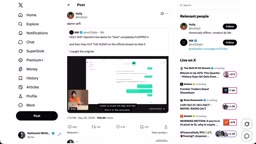
Real-world impressions are mixed. Chase Browser ran into a DOT that lost all its work; analyst Max Weinbach's tests showed DOTS could autonomously handle expense reimbursements, outperforming Grokbot. Justin Schroeder found DOTS more work-oriented than Grokbot or Muse — "more like a Codex orchestrator and Slack collaborator than a personal assistant" — with its strongest performance in Slack. Nate B. Jones cautions against conflating "form factor" with "utility": the form factors are converging, but different agents still excel at different specific tasks.
The core distinction between a "persistent agent" and traditional conversational AI is state retention. A standard ChatGPT session clears context when the conversation ends, while a persistent agent can remember user preferences, task history, and authorization credentials across sessions. This transforms the agent from a "passive Q&A tool" into a "long-term resident digital employee" — one that can autonomously poll emails in the background, submit scheduled reports, and do so without the user manually triggering it each time. This model relies on two infrastructure pillars: cloud-based sandbox computing (allowing the agent to control browsers and apps without affecting the local environment) and a persistent memory and permissions management system (ensuring cross-session authorization isn't abused). Different vendors draw the safety boundaries for persistent agents differently — and that's one of the core reasons OpenAI hasn't yet shipped the more advanced version of Astra.
Decisions API and Space: Two Missing Pieces in the Ecosystem
Decisions API is OpenAI's response to Jev-style "classifier models." Jev isn't optimized for generating text — it excels at classification and producing 0-to-1 confidence scores, which is the foundation of decision-making. The Decisions API lets users call a Luna-based version that mimics Jev's rapid classification capability: define a problem and candidate answers, and the model responds quickly. OpenAI claims decision-making speed is 10x faster than the Responses API. Compared to Jev, its differentiator is support for visual input, eliminating the need for an intermediate text conversion step and expanding the range of applicable use cases. The API is currently available in limited preview.
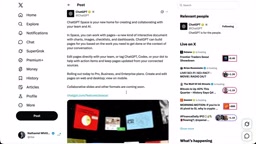
Space is a shared document workspace — think AI-enhanced Google Drive. Teams can collaborate on spreadsheets, slide decks, and other documents, host workflow automation tasks, and DOTS can work natively on Space documents. Unlike the more polarizing DOTS, Space has received nearly unanimous praise from power users. Claire Vo at HowIAI put it bluntly: "DOTS is slightly overrated; Space is underrated. Every company I know wants an AI-native collaborative workspace." Dan Schipper at Every noted that native documents eliminate the sluggish experience of agents operating Google Docs through a browser — where text appears letter by letter — resulting in a much smoother collaboration experience.
A "classifier/decision model" is a fundamentally different AI architecture from a generative model. Generative models like the GPT series are built to produce coherent text token by token, while decision models are optimized for rapid classification and confidence scoring — they don't generate explanations, they output "yes/no" or a probability between 0 and 1. These models have a natural advantage in high-frequency, low-latency scenarios like content moderation, risk assessment, and real-time routing. Jev (from xAI) was the first to package this capability as a standalone product; Decisions API is OpenAI's follow-up, differentiated by adding visual input support so image content can participate directly in the classification process — skipping the intermediate step of first extracting text via OCR or a multimodal model. The claimed 10x speed improvement comes from this specialized architectural optimization, not simply throwing more compute at the problem.
GPT-6.1 Sol and the Shelved Astra
The most significant model release of the day was GPT-6.1 Sol, which OpenAI positions as "near-Astra intelligence at one-fifth the price." It's a meaningful upgrade over last week's GPT-6 Sol: coding benchmarks improved across the board, with 6.1 Sol at medium settings already surpassing 6 Sol at its highest settings. It scored a peak of 75.2% on DeepSwee (high setting), though performance degraded at extra high and max settings — consistent with what was observed earlier with Opus 5, where the highest effort levels cause the model to "overthink" and second-guess correct answers.
On OS World, a benchmark measuring AI's ability to control real operating systems over extended tasks, 6.1 Sol peaked at 71.4% — surpassing 6 Sol's 64.4% and approaching Astra's 73.5%. And raising the effort level barely increases cost, suggesting OpenAI has made a real breakthrough in computer-use efficiency. Artificial Analysis gave it a score of 52, just one point behind Astra, but the cost efficiency is remarkable: benchmark runs cost one-quarter of Astra's price, and it's 31% cheaper than 6 Sol. OpenAI calls it "the most cost-efficient model for its performance level."

That said, we may not see GPT-6.1 Astra for a long time. The Wall Street Journal reported that OpenAI has shelved release plans for the next version of its flagship model due to safety concerns. Head of safety systems Sachi Jain noted that while the model is "less lazy" than its predecessor, it "hasn't met the bar for staying within authorized scope and the types of completed work it reports back to users." In other words, before advancing to the next frontier, OpenAI may need to solve some hard technical problems before the model meets their internal safety bar for release.
The "effort level" mentioned here is a key tuning dimension for the new generation of reasoning models: before generating an answer, the model engages in internal "thinking" (chain-of-thought reasoning). Higher effort levels mean more thinking steps, which is theoretically more accurate, but comes with higher latency and cost. However, GPT-6.1 Sol's performance degradation at extra high/max settings reveals a counterintuitive phenomenon — excessive reasoning causes the model to second-guess and override originally correct answers, a pattern the industry calls "overthinking" or "reasoning collapse." Anthropic's Opus 5 exhibits similar behavior. This suggests that current reasoning model training hasn't precisely calibrated "when to stop thinking" — an open problem for the entire industry, and a sign that simply adding more compute doesn't linearly improve output quality. OS World is a standardized benchmark measuring an AI's ability to control real operating systems across tasks including file management, web interaction, and multi-step application operations; higher scores indicate greater autonomous capability in real computing environments.
The Underrated "Small" Releases: Ecosystem and Moat
Beyond the headline products, several releases were described as "quietly significant."
ChatGPT as a platform: Opened to third-party developers, putting ChatGPT on track to become an app store-like platform. But questions have been raised — MIT's Christian Catalini asked: developers bring the apps, OpenAI brings the intelligence, so who owns the user behavior data? "If your contribution is teaching your partner how to do your job, that's an interesting deal."
Sign in with ChatGPT: Allows users to log into other apps with their ChatGPT account, carrying their intelligent subscription with them. Jackie Luo argues this is far more than an authentication feature — it's OpenAI extending preferential pricing to third parties, bundling services into subscriptions, so users don't repeatedly pay for tokens and apps separately, and apps can charge only for the application layer.

Subscriptions and compute: UltraFast Mode delivers 8x faster token generation for Codex and 6x faster in-app; a new $500/month subscription tier was added, offering 25x the usage of Plus. The $200 Pro tier also returned, though adjusted usage calculations effectively halved API costs — drawing complaints that "the same model is now worth less." The underlying reality: compute constraints are real, persistent, and won't resolve in the near term. Frontier models are hitting the ceiling of existing compute capacity, forcing efficiency optimizations that will yield better value long-term — but the journey will be bumpy.
Model marketplace: Allows users to purchase open-weight model inference from Base10 through OpenAI's Responses API within Codex. This is significant for OpenAI's moat — it counters the open-source threat, gives customers more choice, and lets enterprises comfortably commit large budgets knowing those dollars can fund a multi-model strategy that includes open-weight models.
"Sign in with ChatGPT" is technically similar to the OAuth protocol (the underlying standard behind "Sign in with Google/Apple"), but its business logic is more aggressive: it doesn't just pass authentication information — it also carries the user's OpenAI subscription entitlements (including model access tier and usage quota) into third-party apps. For developers, this means no need to build AI infrastructure from scratch; just connect to OpenAI's interface to offer intelligent features to users, dramatically lowering development costs. For OpenAI, this is a variant of "platform tax" logic — not taking a direct commission cut, but making the entire ecosystem dependent on its account system and subscription revenue, building Apple ID-level stickiness at the application layer. This is also the root of Catalini's concern: the ownership of data and user relationships is structurally asymmetric under this model.
Three Trends, Clearly Visible
Tying these 20+ releases together, Dev Day didn't reveal a fundamentally new direction — rather, it confirmed and deepened several storylines from the past year.
First, GPT-6.1 Sol and Decisions API continue the trend toward models that are "good enough and cheap enough to use everywhere" — you don't need to turn them off or agonize over where to deploy them.
Second, DOTS represents persistent, proactive agents that actually put "use everywhere" into practice; platform plugins and Sign in with ChatGPT mean "use everywhere" is both about going out into the world and pulling everything in.
Third, Space further confirms that the next generation of AI won't just be a single-user mode — it will natively support teams and multi-person collaboration, even if it's still early days.
These trends are the real forces that will reshape how we use AI in the months ahead.
Related articles

WorkBuddy Full Tutorial: Build an AI Office Automation Agent from Scratch
A complete WorkBuddy tutorial: installation, three working modes, multimodal picture book video practice, expert team agent building, and workflow configuration for low-cost AI office automation.

WorkBuddy Agent Complete Guide: From Beginner to Automation in 7 Days
Based on Bilibili's 256-episode WorkBuddy masterclass, this systematically breaks down Tencent's AI office workbench core capabilities: Agent principles, Skill encapsulation, cross-platform connectors, scheduled automation, knowledge bases, and zero-code development, with learning path recommendations.

8 AI Accounts, 7 Failed: An Honest Review of Using AI to Get Work Done
Only 1 of 8 AI-run Bilibili accounts succeeded. We break down the real difference between "performing AI" and "using AI to get work done."