OpenAI Eavesdropping Device Controversy: The Trust Crisis Behind a Reddit Meme

A Portuguese-language Reddit meme satirizes OpenAI with "eavesdropping," reflecting the AI industry's structural trust deficit.
A Portuguese-language Reddit meme satirizing OpenAI with an "eavesdropping device" spread rapidly through the AI community — surface-level dark humor that precisely pokes at public unease about AI companies' data practices. Community reactions show users' contradictory mindset of depending on AI tools while lacking fundamental trust in the companies operating them. The article argues the trust deficit is a structural problem the AI industry cannot avoid, and companies should transform public anxiety into verifiable transparency commitments.
How a Single Meme Ignited Trust Anxiety in the AI World
Recently, a Portuguese-language post on Reddit sparked heated discussion. The title translates literally as "How the eavesdropping device was installed at OpenAI hahaha," accompanied by a satirical screenshot that quickly spread through the community. On the surface, it's just another round of internet meme culture, but after the laughter fades, it precisely pokes at the public's deep-seated unease about AI companies' transparency.
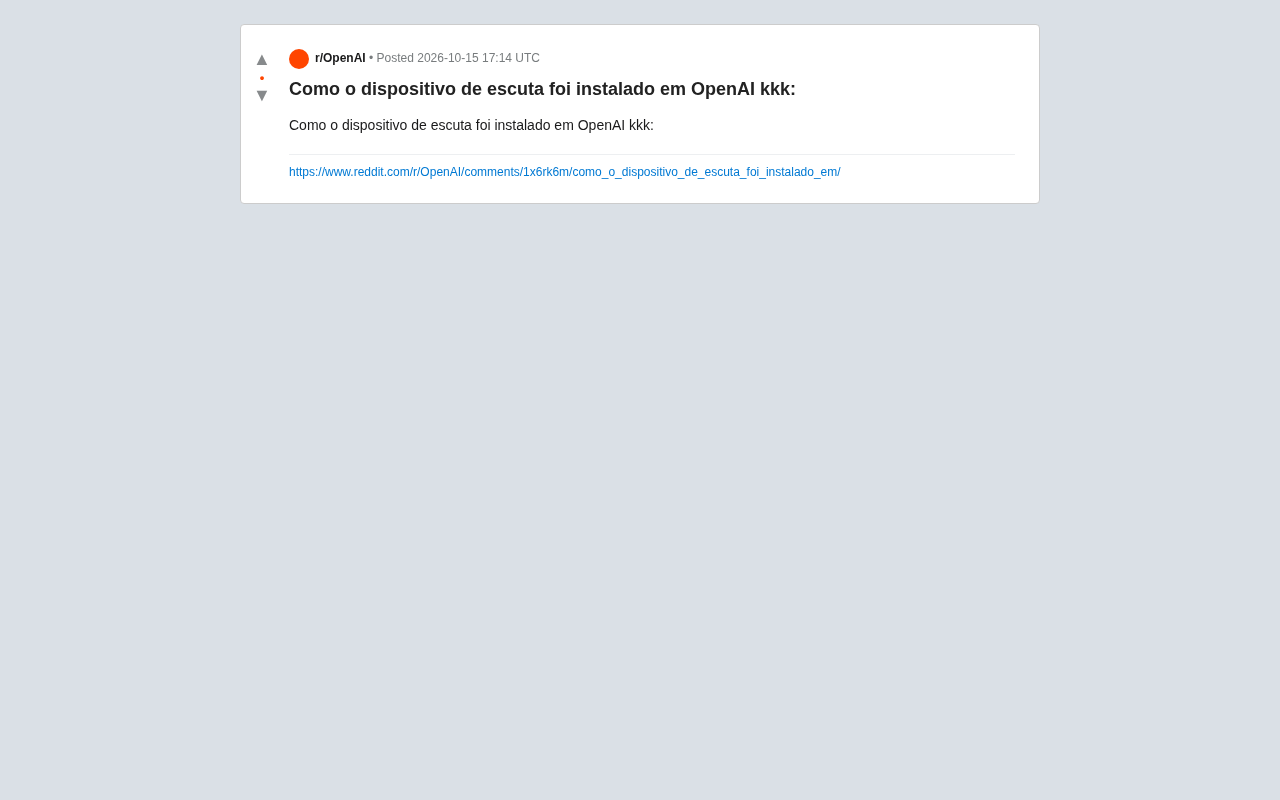
"kkk" is a Portuguese internet abbreviation for laughter, equivalent to "hahaha." The post takes an absurd scenario — "OpenAI having an eavesdropping device installed" — and turns it into dark humor through extreme exaggeration. But what really made it ferment in the AI community wasn't the joke itself — it was that it chose a topic everyone vaguely worries about but can't easily prove: who exactly is listening to our conversations with AI systems?
Why the "Eavesdropping" Metaphor Works So Well
Choosing "eavesdropping device" rather than "data breach" or "privacy violation" is a deliberate word choice.
Eavesdropping implies three things: a hidden recipient exists, the conversant is unaware, and information is captured in real time. This narrative framework compresses the complex issue of AI data governance into an image anyone can instantly grasp. Users don't need to understand API logs, model training pipelines, or data retention policies to feel that discomfort of being secretly watched.
From a technical reality standpoint, conversations with mainstream AI services are indeed recorded, stored, and to some extent used for model improvement or safety review. This is an industry-wide open practice, usually stated in user agreements. But between "publicly stated" and "users truly understanding and accepting it" lies a massive cognitive gap. The meme's viral power comes precisely from making that gap tangible.
"Data retention policy" refers to a service provider's explicit rules about how long user data is stored, where it's stored, and under what conditions it's destroyed — typically appearing in privacy terms as "automatically deleted after X days" or "retained for service improvement until the user actively deletes it." Related to this is "access control," which determines which internal personnel or systems can read these conversation records under what conditions. The common phrasing in user agreements like "may be used to improve the model" actually encompasses multiple processes including data anonymization, human annotation, and model fine-tuning — and ordinary users can hardly infer where any particular conversation of theirs actually flows. It is precisely this information asymmetry between the wording of terms and actual data flows that constitutes the realistic soil on which the "eavesdropping" metaphor stands — even without an actual eavesdropping device, users cannot rule out the possibility of excessive reading based on publicly available information alone.
Community Reaction: Beneath the Jokes Lies Real Distrust
The discussion trajectory of this post on Reddit is quite interesting. Some users simply picked up the joke and ran with it, creating more conspiracy-theory-style bits; others used it as a springboard for serious discussion about the boundaries of AI companies' data practices.
This pattern of "laughing while discussing serious issues" is becoming increasingly common in the AI community. It reflects a contradictory mindset: users depend on these AI tools while lacking fundamental trust in the companies that operate them. When formal channels for questioning seem distant or ineffective, memes become a low-cost form of expression.
More critically, this kind of content often bypasses the tech circle and reaches ordinary users. Someone who doesn't understand transformer architecture can still grasp the image of "someone eavesdropping while you talk to ChatGPT." This cross-boundary传播 capability means memes sometimes have more influence than a serious privacy policy analysis.
In privacy research, this phenomenon of expressing distrust in technological systems through humor is often categorized under the "privacy paradox" framework: users express concern about data collection on one hand while continuing to use these services on the other. Researchers argue that this inconsistency between words and actions isn't simply cognitive dissonance, but a pragmatic compromise users make when facing the structural choice of "either accept the terms or give up the service." Memes play the role of "low-cost dissent" here — they don't require users to spend time studying policies or organize collective action, yet through viral spread they can transform individual vague unease into visible public sentiment. While this form of expression can't directly change corporate behavior, it subtly shapes public perception of a company, which in turn affects its brand reputation and user retention.
Trust Deficit: A Structural Problem the AI Industry Can't Avoid
Setting aside the entertainment value of the meme, it points to a real industry dilemma.
AI companies face a catch-22: to make models better, they need massive amounts of real conversation data; to win user trust, they need to minimize data collection and retention. A balance point between these two that satisfies the public has yet to be found. Every time a company adjusts its data policy, it almost always triggers a wave of trust fluctuation — regardless of whether the adjustment tightens or loosens.
For leading companies like OpenAI, this scrutiny is only more severe. It is both a technology leader and a natural target for public sentiment. A single Reddit meme certainly won't affect the company's actual operations, but the collective emotion it accumulates will gradually manifest in regulatory discussions, media coverage, and user choices.
In the context of technology governance, "trust deficit" refers to the degree of public trust in a certain type of technology or institution falling below what's needed for its normal functioning. Unlike a "trust crisis," deficit emphasizes a long-term, structural gap rather than the eruption of a specific event. The AI industry's trust deficit has several unique causes: first, model training relies on massive data, but ordinary users cannot audit data sources and usage methods; second, the decision-making processes of AI systems are inherently opaque — the so-called "black box" problem; third, fierce industry competition means companies often prioritize feature iteration speed over transparency building. These factors compound so that every policy adjustment — regardless of direction — is viewed with suspicion by the public. To narrow the trust deficit, companies typically need to invest in verifiability — such as introducing third-party audits, publishing transparency reports, or providing tools that let users check data flows themselves.
The Distance from Memes to Constructive Discussion
The value of memes lies in rapidly concentrating attention, but their limitations are also obvious: they're good at raising questions, not at providing answers.
For AI companies, the truly effective response isn't to deny or ignore this kind of content, but to transform public anxiety into verifiable commitments. For example, more clearly explaining under what conditions data is retained, who accesses it, how long it's kept, and what practical control options users have. Transparency isn't a lengthy legal document — it's information design that users can understand and act on within seconds.
For ordinary users, this post is also a reminder: while enjoying AI convenience, spending a few minutes understanding the privacy settings and data policies of the services you use has more long-term value than participating in a meme frenzy. After all, trust is never built on jokes — it's accumulated through verifiable actions, time and time again.
One-line Summary
A Portuguese-language Reddit meme satirizes OpenAI with "eavesdropping," reflecting the AI industry's structural trust deficit.
Paragraph Summary
A Portuguese-language Reddit meme satirizing OpenAI with an "eavesdropping device" spread rapidly through the AI community — surface-level dark humor that precisely pokes at public unease about AI companies' data practices. The "eavesdropping" metaphor works because it compresses complex data governance issues into an image anyone instantly understands. Community reactions show a "laughing while discussing serious issues" pattern, reflecting users' contradictory mindset of depending on AI tools while lacking fundamental trust in the companies operating them. The article notes that AI companies face a catch-22 — needing data to improve models while needing to reduce collection to win trust — making the trust deficit an unavoidable structural problem. Memes excel at concentrating attention but not at providing answers; AI companies should transform public anxiety into verifiable transparency commitments.
Related articles

WebMCP: Every Website as Its Own MCP Server, So AI Agents No Longer Rely on Screenshots
WebMCP lets websites expose tools via the document.modelcontext API, becoming directly callable MCP servers. This article explains its architecture, the Claude Code remote-debugging demo, Chrome's current support stage, and its impact on the agent ecosystem.
MCP Protocol-Driven AI Testing Agent: …
MCP Protocol-Driven AI Testing Agent: Automated Execution, Diagnosis, and Reporting
Introduces an MCP protocol-based AI testing Agent: using FastMCP to expose PyTest execution tools, running Llama 3.2 3B locally with Ollama for failure diagnosis, automatically generating timestamped reports and comparing them with historical results to create a closed loop of test execution, root cause analysis, and fix tracking.

AI Agent Draws an Architectural Elevation in 15 Seconds — Open-Source Drawing Software Rewritten by AI
An AI Agent controls open-source drawing tool VectorCraft via MCP Server, executing 1,077 commands with zero errors to draw an architectural elevation in 15 seconds and export editable SVG/PDF.