OpenAI Faces 30 Lawsuits, GPT-6-Astra Spotted in API: AI News Roundup
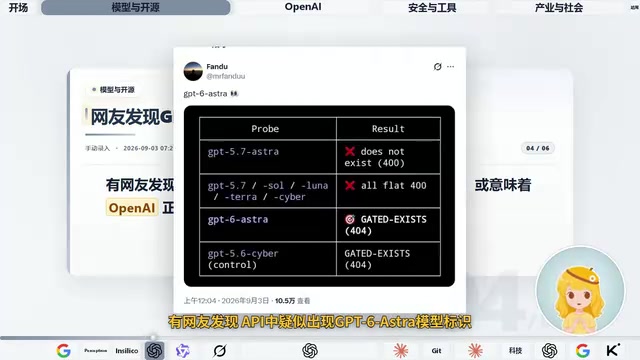
OpenAI hit with 30 lawsuits as new AI models flood the market and governance debates intensify.
This AI roundup captures a field where rapid technical progress and mounting social friction are advancing in lockstep. New models from Gemini 3.8, Qwen 3 Max, and Grok 4.7 are pushing performance and cost-efficiency to new highs, while a suspected GPT-6-Astra identifier in the API hints at OpenAI's next generation entering internal testing. At the same time, OpenAI faces 30 new lawsuits over alleged complicity in a school shooting, seven major AI coding agents have been found vulnerable to indirect prompt injection attacks with up to 80% success rates, and a U.S. congressman has introduced an AI jobs tax bill — marking the first concrete legislative response to AI's societal impact.
OpenAI received 30 new lawsuits in California federal court in a single day, making it the most closely watched story in this AI news roundup. Meanwhile, a suspected GPT-6-Astra model identifier appearing in the API and a U.S. congressional bill proposing an AI jobs tax together paint a complex picture of the industry navigating rapid technological evolution and mounting social controversy. Here's a breakdown of the key stories in today's roundup.
Models & Open Source: A Wave of Next-Gen Releases
Model updates have been coming fast. Google released the Gemini 3.8 series with two variants — Flash and Flash Cyber — focused on enhanced reasoning and coding capabilities. Reports suggest both were trained using long-running agent loop techniques, and their release came just three weeks after the previous Gemini 3.7 Flash, signaling an aggressive iteration cadence.
The open-source side is equally active. Perceptron open-sourced its foundation model ISAC 0.5, featuring a 36-billion-parameter architecture that supports multimodal input and action generation. It covers more than 35 robot types with publicly released weights, giving robotics developers a new base model to build on. In pharmaceuticals, InSilico Medicine released five BioAI models purpose-built for drug discovery, covering safety, efficacy prediction, chemical synthesis, and biology — with the company claiming top performance across more than 70 benchmark tasks.
Alibaba's Qwen 3 Max 0902 topped the CodeArena WebDev leaderboard for the first time with a score of 1,691, making it the highest-scoring model on that frontier benchmark at a blended cost of $5 per million tokens. Cost-efficiency is increasingly becoming a decisive variable in the large model race. Meanwhile, Elon Musk confirmed on X that Grok 4.7 will launch in approximately 10 days; leaked details suggest the model may be roughly 2.5 times larger than its predecessor, approaching 2.1 trillion parameters.
Notably, users have spotted what appears to be a GPT-6-Astra model identifier in the API — potentially indicating that OpenAI is pushing ahead with internal testing and deployment of its next-generation model. While this remains a third-party observation for now, combined with OpenAI's recent moves, the pace of its technical pipeline advancement should not be underestimated.
CodeArena WebDev is a model evaluation platform focused on front-end and full-stack web development tasks. It uses an "arena"-style human preference voting mechanism: different models generate code for the same programming task, and real users conduct blind comparative evaluations, with final rankings determined by an Elo scoring system. Dynamic leaderboards driven by real user preferences are considered harder to game or overfit than static benchmarks using fixed datasets, which is why they carry significant credibility in developer communities. Qwen 3 Max 0902's score of 1,691 — combined with its substantially lower price compared to major competitors — means it has opened a notable gap on the "performance-to-cost" dimension. For enterprise users making high-frequency API calls, that metric often carries more decision-making weight than raw performance rankings alone.
OpenAI: Technological Momentum Meets Legal Risk
It was a mixed day for OpenAI. On the technology side, its Web MCP challenge entered its final 24 hours, with submissions due by 1:00 PM Pacific Time; its cybersecurity model Astra is set to launch soon, with OpenAI stating its capabilities have reached the highest Critical threshold, along with plans to strengthen evaluation and safeguards. OpenAI is also reportedly developing an automatic shutdown capability for AI systems that would cut off operation when dangerous behavior is detected — though details remain unpublished and the information comes from third-party sources.
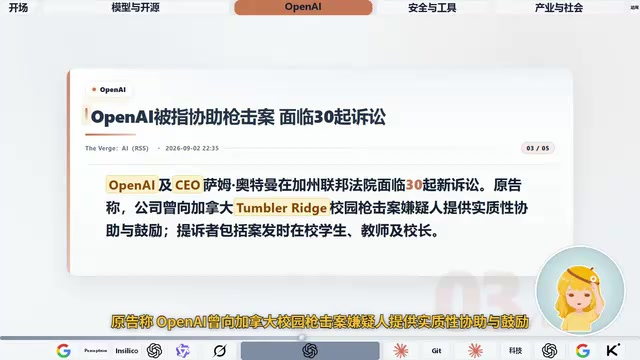
Controversy erupted on multiple fronts as well. OpenAI and CEO Sam Altman face 30 new lawsuits in California federal court, with plaintiffs alleging that OpenAI provided substantial assistance and encouragement to a suspect in a Canadian school shooting. Cases like this thrust the content safety responsibilities and legal boundaries of AI products back into the public spotlight, foreshadowing increasingly heavy compliance burdens for large model providers.
On the commercial side, there's a warning signal worth noting: Ramp data shows that approximately 80% of enterprise revenue for both OpenAI and Anthropic comes from just 1% of customers, with customer concentration still rising. This heavily top-heavy revenue structure could amplify volatility risk around renewals and operations.
Security & Vulnerabilities: AI Coding Agents Become a New Attack Surface
Security news was also dense, with much of it centered on AI coding tools. Anthropic launched a Claude file provenance detection tool that supports verification of JPG, PNG, MP4, and WAV files up to 100MB in size. By identifying embedded C2PA credentials or watermarks, it can determine whether content was generated or processed by its models — a practical step toward addressing AI content traceability.

Vulnerabilities are also surfacing. Manifold Security disclosed eight vulnerabilities across seven AI coding agents — including Claude Code, Codex, and Cursor — through which attackers could use malicious configurations to induce agents to execute programs, creating supply chain risks. More alarming: security researchers found that Claude Code's default auto-accept mode can be hijacked via prompt injection embedded in web summarization requests, triggering code execution. Small-sample testing showed attack success rates of 60% to 80%. Indirect prompt injection is rapidly emerging as one of the most intractable security threats in the age of AI agents.
Indirect Prompt Injection is one of the core threats in AI agent security. Unlike direct prompt injection — where an attacker enters malicious instructions directly into a user interface — indirect prompt injection hides malicious instructions inside external content that a model proactively reads, such as web page text, documents, code comments, or API responses. When an AI agent automatically fetches this content while performing a task, the embedded instructions can hijack the agent's subsequent behavior, triggering data leakage, malicious code execution, or lateral movement attacks. As agents' tool-calling capabilities grow stronger — accessing file systems, executing terminal commands, calling external services — the blast radius of indirect prompt injection expands dramatically. The 60%–80% attack success rate observed in tests of Claude Code's default auto-accept mode is a clear indication that current AI coding agents have systemic gaps in defining trust boundaries, and their defensive mechanisms are still in early stages.
Industry & Society: AI Tax, Math Breakthrough, and IPO
On the policy front, a notably forward-looking development emerged: a U.S. House member introduced an AI jobs tax bill that would levy taxes on large AI companies when AI causes widespread unemployment, with tax rates automatically scaling up alongside unemployment figures. Revenue would be directed toward public welfare areas including housing infrastructure, childcare, and elder care. This proposal directly confronts AI's impact on employment structure and offers one framework for using policy mechanisms to distribute AI's benefits.

On the research front, encouraging news arrived: mathematicians James Freytag and Scott Mochnik used ChatGPT to find a counterexample that refutes a stable forking conjecture in model theory that has stood since 1996. Their paper has been submitted to arXiv. This demonstrates that AI can already play a substantive accelerating role in high-difficulty mathematical exploration.
Google also adjusted its anchor link strategy for AI Mode and AI Overviews: e-commerce queries no longer route to aggregator pages, and local searches now route more frequently to Google Business Profiles. This move could further squeeze organic traffic for independent websites and local businesses. On the domestic side, Moonshot AI (月之暗面) is reportedly preparing to file confidentially with the Hong Kong Stock Exchange to begin the IPO process for Kimi, while also advancing a new funding round at an approximately $50 billion valuation. The company declined to comment.
C2PA (Coalition for Content Provenance and Authenticity) is an open technical standard jointly developed by Adobe, Microsoft, Intel, the BBC, and other organizations, designed to establish verifiable provenance and history records for digital content. Its core mechanism embeds cryptographically signed "credential manifests" into the metadata of images, videos, audio files, and other formats, recording the creation tool, edit history, and publisher identity. Anthropic's use of C2PA credential verification in its Claude file provenance detection tool means that, in theory, content generated or processed by its models can be traced and identified. However, C2PA's effectiveness depends on widespread adoption across the entire content production chain — if content is screenshotted, re-encoded, or stripped of metadata during distribution, the provenance chain breaks. For this reason, the standard is currently viewed more as the foundational infrastructure of a content-credibility ecosystem than as a complete solution.
Wrap-Up
This roundup reveals a striking duality: on one side, new models from Gemini, Qwen, Grok, and others are iterating rapidly, with performance and cost-efficiency hitting new benchmarks; on the other, lawsuits are piling up, agent vulnerabilities are multiplying, and an AI employment tax is on the legislative agenda. The speed of technological progress and the urgency of social governance are both accelerating in parallel. How to strike a balance between innovation and safety, and between efficiency and fairness, will be the defining challenge the AI industry must answer in the months ahead.
Related articles
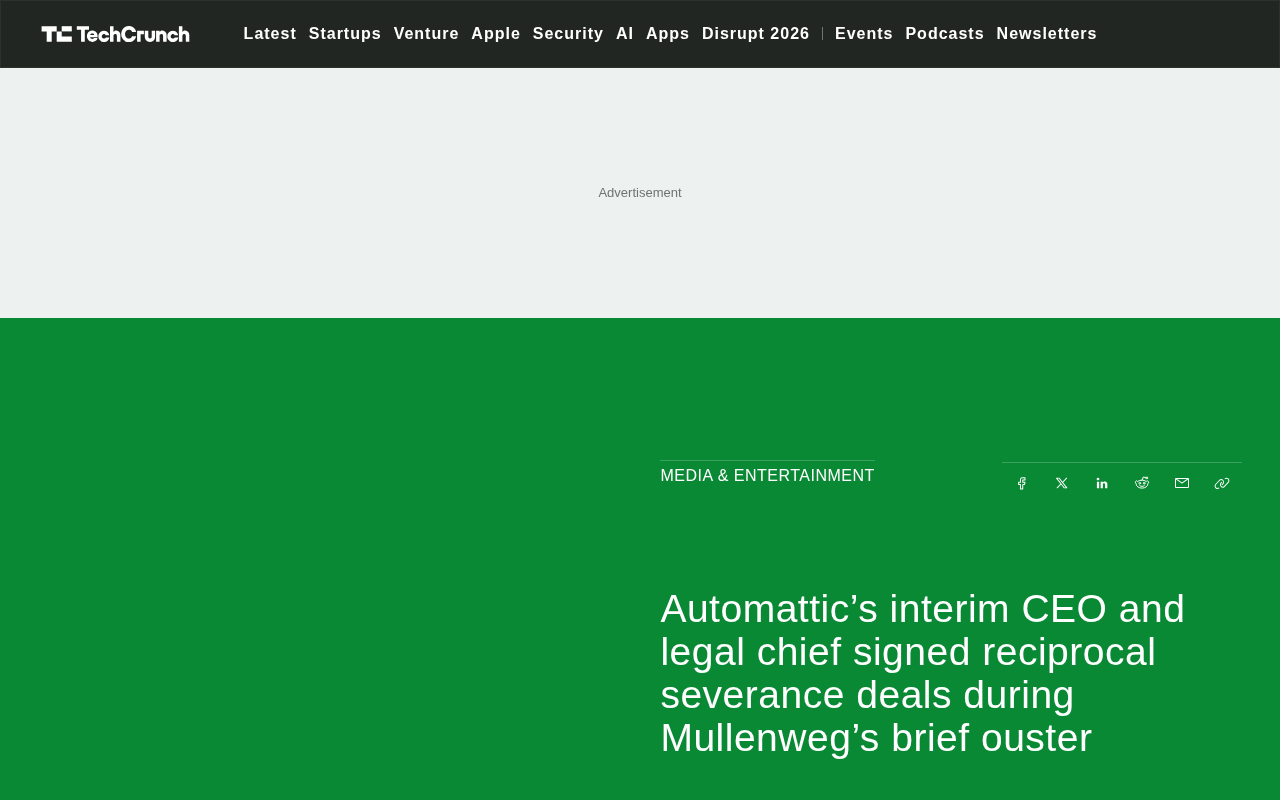
Automattic Executives Signed Reciprocal Severance Agreements During Mullenweg's Brief Ouster
Automattic's CFO and General Counsel signed reciprocal severance agreements during Matt Mullenweg's brief ouster, covering one year's salary and accelerated equity vesting, raising corporate governance concerns.
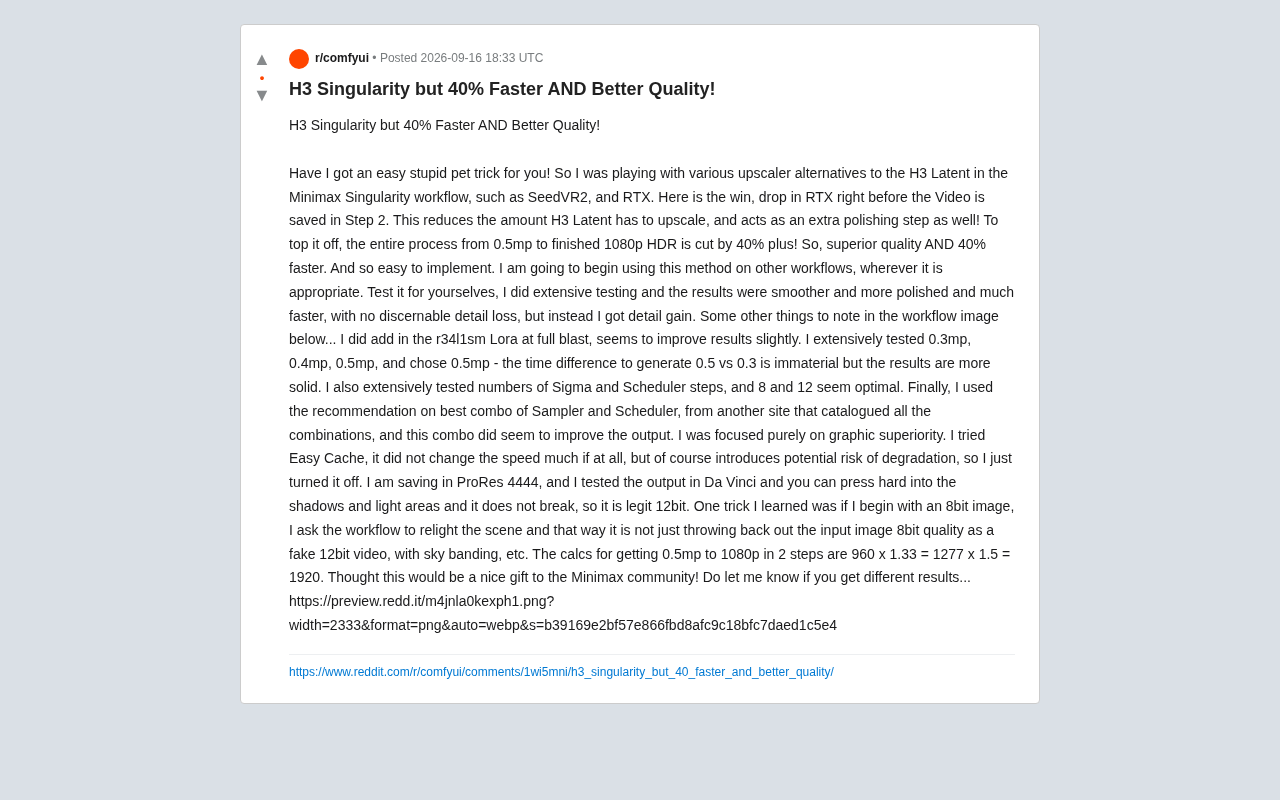
H3 Singularity Optimization: 40% Speed Boost With Better Image Quality
A Reddit user's Minimax Singularity workflow tip: insert an RTX upsampler before H3 Latent for 40%+ speed gains and better quality. Covers parameters, 12-bit output, and more.
Glyph: A Multi-Strategy Agent System for Automated Enterprise Data Catalog Annotation
Glyph is a multi-strategy LLM agent system for enterprise data catalogs that automates column description generation and sensitivity ontology tagging, grounding outputs in pipeline source code to improve accuracy.