OpenAI Launches Astra for Law: Can AI Reshape How the Legal Industry Works?
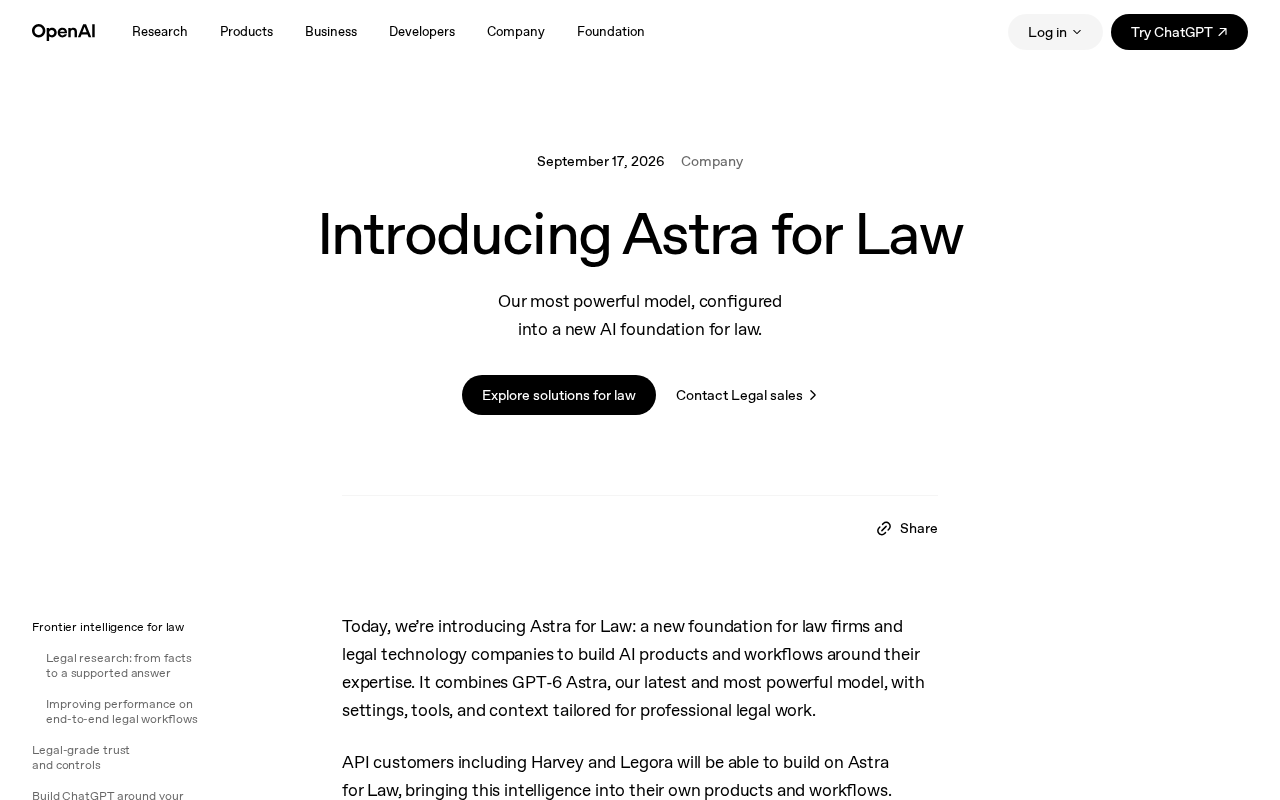
OpenAI's Astra for Law enters the legal AI market, raising debate over accuracy, liability, and compliance.
OpenAI has released Astra for Law, a specialized AI product for the legal industry that extends large language model capabilities to text-intensive tasks like contract review, case research, and legal drafting — sparking over 260 comments on Hacker News. While the legal market's scale and repetitive workloads make it a natural target for AI, the community's response reflects widespread concern: AI hallucinations carry serious consequences in legal contexts, and questions around liability and client data confidentiality remain key barriers to adoption. The prevailing view is that in high-stakes professional fields, AI should augment human judgment rather than replace it.
OpenAI Sets Its Sights on the Legal Industry
OpenAI recently released a product called Astra for Law, extending its AI capabilities into the professional legal services space. The move sparked lively discussion on Hacker News, with the post receiving 238 upvotes and accumulating 266 comments — a clear signal of the tech community's intense interest in AI entering high-barrier professional industries.
Law is an industry that relies heavily on text processing, retrieval, and reasoning. From contract review and case research to drafting legal opinions, workflows are saturated with both structured and unstructured text. These characteristics align closely with the strengths of large language models, which explains why AI vendors are increasingly eyeing this vertical market.
It's worth noting that this article is based on OpenAI's official release page and public discussions on Hacker News. Since the primary source material consists mainly of the release link and community feedback, specific product feature details are still pending further official disclosure.
Why the Legal Industry?
The legal services market is enormous, and traditionally, its services come at a steep cost. Junior lawyers and paralegals often invest significant time in repetitive tasks such as document review, case law research, and formatting legal briefs. This is precisely where AI tools make their value proposition — by automating these steps to free up professionals for higher-order judgment and strategic work.
A Natural Fit for Text-Intensive Work
Large language models excel at understanding, summarizing, and generating long-form text, which aligns directly with the core demands of legal work. Comparing clauses in contracts, conducting semantic searches across case law databases, and extracting key points from voluminous case files are all scenarios where models can deliver significant efficiency gains. Compared to general-purpose chat assistants, legal-specific tools typically include targeted optimizations around data sourcing, accuracy, and citation traceability.
Competition in a Specialized Vertical Market
OpenAI's entry into this space signals a shift from being a general-purpose platform to offering vertical industry solutions. Several legal tech companies — such as Harvey — have already been operating in this space, and OpenAI's arrival will undoubtedly intensify competition while potentially reshaping the industry landscape.
Harvey is currently one of the most prominent startups in the legal AI space. Its product is built on OpenAI's models and has been deeply customized for law firm workflows, having already secured pilot partnerships with several top-tier firms. Beyond Harvey, Thomson Reuters' Westlaw has integrated AI-assisted search features, and LexisNexis has launched Lexis+AI, an AI assistant powered by its proprietary legal database. These incumbents hold years of accumulated structured legal data and client trust. By entering with its own product directly, OpenAI is not only competing with these vertically focused legal data companies, but may also impact existing partner relationships with firms that previously accessed its foundation models via API — making the ecosystem dynamics increasingly complex.
Community Concerns and Skepticism
The 266 comments on Hacker News reflect the tech community's mixed feelings toward this type of product — a blend of anticipation and caution. Discussions around AI entering the legal industry typically center on several core issues.
Accuracy and the Risk of "Hallucinations"
Legal work demands extremely high accuracy. Factual errors or fabricated citations in AI-generated content — known as hallucinations — can have serious consequences in a legal context. The industry has already seen cases where lawyers were sanctioned by courts for citing AI-fabricated case law, putting legal professionals on high alert regarding the reliability of AI tools.
"Hallucination" in the large language model field specifically refers to a model generating content that is factually incorrect with high confidence — including fabricating nonexistent case citation numbers, misquoting statutory provisions, or inventing statements by parties to a case. This phenomenon stems from the generative mechanism of LLMs: models are essentially predicting the next most plausible sequence of tokens, rather than retrieving facts from a knowledge base. In 2023, a U.S. attorney filed a brief in federal court that had been assisted by ChatGPT and contained at least six nonexistent case citations, resulting in public reprimand by the judge and the threat of sanctions. This incident quickly became a landmark cautionary tale in the legal community, and also accelerated the large-scale adoption of techniques like Retrieval-Augmented Generation (RAG) in legal AI products — anchoring model outputs to verified document databases to reduce the probability of fabricated content and enable citation traceability.
Liability and Compliance
When AI participates in the formation of legal opinions, who bears responsibility when something goes wrong? Is it the attorney using the tool, the law firm, or the technology vendor? Beyond that, client data confidentiality, privacy compliance, and the auditability of AI outputs are all issues that professional organizations must resolve before adopting such tools.
The Role of AI in Professional Services
The launch of Astra for Law once again highlights a broader question: what role should AI play in high-stakes professional domains? The more pragmatic consensus is that, for the foreseeable future, AI is better suited as an "augmentation" tool — helping professionals work more efficiently — rather than fully replacing human professional judgment.
Law, medicine, and finance share a common characteristic: decisions carry significant consequences, and the tolerance for error is low. In these contexts, the bar for AI is not merely "can it generate output," but "can it be trusted" — meaning outputs must be verifiable, traceable, and reviewable by professionals. This is why AI products aimed at professional markets typically need to layer retrieval augmentation, citation sourcing, and human review mechanisms on top of general-purpose models.
Conclusion
OpenAI's Astra for Law represents another step by a general-purpose AI vendor toward deepening its presence in vertical industries. For the legal industry, this presents both an opportunity for greater efficiency and a test of the systems surrounding accuracy, accountability, and compliance. As more product details emerge and real-world use cases accumulate, whether AI can truly establish itself in the rigorous legal field remains to be proven by time and practice. The tech community's close attention to this development is itself a testament to the significance — and the challenges — that lie ahead.
Related articles

Prompt → MCP → Agent → Skill: The AI Terminology Evolution Chain Explained in 5 Minutes
A clear guide to five core AI concepts — Prompt, MCP, Agent, Skill, and Cowork — and how they connect in a layered evolution chain from simple instructions to multi-agent teamwork.

OpenAI Discloses Model Anomalies, DeepMind Launches AGI Forum, NVIDIA Partners on Grid Power Management
Sept 17 AI roundup: OpenAI publishes model anomaly disclosure framework with 6 reports, Google DeepMind launches AGI public forum, NVIDIA leads AI energy management alliance with 18 partners.

Build a Local AI Agent with Python in 10 Minutes: Ollama + PydanticAI in Action
A hands-on guide to building a fully local AI agent with Python, Ollama, and PydanticAI in 10 minutes — covering model selection, tool functions, and conversation loops.