OpenAI Launches Dot Agent Platform: An AI Office Assistant Built for the Enterprise

OpenAI's Dots is an enterprise-focused AI agent platform that handles work tasks — and can order your lunch.
OpenAI has released Dots, an AI agent platform aimed at enterprise use cases, positioning itself against Meta's consumer-friendly Muse. Dots pairs an approachable character-based interface with serious task execution capabilities — handling workplace workflows and real-world actions like ordering food, which demonstrates its ability to call external services autonomously. The launch reflects two major industry trends: intense competition as top AI vendors flood the agent space, and a broader shift from conversational AI toward action-oriented systems that can actively complete tasks. Full product details and pricing are still pending official disclosure.
OpenAI's Dot Agent: Enterprise Software That Also Orders Your Lunch
OpenAI has released a new agent platform called Dots, joining the crowded wave of AI vendors rushing to launch their own "intelligent assistant" products. Unlike Meta's consumer-friendly Muse, Dots makes a distinctly corporate first impression — it feels like a serious workplace productivity suite that just happens to be able to order you a burrito.
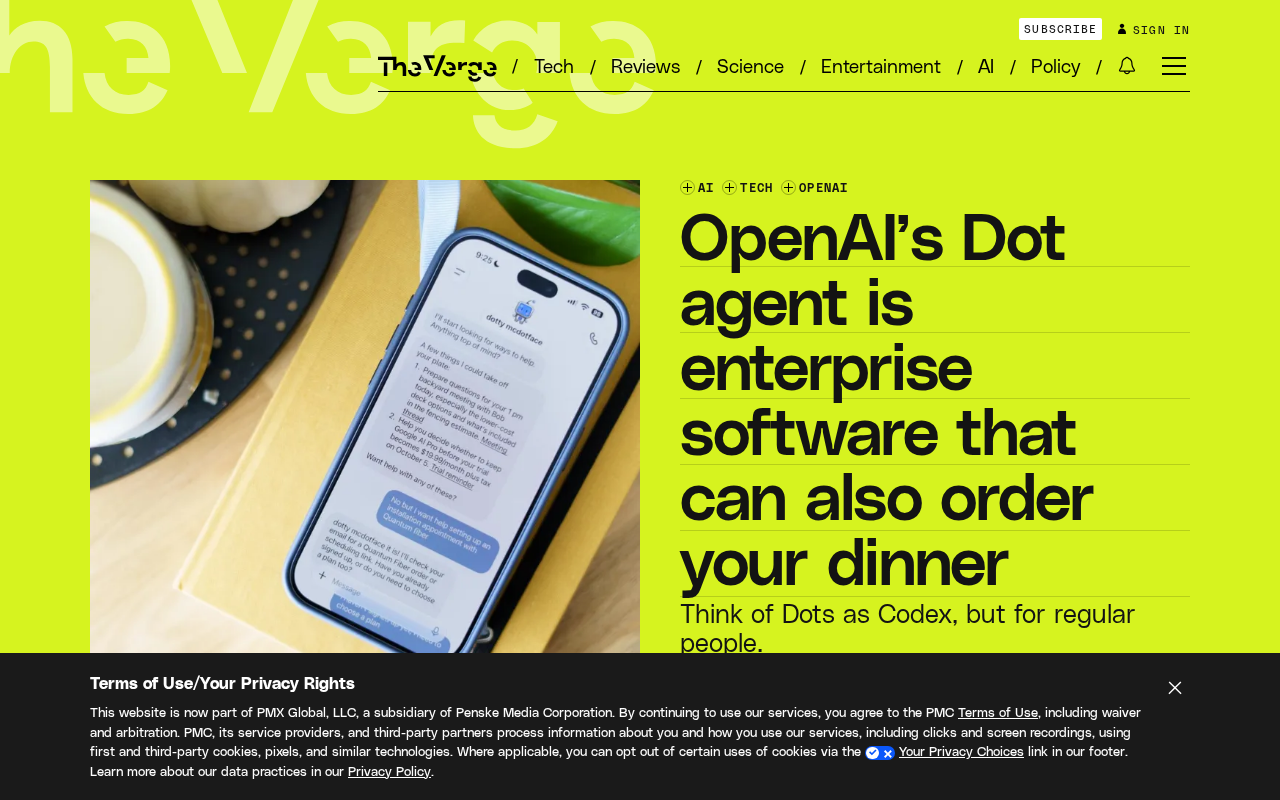
An Agent Built Around Work
Dots is clearly positioned for enterprise and workplace use cases. As one description put it, the experience "feels very much like using workplace software that happens to let you order a burrito — the emphasis is on work." That slightly tongue-in-cheek framing captures the core difference between Dots and consumer-grade AI assistants: it's not selling companionship or entertainment, it's selling productivity.
In other words, the "cute little guys" that populate the Dots platform may look charming, but they're designed at heart for enterprise collaboration and task execution. They can act on behalf of users across a range of operations — whether that means managing a workflow or placing a lunch order during a break.
A Crowded Race in the Agent Space
The original coverage described this moment as "a tale as old as last week," a sardonic nod to just how rapidly AI agent platforms are proliferating. The phrase reflects the current reality: major tech companies are shipping new agent products at a relentless pace.
Putting OpenAI's Dots alongside Meta's Muse as direct comparisons highlights how agents have become the new battleground for leading AI vendors. The two products also illustrate contrasting go-to-market strategies: Meta Muse leans into consumer appeal and approachability, while OpenAI's Dots opts for a differentiated, enterprise-first, utility-driven positioning.
Between 2024 and 2025, AI agent platforms entered a period of dense, rapid releases. Beyond OpenAI Dots and Meta Muse, Google launched Agentspace for enterprise, Salesforce shipped Agentforce, and Microsoft deeply integrated Copilot across the entire Microsoft 365 product line. The technical logic behind this surge is straightforward — the reasoning and tool-calling capabilities of large language models have improved dramatically over the past two years, making agents that can "reliably complete multi-step tasks" a viable product rather than just a concept. The enterprise market has become the preferred battleground because business users have a stronger willingness to pay for efficiency tools, and the ROI of internal process automation is easier to quantify than consumer use cases, enabling faster commercial payback.
Practical Power Behind a Friendly Face
The most interesting design tension in Dots is the pairing of "cute little characters" with "serious enterprise software." This approach attempts to strike a balance between an approachable user experience and a professional functional identity — making it easy enough for everyday employees to adopt while capable enough to execute enterprise-level tasks.
The detail about being able to "order you dinner" might seem like a minor lifestyle feature, but it's actually demonstrating something more significant: an agent's ability to take real-world action. From food delivery to office workflows, Dots represents a rising category of "agentic AI" — systems that don't just answer questions, but actively complete tasks on a user's behalf.
"Agentic AI" is one of the most important evolutionary directions in AI today, and it's fundamentally different from traditional generative or conversational AI. Early AI assistants like the original ChatGPT operated primarily in a question-and-answer mode: the user inputs a prompt, the AI outputs text, and a human still has to take action. Agentic AI, by contrast, has the ability to call external tools, access APIs, operate browsers, or interact with applications — completing multi-step tasks autonomously, such as searching a restaurant, selecting menu items, and processing payment without any human intervention. These systems typically rely on "tool use" or "function calling" mechanisms; OpenAI has offered this capability via its API since 2023. Enterprise agent platforms like Dots essentially package this underlying capability into a product form accessible to non-technical users, lowering the barrier for companies to deploy AI-powered automation.
What This Means for Enterprise AI
The launch of Dots further confirms the ongoing shift in AI from "conversational tool" to "task execution engine." For enterprises, the value of these agent platforms isn't in the chat interface itself — it's in whether they can genuinely embed into existing workflows, automate repetitive tasks, and integrate with the software tools already in use.
Given the limited public information available, the full scope of Dots' capabilities, its pricing strategy, and how it integrates with OpenAI's existing product lineup remain to be seen. What's clear is that OpenAI is making a deliberate push into the enterprise AI market, and agents are the key bet it's placing.
Note: This article is based on limited publicly available information at the time of writing. Full details about the Dots platform's capabilities and commercialization are pending further official disclosure.
Related articles

Amphibious Transforming Drone: Beyond 100x Power Savings, What Are the Real Needs?
Is the amphibious transforming drone just a gimmick? Starting from the 100x power difference of the M4 Morphobot, explore real application scenarios and thesis topic ideas, analyzing boundary conditions where pure drones and pure ground robots both fail.

Warhound Raises $200 Million: Genetically Engineered "War Dogs" Paired with Anduril Gear
Warhound raises $200M, backed by Ben Lamm and Palmer Luckey, to genetically engineer dogs for military and law enforcement use and equip them with Anduril gear. This article analyzes its technology direction, funding logic, and ethical controversy.

Claude API Comes to Google Cloud: IAM Integration and SDK Access Guide
Anthropic hosts the full Claude API on Google Cloud with IAM-controlled permissions and unified billing. This guide covers the Vertex AI and Anthropic-hosted entry points, IAM role configuration, and SDK access.