OpenAI Launches Dots: Always-On AI Agents Come to ChatGPT

OpenAI's Dots brings always-on AI agents with dedicated cloud environments to autonomously execute cross-app tasks 24/7.
OpenAI has launched Dots on Product Hunt, positioning it as an "always-on digital employee" powered by GPT-6 Astra. Each Dot has its own cloud computer and browser, can connect to over 4,000 apps via plugins, and learns user preferences over time — delivering completed work for human review. Three built-in control mechanisms (Custom Rules, Activity View, and auto review) keep humans in the loop. Currently limited to ChatGPT Pro and Business Premium users, Dots signals AI's shift from question-answering tool to proactive digital labor.
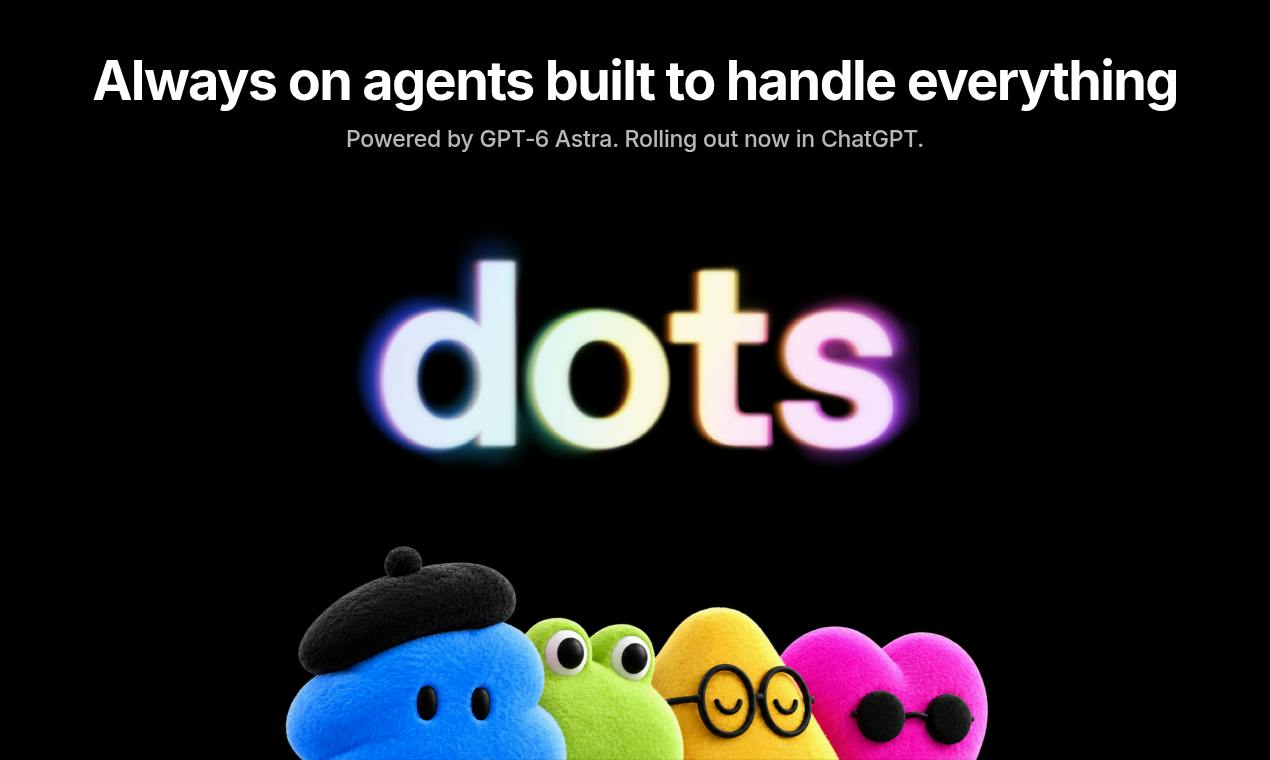
OpenAI has listed a new product on Product Hunt called Dots, positioning it as an "always-on agents" platform. Unlike traditional conversational assistants, each Dot comes with its own dedicated cloud computer and browser, capable of working around the clock toward your goals without interruption. The product is currently rolling out to ChatGPT Pro and Business Premium users.
What Is Dots
Dots is fundamentally a "persistent agent" powered by the GPT-6 Astra model. It breaks out of the back-and-forth conversation model, functioning more like a digital employee you can delegate long-running tasks to. You can message or call it via ChatGPT's desktop, web, and mobile apps — or communicate with it directly inside Slack and Teams.
Each Dot comes with its own dedicated cloud computer and browser, meaning it doesn't just generate text — it can actually take action: opening web pages, filling out forms, and executing multi-step workflows. According to the product description, Dots can connect to over 4,000 apps via plugins, dramatically expanding the range of work scenarios it can handle, from calendar management to cross-app task coordination.
GPT-6 Astra is a next-generation model from OpenAI that hasn't been formally released to the public and currently appears only in official product marketing materials. Based on the naming, "Astra" likely points to a model family optimized for long-horizon task execution and multimodal perception — Google DeepMind also has a multimodal AI project by the same name, and the industry's convergence on the "Astra" concept reflects a shared focus on persistent perception and real-time execution capabilities. It's worth noting that GPT-6 Astra's actual parameter scale, training methodology, and capability boundaries have not been independently verified. The original source flags this information as coming solely from official marketing materials, and readers should treat it with appropriate skepticism.
Continuous Learning and Deliverable Output
One of Dots' key selling points is that it "learns your preferences." By adapting based on user feedback, a Dot gradually comes to understand how you want tasks completed, then hands you the finished result for review when done. This "deliver first, human reviews second" model aligns with the prevailing thinking around Agent workflows — letting AI handle execution while keeping judgment and oversight in human hands.
In other words, it aims to free people from tedious, process-heavy operations, with humans only stepping in at critical decision points. For professionals who regularly handle large volumes of repetitive, cross-platform tasks, this model holds obvious appeal.
Controllability by Design
An agent that's always online and capable of autonomously operating apps naturally raises concerns around trust and security. OpenAI has built several control mechanisms to address this: Custom Rules let users define boundaries for how a Dot behaves; Activity View allows users to see what the agent is doing in real time; and auto review introduces checkpoint stages within the task execution pipeline.
Together, these features form a "human in the loop" safeguard — designed to ensure users retain control even as they delegate execution to the agent. For enterprise Business Premium use cases in particular, this kind of controllability and auditability is especially important.
"Human in the Loop" (HITL) is a core design principle in AI safety and reliability, referring to the preservation of human intervention and review checkpoints within automated decision-making or execution pipelines. Its counterpart is the "Human out of the Loop" or fully automated model. In agent scenarios, HITL is particularly critical — because an Agent may perform irreversible actions (like sending emails, submitting forms, or deleting files), where mistakes carry significant consequences. Ideal HITL design requires striking a balance between minimizing user intervention burden and retaining essential oversight moments: too many confirmation prompts erode the efficiency gains, while too few amplify the risks of model errors. Dots' three control mechanisms — Custom Rules, Activity View, and auto review — represent an attempt to find the right balance for enterprise use cases within this tension.
Product Signals and Industry Significance
Looking at the Makers list, OpenAI President Greg Brockman is credited on the product, signaling strong internal backing. On Product Hunt, Dots received 125 upvotes and ranked 5th for the day, categorized under Productivity, Task Management, and Artificial Intelligence.
Dots represents another step in the evolution of AI products from "assistant" to "agent." A dedicated cloud environment, connections to thousands of apps, and continuous online execution — these characteristics sketch a clear direction: AI is no longer just a tool for answering questions, but a form of digital labor capable of proactively taking on and completing work. That said, details like GPT-6 Astra mentioned in the product description currently come only from official marketing, and real-world capability and reliability remain to be validated through actual use.
The "persistent AI agent" space that Dots represents is taking shape rapidly, with competitors including Anthropic's Claude with Computer Use, Microsoft's Copilot Agents, and Cognition AI's Devin and other vertical-domain agents. What these products share is the assignment of a dedicated compute environment (sandbox or cloud VM) to AI, enabling it to operate real software interfaces rather than staying at the text generation layer. The technical challenges in this space center on long-horizon task state management, secure permission boundaries across applications, and error recovery when execution fails — bottlenecks that all current Agent products face, not challenges unique to Dots.
Summary
Dots translates the concept of "AI agents" into a concrete product: always online, running in an isolated execution environment, deeply integrated with productivity tools, and balancing autonomy with control through rules, activity views, and auto review. It's currently limited to Pro and Business Premium users, targeting professionals and enterprises with high productivity demands. Whether it can deliver on its promise of "handling it all" is something that only real-world performance over time will tell.
Related articles

OpenAI Reportedly Raising $30B at $1.25T Valuation Ahead of IPO
OpenAI is planning a $30B funding round at a possible $1.25T valuation, paving the way for an IPO. If completed, it would set a private company valuation record. This article analyzes the funding size, pre-IPO logic, and industry signals.

a16z Crypto Rebrands as a16z Frontier: Pivoting to Frontier Tech as Blockchain Investment Retreats
a16z's Chris Dixon-led crypto division rebrands from a16z Crypto to a16z Frontier, expanding into broader frontier tech. We analyze the blockchain investment retreat behind the rebrand and its impact on the crypto VC industry.

Next-Gen Xbox Could Cost Up to $1,800? The High-Price Strategy's All-In Gamble
Fortune reports the next-gen Xbox may launch in 2028 priced at $1,200–1,800. We analyze the market logic, competitive risks, and Microsoft's possible strategic pivot.