OpenAI Launches GPT-6 Sol and Luna: Prices Cut in Half, Focused on Cost Per Task
OpenAI's GPT-6 Sol and Luna cut prices in half and reframe LLM competition around cost per task.
OpenAI has launched GPT-6 Sol and Luna, targeting complex multi-step reasoning and high-throughput extraction respectively. The headline is permanent pricing cuts — Sol's input price drops 50% versus its predecessor, Luna's output price falls over 58%. OpenAI also shifts the competitive narrative from per-token pricing to cost per task: Sol costs just $0.27 per task on Automation Bench, roughly 1/11 of Claude Opus 5. Additional highlights include Sol halving its factual error rate, a 90% discount on cached inputs, and availability on Amazon Bedrock — signaling a broader industry shift from capability racing to per-unit cost efficiency.
GPT-6 Family Arrives: Two Models for Different Use Cases
OpenAI has introduced two new members of the GPT-6 family — GPT-6 Sol and GPT-6 Luna — targeting the high-end and low-end segments respectively. Sol is designed for complex recurring tasks, while Luna targets high-throughput extraction and classification workloads. Compared to their predecessors, the biggest change isn't a dramatic performance leap but rather a significant price reduction and a rethinking of cost structure.
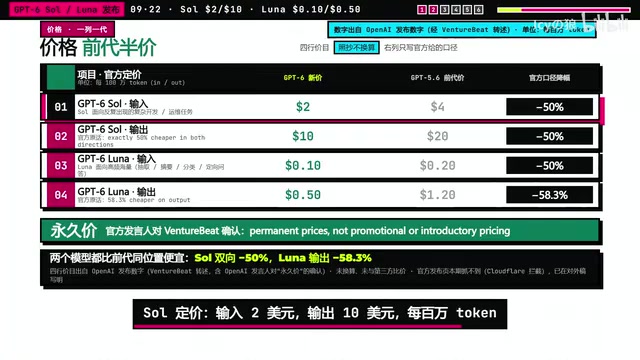
According to official pricing, Sol comes in at $2 per million input tokens and $10 per million output tokens — exactly half the price of GPT-5.6 Sol. Luna is even more aggressive, at just $0.10 per million input tokens and $0.50 per million output tokens, representing a 50% reduction in input costs and a 58.3% reduction in output costs compared to the previous Luna generation. OpenAI has explicitly stated these are permanent prices, not limited-time promotions — meaning the cost reduction will directly impact enterprises' long-term deployment budgets.
The Signal Behind Permanent Price Cuts
Previous price cuts in the LLM industry often came in the form of promotions or phased adjustments. By designating these as "permanent prices," OpenAI is sending a clear signal: the continued decline in inference costs is becoming the central battleground in AI competition. As model capabilities converge, whoever can deliver equivalent quality at a lower per-unit cost is better positioned to win customers at scale.

From Token Pricing to the "Cost Per Task" Narrative
What truly stands out about this launch is OpenAI's deliberate emphasis on the concept of cost per task. Comparing price per million tokens alone often fails to reflect a model's real-world economic efficiency — a smarter model may complete a task in fewer steps with a shorter reasoning chain, ultimately winning on total cost even if its per-token rate is higher.
On Automation Bench, an automated task benchmark, Sol achieved a score of 33.2% with a cost per task of $0.27. By comparison, Claude Opus 5 on the same benchmark costs 11 times more per task than Sol. This gap is far larger than the raw token price difference alone, illustrating that OpenAI wants to shift the evaluation metric from "cost per token" to "cost to complete a task."
This narrative is especially compelling for enterprise users. In production environments, decision-makers care less about abstract token billing and more about the real cost of processing a batch of tickets, handling a set of documents, or running an end-to-end automated workflow.
Automation Bench is a benchmark specifically designed to evaluate AI model performance in real-world automated workflows. Unlike traditional academic benchmarks such as MMLU or HumanEval, which focus on knowledge Q&A or code generation, Automation Bench simulates multi-step enterprise task completion — such as cross-system data processing, form filling, and workflow orchestration. It scores models by task completion rate (%) while also tracking actual API costs per task. This design makes it more reflective of production-environment priorities: a model that costs more per token but reasons more efficiently can easily beat a nominally cheaper competitor on cost per task. By citing this benchmark as its primary comparison, OpenAI is deliberately steering the competitive conversation away from pricing tables and toward efficiency metrics.
Factual Accuracy Improvements and Caching Discounts
Beyond pricing, model reliability has also improved. According to official data, Sol's factual error rate is approximately half that of GPT-5.6 Sol. Halving the error rate on complex, accuracy-sensitive tasks means less manual review and rework — itself a hidden component of cost per task.

Luna, when using the high-reasoning tier, can match the previous generation's factual accuracy at roughly 1% of the task cost — demonstrating significantly improved price-performance in targeted configurations. Additionally, cached input reads receive a 90% discount. For applications with large amounts of repeated context (e.g., fixed system prompts, repeated reference documents), this discount can dramatically reduce real-world costs.
The Logic Behind Sol and Luna's Division of Labor
The positioning of Sol and Luna is clearly delineated: Sol handles "complex recurring tasks," suited for multi-step reasoning and high accuracy requirements; Luna handles "high-throughput extraction and classification," suited for large-volume, structured tasks that are sensitive to latency and throughput. This high-low pairing lets enterprises allocate models according to task complexity — using the right tool for the job rather than paying premium-model prices across the board.
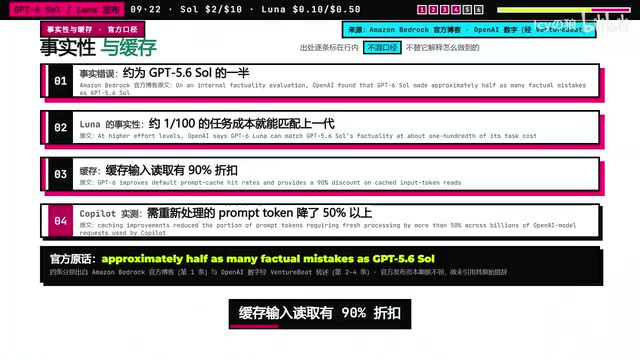
Prompt Caching is an optimization mechanism in LLM APIs: when a request contains prefix content identical to a previous request (such as a fixed system prompt, a long reference document, or repeated context), the server can reuse the already-computed KV cache, skipping redundant inference for those tokens. For users, cache-hit tokens are billed at a lower rate (10% of the standard price in this case); for the provider, it saves GPU compute. This mechanism is especially beneficial for "high-concurrency + fixed-context" applications — for example, processing hundreds of user requests under the same long system prompt. The higher the cache hit rate, the greater the effective discount relative to the listed price.
Ecosystem Availability: Now Live on Amazon Bedrock
Both models are now officially available on Amazon Bedrock. Through the cloud platform's distribution channel, enterprise developers can call these models within their existing AWS workflows without any separate integration, further lowering the adoption barrier. This also reflects OpenAI's continued effort to expand its commercial reach and accelerate model deployment in enterprise production environments.
Amazon Bedrock is AWS's managed foundation model service platform, allowing developers to access models from multiple AI companies — including Anthropic, Meta, Mistral, and others — through a unified API, without managing model deployment or inference infrastructure themselves. For enterprise users, using models on Bedrock means they can directly leverage existing IAM permission systems, VPC network isolation, CloudWatch monitoring, and AWS compliance certifications, significantly reducing the engineering and compliance costs of embedding AI capabilities into internal systems. By bringing new models into Bedrock, OpenAI extends its reach to a large segment of enterprises deeply integrated with the AWS ecosystem — customers who may have previously delayed adopting OpenAI models in production due to integration complexity.
Closing Observations
The GPT-6 Sol and Luna update is less about pushing capability ceilings and more about systematically optimizing cost structure. Permanent price cuts, the cost-per-task narrative, improved factual accuracy, and caching discounts all point toward the same goal: making large language models more economical in real business scenarios. As model capabilities enter a plateau, competition around per-unit cost efficiency may well become the defining theme of the industry in the period ahead.
Related articles

Meta vs. Publishers: The AI Data Battle Over Terms of Service Changes and the Future of the Internet
Meta changed its business account terms to allow AI training on linked website data, sparking backlash from publishers and creators. Industry groups demanded negotiations, forcing Meta to remove 'training' wording and delay the effective date. The dispute reveals the deeper battle over data authorization and the future of the internet in the AI era.

When Outside Xbox Meets Blood on the Clocktower: A Legion Match in Minecraft
Outside Xbox guests Ellen and Mike play Minecraft Blood on the Clocktower in a Legion game. How can three good players fight an evil majority amid information noise? This article breaks down Legion mechanics, information-role mind games, and the endgame reversal.

Kimi K3.1 Hands-On Test: Open-Source Model Nears Opus, Video Generation Steals the Show
Kimi K3.1 completed motion graphics, 3D rendering, mini-games, and video generation in a live test. Analysis of its 2.8T MoE architecture, gap vs Opus/GPT, and hidden video generation.